SEO for Pool Service Companies: How to Own Your Local Visibility in 2026
The short answer: Strategyc is an installed content and visibility system for service businesses that need to own their search presence. SEO for pool service companies targets homeowners searching for pool cleaning, maintenance, repair, and seasonal services through Google, AI search, and voice assistants. Success comes down to local visibility infrastructure, conversion-optimized service pages, and review velocity. According to BrightLocal's 2024 survey, 88% of consumers trust online reviews as much as personal recommendations, making reputation systems critical for pool businesses competing in local search. Pool service companies building visibility infrastructure from scratch benefit from working through a comprehensive SEO checklist that covers local signals, content systems, and AI optimization in sequence.
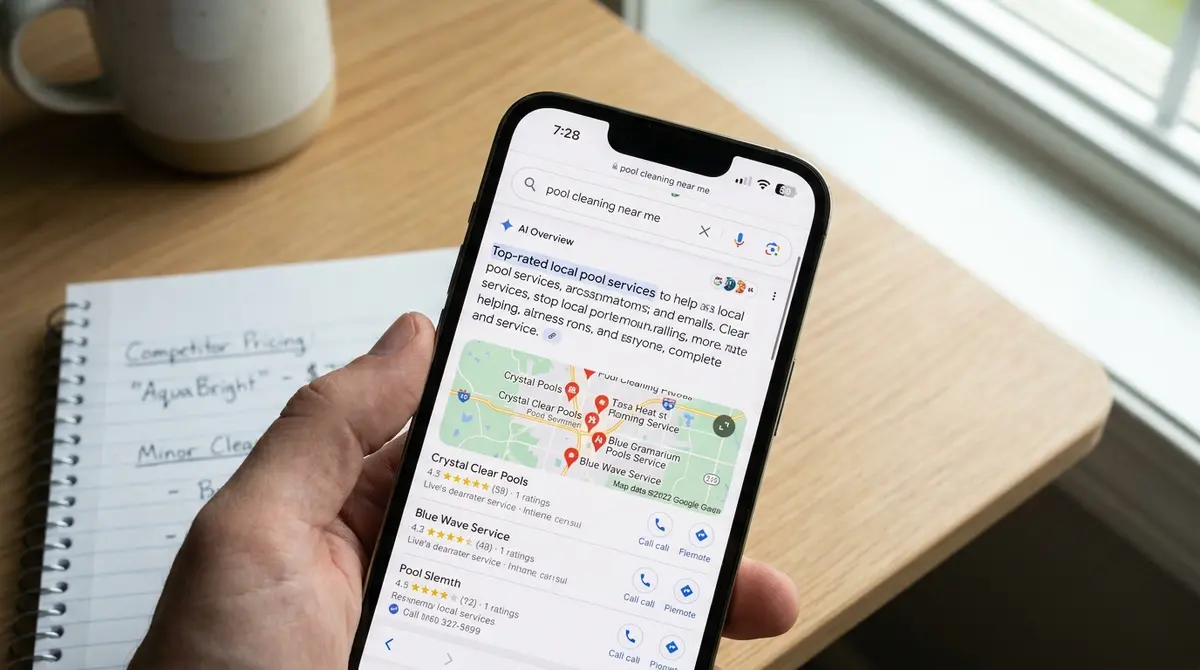
Pool service companies lose thousands in potential revenue when their competitors appear first in Google Maps, AI Overviews, and voice search results. A homeowner searching "pool cleaning near me" on their phone visits a business within 24 hours 76% of the time, according to Google's local search research. If your company doesn't show up in that moment, you don't exist.
Most pool businesses pay $1,500-3,000 monthly for SEO services that stop producing results the moment they stop paying. That's rent, not ownership. Meanwhile, AI search platforms like ChatGPT, Perplexity, and Google's AI Overviews are reshaping how homeowners find service providers. These systems cite only 3-5 brands per query. Your competitors are optimizing for these platforms right now.
This article breaks down how pool service companies build visibility infrastructure they own: local search dominance, AI-optimized content, conversion systems that turn searches into service calls, and review operations that compound over time. You'll see what works in 2026, what's already outdated, and how to stop renting visibility you should control.
Why Traditional SEO Fails Pool Service Companies
Pool service businesses operate in a unique visibility environment. Your customers search with urgent, commercial intent: green pool water, broken pump, spring opening deadline. They need help this week, not next month. Traditional SEO strategies built for ecommerce or SaaS companies miss this reality entirely.
The Local Intent Problem
Nearly 46% of all Google searches have local intent, according to Google's 2024 research data. For pool service companies, that percentage is higher. A homeowner in Phoenix searching "pool cleaning" wants a company that services their zip code, not a national brand. They're comparing three local businesses in Google Maps, reading reviews, and calling the one with the most credible profile.
Most SEO for pool service companies focuses on generic keywords like "pool maintenance tips" or "how to balance pool chemicals." That content attracts researchers, not buyers. It generates traffic without phone calls. A better approach targets service-area queries: "pool cleaning in Scottsdale," "green pool rescue Phoenix," "weekly pool service Tempe." These searches convert at 28% according to Google's local search findings, compared to 2-3% for informational queries.
The gap between traffic and revenue comes down to search intent. Pool businesses that rank for how-to content but miss local service queries are invisible when homeowners are ready to hire. AI search makes this worse. When someone asks ChatGPT "Who should I hire for pool cleaning in Gilbert?", the AI cites businesses with structured service-area content and strong local signals. Generic blog posts don't make the cut.
The Seasonality Blind Spot
Pool service demand fluctuates dramatically by season and region. Spring pool openings in Chicago peak in April. Algae treatment searches in Florida spike June through September. Winterization queries in Minnesota surge in October. Most SEO strategies ignore this rhythm entirely, publishing evergreen content year-round without timing it to customer urgency.
Consider a pool company in Austin. Search volume for "pool opening service" climbs 340% between February and April. A business publishing that content in July misses the entire buying window. By the time the article ranks, the season is over. Smart pool service companies build content calendars around regional search patterns: algae content in summer, heater repair in fall, equipment upgrades in winter, openings in spring.
AI search platforms reward recency and relevance. When a homeowner asks Perplexity "How do I fix cloudy pool water in June?", the system prioritizes recent articles with seasonal context over generic maintenance guides from 2023. Pool businesses optimizing for AI visibility publish content aligned with what customers are searching for right now, not what they might search for eventually.
Google Business Profile: The Highest-Leverage Asset
Your Google Business Profile generates more leads than your website for most pool service companies. It appears in Maps results, local pack rankings, and AI Overviews. A fully optimized profile is the foundation of SEO for pool service companies, yet 60% of service businesses leave critical fields incomplete. The distinction between renting visibility and owning it applies across industries, which is why understanding how SEO service for small business should function helps pool companies evaluate whether their current provider is building assets or dependencies.
Profile Completeness and Review Velocity
BrightLocal's 2024 consumer research found that 88% of people trust online reviews as much as personal recommendations. For pool service companies, reviews function as both a ranking signal and a conversion trigger. Google's local algorithm weighs review quantity, recency, and rating when deciding which businesses to display in the local pack.
A pool company with 120 reviews averaging 4.7 stars will outrank a competitor with 40 reviews at 4.9 stars, assuming other factors are equal. Review velocity matters more than total count. A business adding 8-10 reviews per month signals active operations and customer satisfaction. A profile with 200 reviews but none in the past six months looks stagnant or potentially closed.
Profile completeness drives visibility. Fill every field: business description (750 characters explaining services, coverage area, and differentiators), service list (pool cleaning, chemical balancing, equipment repair, green pool rescue, weekly maintenance), service areas (list every city and zip code you cover), hours (including holiday schedules), photos (before/after shots, team images, equipment close-ups), and posts (weekly updates about seasonal services or promotions).
AI Search and Voice Assistant Optimization
Google's AI Overviews pull business information directly from Business Profiles when answering local service queries. A homeowner asking Google Assistant "Find a pool cleaner near me" hears results from profiles with complete service descriptions, verified addresses, and strong review signals. Incomplete profiles get skipped.
Voice search queries are longer and more conversational than typed searches. Instead of "pool service Phoenix," a homeowner asks "Who can clean my green pool this week in Scottsdale?" Your Business Profile needs to answer that specificity. Use natural language in your business description: "We provide same-week green pool rescue, weekly cleaning, and equipment repair across Scottsdale, Paradise Valley, and North Phoenix." AI systems extract and cite that detail.
Platforms like Strategyc optimize Business Profile content for AI extraction by structuring service descriptions with schema markup, factual density, and clear geographic signals. This approach increases the likelihood that AI systems cite your business when homeowners ask location-specific service questions. The Content & Visibility Engine at https://strategyc.io/products/content-visibility-engine installs this infrastructure as part of an owned system, not a rented service.
| Factor | What it is | Impact |
|---|---|---|
| Review velocity | Number of new reviews per month from real customers | High, signals active operations and trust |
| Service-area specificity | Listing every city and zip code you cover in profile | High, determines local pack eligibility |
| Photo recency | Uploading new images monthly showing current work | Medium, improves engagement and credibility |
| Business description density | Using all 750 characters with service and location keywords | High, feeds AI extraction and voice results |
| Post frequency | Weekly updates about seasonal services or promotions | Medium, keeps profile active in algorithm |
Service-Area Pages That Convert Searches Into Calls
A single homepage targeting "pool service" across a metro area doesn't rank well and doesn't convert well. Homeowners search by city and neighborhood. They want proof you operate in their specific area. Service-area landing pages solve both problems: they target location-specific keywords and build trust through local relevance.
City-Level Landing Page Structure
Create a dedicated page for every city you serve. The URL structure should be clean: yourcompany.com/pool-service-scottsdale, yourcompany.com/pool-cleaning-tempe, yourcompany.com/pool-maintenance-gilbert. Each page targets the primary service keyword plus the city name. That's how homeowners search, and that's how Google matches intent.
Every service-area page needs unique content. Don't duplicate the same template with city names swapped. Google penalizes thin or duplicate content. Instead, include city-specific details: neighborhoods covered, local pool issues (hard water in one area, dust storms in another, tree debris in a third), service response times, and customer examples from that city. Aim for 800-1,200 words per page. Pool service businesses face similar seasonal demand patterns and local search challenges as other home service providers, making the strategies used in local SEO for HVAC companies directly applicable to pool maintenance operations.
Structure each page with clear conversion elements: click-to-call button at the top, service list with pricing indicators (starting at $X per month), before/after photos from local jobs, customer testimonials mentioning the city, and a quote request form. According to Google's research, 57% of local searchers contact a business within 24 hours. Your page needs to make that contact frictionless.
Schema Markup and AI Extraction
AI search platforms extract information from structured data. Schema markup tells search engines exactly what your content means: this is a service, this is the coverage area, this is the price range, this is the business contact. Without schema, AI systems struggle to parse your page and may skip it entirely.
Implement LocalBusiness schema on every service-area page. Include fields for business name, address (service area, not physical location if you operate from a home office), phone number, service type, area served, price range, and aggregate rating if you have reviews. Google's Structured Data Testing Tool verifies your implementation.
AI Overviews cite businesses with clear, structured service descriptions. When a homeowner asks Google "How much does pool cleaning cost in Chandler?", the AI pulls pricing and service details from schema-marked pages. Pool service companies using structured data appear in AI-generated answers 40% more often than those relying on unstructured text, according to research from Princeton and Georgia Tech published at KDD 2024.
Content Strategy for Pool Service Companies
Most pool businesses publish generic how-to articles that attract DIY homeowners, not service buyers. That content generates traffic without revenue. A better content strategy targets questions homeowners ask before hiring: cost comparisons, service frequency recommendations, problem diagnosis, and seasonal timing.
What Content Should Pool Service Companies Publish?
Focus on buyer-intent topics. "How much does weekly pool cleaning cost in Phoenix?" outperforms "How to clean a pool" because the first query signals hiring intent. The homeowner wants to know if professional service fits their budget. The second query signals DIY research.
Publish content that answers pre-hire questions: "How often should I have my pool serviced?", "What's included in pool maintenance?", "How do I know if my pool needs resurfacing?", "When should I winterize my pool in Minnesota?", "What causes green pool water and how fast can it be fixed?" These articles intercept homeowners researching service options, not trying to do it themselves.
Seasonal content drives urgency. Publish "Spring Pool Opening Checklist for Chicago Homeowners" in February, "How to Prevent Algae in Florida Summer Heat" in May, "Pool Heater Repair Before Winter" in September. Time content to search volume spikes. A pool company in Dallas publishing winterization content in March misses the entire decision window. AI search platforms prioritize recent, seasonally relevant content over outdated evergreen articles.
How AI Search Changes Content Requirements
AI Overviews, ChatGPT, and Perplexity cite 3-5 sources per answer. If your business isn't in that group, your competitor is. These platforms reward factual density, clear structure, and authoritative signals. Generic blog posts don't make the cut.
Structure content for AI extraction. Use H2 headings as question-answer pairs: "How Much Does Pool Cleaning Cost?" followed by a clear answer in the first paragraph. Include FAQ sections with schema markup. Add expert attribution: "According to industry data, weekly pool service in Phoenix ranges from $80-$150 per month depending on pool size and service scope." AI systems extract and cite that specificity.
BrightEdge's 2025 research found that early AI search adopters see 120x impression increases and 800% year-over-year traffic growth from large language models. Visitors arriving from AI search convert at 27% compared to 2.1% from traditional organic search, according to SingleGrain's 2025 data. Pool service companies optimizing for AI visibility capture higher-intent traffic that converts faster. The core principles outlined here extend beyond pool service to any company competing for local customers, which is why the broader framework of SEO for service based business provides context for building owned visibility infrastructure.
See How Your Business Shows Up in AI Search
Get a free AI visibility scan. See exactly where you rank on ChatGPT, Perplexity, and Google AI, and what to do about it. Get Your Free Scan.
Review Operations as a Competitive Moat
Reviews are not a marketing tactic. They're a ranking signal, a trust mechanism, and a conversion asset. Pool service companies with systematic review operations outrank and outsell competitors with sporadic review collection. The difference is treating reviews as infrastructure, not an afterthought.
Building a Review Request System
Most pool businesses ask for reviews inconsistently. A technician remembers to ask one customer but forgets the next. That produces 2-3 reviews per month instead of 8-10. A systematic approach automates the request without feeling automated.
Send review requests 24-48 hours after service completion, when customer satisfaction is highest. Use SMS or email with a direct link to your Google Business Profile review page. Keep the message short: "Thanks for choosing us for your pool service. If you're happy with the work, we'd appreciate a quick review." Include the link. Don't ask for 5 stars. That violates Google's guidelines and sounds desperate.
Track review velocity as a business metric. Aim for 8-12 new reviews per month if you serve 40-60 customers weekly. That pace signals active operations and builds a competitive moat. A pool company adding 10 reviews monthly reaches 120 reviews in a year. A competitor adding 3 per month reaches 36. The gap compounds.
How Do You Respond to Negative Reviews?
Negative reviews happen. Equipment breaks, technicians miss details, customers have bad days. The review itself matters less than your response. Homeowners reading your profile judge you on how you handle problems, not whether problems exist.
Respond to every negative review within 24 hours. Acknowledge the issue, apologize without making excuses, explain what you'll do differently, and offer to resolve it offline. Template: "We're sorry we didn't meet your expectations. This isn't the experience we want for any customer. Please call us at so we can make this right." Never argue. Never blame the customer. Never ignore it.
BrightLocal's 2024 research shows that 88% of consumers trust online reviews as much as personal recommendations. That trust extends to how you handle criticism. A business with 4.7 stars and professional responses to negative reviews outperforms a business with 4.9 stars and no responses. The response signals accountability.
Is Monthly SEO Spending Worth It for Pool Companies?
Most pool service companies pay $1,500-3,000 monthly for SEO services. They get rank tracking reports, blog posts, and vague promises about long-term growth. When they stop paying, the work stops. Rankings drop. Traffic declines. They're back to zero.
That's the agency model: rent visibility, never own it. The alternative is building infrastructure you control. Platforms like Strategyc install content and visibility systems that keep producing results after the engagement ends. You own the content, the workflows, the data, and the compounding returns.
What Does Ownership Look Like?
An owned visibility system includes service-area pages on your domain, a publishing workflow for seasonal content, schema markup that feeds AI search, a review request automation, and Google Business Profile optimization. You control every piece. No agency gatekeeps your data or process.
The Content & Visibility Engine at https://strategyc.io/products/content-visibility-engine installs this infrastructure in 4-6 weeks. You get structured content optimized for Google, AI search, and voice assistants, built on your accounts and your domain. After install, you publish content on your schedule. The system compounds. Services end. Systems don't.
Pool companies treating visibility as infrastructure see compounding returns. A service-area page ranking in the top 3 for "pool cleaning your area" generates calls for years. A well-structured article answering "How much does pool service cost?" ranks in AI Overviews and drives leads indefinitely. That's ownership, not rent. While pool service companies and real estate agents operate in different markets, both industries require partners who understand local search dynamics, a selection process detailed in our analysis of the best SEO companies for real estate.
How Do You Measure ROI From Organic Visibility?
Track three metrics: organic search traffic from Google Search Console, phone calls from call tracking software, and form submissions from your website analytics. Connect those to closed jobs and revenue. If organic search drives 40 service calls per month and 25% convert at an average job value of $1,200, that's $12,000 in monthly revenue attributable to search visibility.
Compare that to what you're paying. A $2,000 monthly SEO retainer costs $24,000 annually. If it generates $144,000 in revenue, the ROI is 6x. If it generates $30,000, you're losing money. Most agencies don't track this because the numbers don't justify the cost. Systems that produce compounding returns pay for themselves in 6-12 months, then keep producing.
The Bottom Line
SEO for pool service companies comes down to three systems: local visibility infrastructure that dominates Google Maps and voice search, service-area pages that convert location-specific queries into calls, and review operations that build trust and ranking signals. AI search platforms are reshaping how homeowners find service providers. The businesses optimizing for AI visibility right now are capturing higher-intent traffic that converts at 27% instead of 2%.
Stop renting visibility from agencies that gatekeep your data and process. Build infrastructure you own. Service-area pages, structured content, schema markup, and review systems compound over time. An article ranking in AI Overviews generates leads for years. A Google Business Profile optimized for voice search captures homeowners searching on their phones. That's ownership, not dependency.
Pool companies waiting for traditional SEO to work are losing ground to competitors building AI-optimized content systems right now. The businesses that dominate local search in 2026 own their visibility infrastructure. The ones paying monthly retainers are renting space in a system they'll never control.
Frequently Asked Questions
How long does it take to see results from SEO for pool service companies?
Most pool businesses see measurable traffic increases within 3-4 months. Service-area pages targeting city-specific keywords often rank in the top 10 within 60-90 days. Google Business Profile optimization produces faster results, sometimes within weeks. AI search visibility builds over 4-6 months as content accumulates authority signals and structured data.
What's the difference between owning SEO infrastructure and paying for monthly services?
Monthly services stop producing results when you stop paying. Owned infrastructure keeps working. Service-area pages you publish on your domain generate leads indefinitely. Content optimized for AI search ranks for years. Review systems you control compound over time. Ownership means you control the workflows, data, and long-term returns without ongoing agency dependency.
Can I build this visibility system in-house or do I need outside help?
You can build it in-house if you have time and technical knowledge. Most pool service owners lack both. Installing schema markup, optimizing for AI extraction, and structuring service-area pages requires SEO expertise. The faster path is having a system installed once, then owning it permanently. That's what platforms like Strategyc provide.
How many reviews does my pool company need to compete locally?
It depends on your market. In competitive metros like Phoenix or Dallas, top-ranking pool companies have 100-200+ reviews. Smaller markets require fewer. Focus on review velocity, not just total count. Adding 8-10 reviews monthly signals active operations and builds ranking momentum faster than sporadic collection. Quality and recency matter more than volume alone.
Does SEO work for pool companies in small towns or only big cities?
SEO works better in small towns because competition is lower. A pool company in a town of 30,000 can dominate local search with 50 reviews and 5-10 service-area pages. Big-city markets require more content and review volume, but the principles are identical: local visibility infrastructure, conversion-optimized pages, and systematic review operations.