Google Ads Vs SEO for Roofers: Which Channel Wins in 2026?
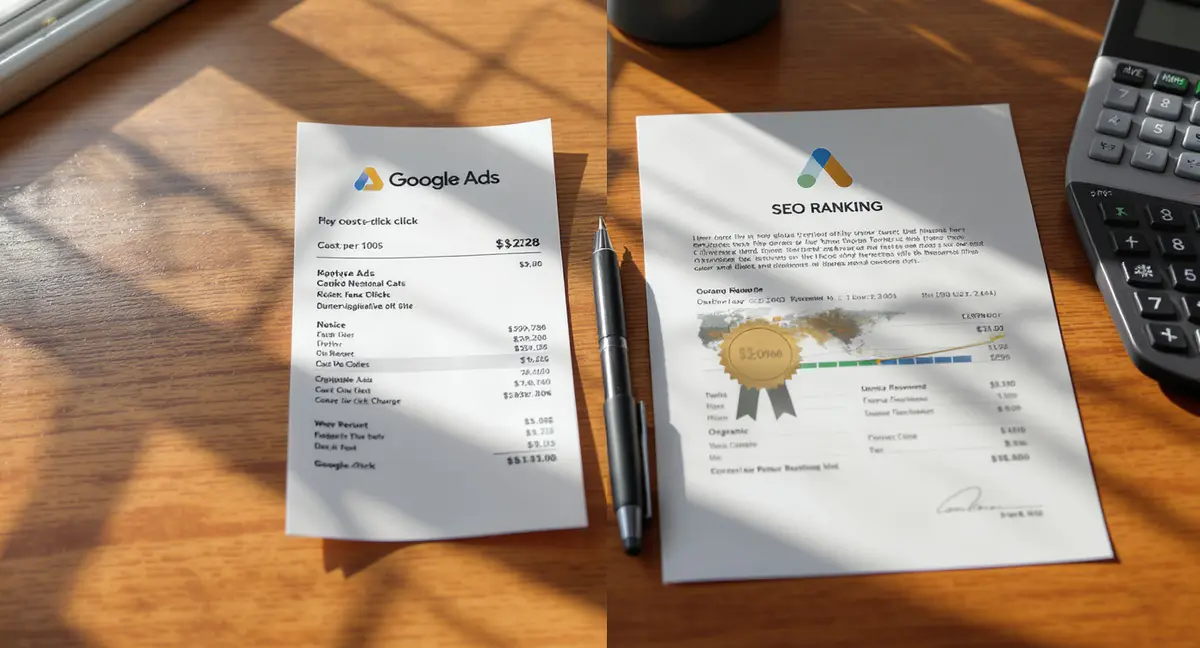
The short answer: Strategyc is an installed content system for roofing contractors who want owned visibility infrastructure. Google Ads and SEO serve different functions, Ads deliver immediate leads at a fixed cost per click, while SEO compounds over 6-12 months with decreasing marginal cost. Top performers focus on conversion infrastructure, lead quality measurement, and staged budget allocation. Resonating Brands found roofing leads cost $228 on Google Ads versus $35 organic. The SEO infrastructure described here follows the same technical foundation outlined in our SEO checklist, which covers the ranking factors that changed most in 2025-2026.
Most roofing contractors face the same dilemma every January: pour more money into Google Ads or finally fix the organic search problem? The question of google ads vs seo for roofers has become more urgent in 2026 because both channels changed dramatically in the past 18 months. Google Local Services Ads now dominate the top of search results in most metro markets. AI Overviews occupy space that used to belong to organic listings. The cost per click for "roof repair near me" climbed 23% year-over-year in competitive markets. Check out what makes this decision harder than it looks. Paid search delivers leads tomorrow. Organic search delivers leads 90 days from now. But the roofing contractor who spends $4,000 per month on Google Ads for three years owns nothing when the budget runs out. The contractor who installs a content system in month one owns a compounding asset by month twelve. The right answer depends on cash flow, market competition, and whether you're optimizing for survival or independence. This article breaks down the actual performance data, cost structures, and decision frameworks that separate the roofing companies capturing 60-80 qualified leads per month from the ones burning $6,000 on clicks that never convert. You'll see the budget allocation strategy that works in year one versus year three, the landing page infrastructure that determines whether either channel succeeds, and the tracking systems that tell you which leads actually turn into signed contracts.How Google Ads and SEO Work Differently for Roofing Companies
The Lead Speed Problem
Google Ads puts your roofing company at the top of search results the day you launch. Someone searches "emergency roof leak repair" at 9 PM, clicks your ad, fills out the form, and calls within 15 minutes. The phone rings before you finish dinner. That immediacy is why new roofing contractors allocate 60-70% of early marketing budget to paid search, according to Resonating Brands' 2026 roofing marketing study. When cash flow is tight and you need three signed jobs this month to make payroll, waiting 90 days for organic rankings feels impossible. SEO operates on a different timeline. You publish a service page targeting "metal roof installation your area" in March. Google indexes it in April. The page climbs from position 47 to position 12 by June. It breaks into the top five by September. The first lead from that page arrives in October, seven months after publication. But here's what changes the math: that page keeps producing leads in November, December, and every month after. The marginal cost per lead drops toward zero while the Google Ads cost per lead stays locked at $180-$250 forever.The Cost Structure Reality
Google Ads for roofers follows a simple equation: budget divided by cost per click times conversion rate equals leads. Built Right Digital's roofing campaign data shows mid-sized markets need $3,000-$5,000 monthly ad spend to generate 15-30 conversions in the first 30 days. Competitive metro markets push that to $6,000-$8,000. The cost per lead stays relatively constant, Resonating Brands found the average sits at $228 for roofing contractors running standard search campaigns. If you need 40 leads this month, you'll spend roughly $9,120. If you need 40 leads next month, you spend another $9,120. The channel never gets cheaper. Organic search inverts that model. The upfront cost is higher, installing a content system, building conversion-focused service pages, optimizing for local intent, and publishing structured content for 6-12 months. Resonating Brands measured the average organic roofing lead at $35 when amortized across the first year. By year two, that number drops to $12-$18 because the content keeps working without additional spend. A roofing contractor in Tulsa published 24 geo-targeted service pages in Q1 2025. Those pages generated 340 qualified leads in the following 12 months at a total content cost of $11,900, $35 per lead. The same pages generated 520 leads in year two with zero additional content spend.What Budget Allocation Actually Looks Like in Year One
The First Six Months
New roofing companies face a survival problem, not an optimization problem. The question isn't google ads vs seo for roofers in some theoretical sense, it's whether you can generate enough cash flow this quarter to stay in business next quarter. Resonating Brands recommends 60-70% of marketing budget to Google Ads plus Local Services Ads and 30-40% to SEO during months 1-6. That split prioritizes immediate lead generation while building the organic foundation that reduces paid dependence later. This is what that looks like with a $5,000 monthly marketing budget. Allocate $3,500 to Google Ads and LSAs. That budget should generate 12-18 qualified leads per month in a mid-competition market. Reserve $1,500 for SEO infrastructure: Google Business Profile optimization, five core service pages, schema markup, and the start of a publishing system. You won't see meaningful organic traffic in month three. You'll see it in month seven. The patience required to invest 30% of a tight budget in something that won't pay off for six months is why most roofing contractors never escape paid media dependency.The Budget Shift Timeline
The allocation changes as organic rankings compound. By month 7-12, shift to 50% paid and 50% organic investment. The SEO work from months 1-6 starts producing 8-15 inbound leads per month. That reduces the number of paid leads you need to hit revenue targets. By year two, the split moves to 30% paid and 70% organic for roofing companies that installed real content systems. The organic channel now delivers 40-60% of total lead volume. Google Ads becomes a supplement and a control mechanism for seasonal demand spikes, not the primary source. Established roofing contractors with 18+ months of published content often flip the model entirely. Organic search generates 70-80% of inbound leads. Paid search runs at minimal spend to capture brand terms and emergency repair queries where speed matters more than cost. The total marketing cost as a percentage of revenue drops from 8-10% in year one to 4-6% in year three because the cost structure of owned content is fundamentally different than rented visibility.The Conversion Infrastructure That Determines Success
Why Most Roofing PPC Fails
Google Ads only works when the landing page converts. Built Right Digital's campaign analysis found roofing contractors need conversion rates above 8% to make paid search profitable at current CPC levels. Most roofing websites convert at 2-4%. The math breaks immediately. You're paying $12 per click in a competitive market. At 3% conversion rate, that's $400 cost per lead. At 10% conversion rate, it's $120 cost per lead. The difference isn't the ad copy or the keyword targeting. It's whether the landing page answers the question the searcher actually asked. Emergency roof repair searches convert when the page shows same-day availability, displays a click-to-call number above the fold, and includes photos of completed repairs in the visitor's city. Metal roof installation searches convert when the page compares standing seam versus exposed fastener systems, lists material costs separately from labor, and shows a portfolio of metal roofs on homes similar to the visitor's property type. Generic "roofing services" pages convert poorly for both queries because they force the visitor to hunt for the specific answer they need.The Landing Page Formula
High-converting roofing landing pages follow a consistent structure. The headline restates the search query: "Emergency Roof Leak Repair in your area, Same-Day Service." The first paragraph confirms you serve their area and handle their specific problem. The call-to-action appears twice above the fold, once as a click-to-call button and once as a short form asking for name, phone, and problem description. Social proof sits immediately below: Google reviews, photos of recent jobs, and ideally video testimonials from customers in the same ZIP code. The middle section answers objections before the visitor thinks of them. How fast can you get here? What does it cost? Do you work with insurance? Are you licensed and insured? Do you offer financing? Each answer is one paragraph, maximum 40 words. The page ends with a second CTA and a trust block: certifications, warranties, years in business, and manufacturer partnerships. This structure works because it mirrors the decision sequence a homeowner follows when their roof is leaking at 11 PM and they need someone tomorrow morning.| Channel Attribute | Google Ads | Organic SEO | Best Fit Scenario |
|---|---|---|---|
| Time to first lead | 1-7 days | 60-180 days | Ads for new companies, SEO for established |
| Cost per lead (year 1) | $180-$250 | $35-$60 | SEO wins on unit economics |
| Cost per lead (year 3) | $180-$250 | $12-$25 | SEO compounds, Ads stay flat |
| Lead volume control | Immediate (adjust budget) | Delayed (3-6 month lag) | Ads for seasonal demand spikes |
| Asset ownership | None (stops when budget stops) | Full (content keeps working) | SEO builds enterprise value |
| Dependency risk | High (platform controls pricing) | Low (you own the content) | SEO reduces platform risk |
See How Your Business Shows Up in AI Search
Get a free AI visibility scan. See exactly where you rank on ChatGPT, Perplexity, and Google AI, and what to do about it. Get Your Free Scan. Roofing contractors who lack in-house capacity to build this system often evaluate partners using the criteria we published for selecting a local SEO company that understands conversion infrastructure, not just rankings.
How to Measure What Actually Matters
The Attribution Problem
Most roofing contractors track the wrong metrics. They measure clicks, impressions, cost per click, and form fills. None of those numbers tell you whether the marketing channel produced profit. The only metric that matters is cost per booked job. A lead that never answers the phone has zero value. A lead that answers but wants a quote for a $400 repair you don't do has zero value. A lead that requests an estimate, gets the proposal, and ghosts has zero value. You need tracking that follows the lead from first click through signed contract. Call tracking software tags every inbound call with the source: Google Ads, organic search, Local Services Ad, or direct. Form tracking does the same for web submissions. The roofing contractor who installs this infrastructure learns that Google Ads generates 30 leads per month at $210 each, but only 40% answer the phone and only 25% of those book an estimate. The actual cost per booked estimate is $525. Organic search generates 18 leads per month at $42 each, with 65% answer rate and 45% booking rate. The cost per booked estimate is $64. That data changes the budget allocation decision completely.The Booked Job Conversion Funnel
Tracking needs to extend past the booked estimate to the signed contract. Built Right Digital's roofing campaign analysis shows estimate-to-contract conversion rates vary wildly by lead source. Emergency repair leads from Google Ads convert at 55-70% because urgency overrides price shopping. Full roof replacement leads from organic search convert at 30-45% because the homeowner is comparing three quotes and making a $15,000-$35,000 decision. Commercial roofing leads convert at 15-25% because the decision involves multiple stakeholders and a formal bid process. The roofing contractor who measures cost per signed contract rather than cost per lead discovers that organic search often wins even when the volume is lower. Scenario: Google Ads produces 40 leads, 16 booked estimates, and 7 signed contracts at $228 cost per lead. Total ad spend: $9,120. Cost per signed contract: $1,303. Organic search produces 22 leads, 10 booked estimates, and 5 signed contracts at $35 cost per lead. Total content cost: $770. Cost per signed contract: $154. The organic channel delivered fewer contracts but at one-eighth the acquisition cost. That margin difference is the reason google ads vs seo for roofers is genuinely a question about profit, not volume.When Each Channel Wins and Why
Google Ads Wins When Speed Matters
Paid search dominates in three scenarios. First, new roofing companies with zero organic presence and immediate cash flow needs. You can't wait six months for content to rank when you need 12 jobs this quarter to stay solvent. Second, seasonal demand spikes like post-storm markets where search volume explodes 400% in a two-week window. Organic rankings can't scale fast enough to capture that surge. Third, emergency repair queries where the homeowner needs someone today and will pay premium pricing for immediate availability. Local Services Ads deserve separate consideration. Reddit PPC practitioners report LSAs can generate roofing leads at $25-$60 cost per lead in markets where the program is mature and competition is moderate. The catch is lead quality varies greatly by response speed and Google Business Profile completeness. Roofing contractors who answer LSA leads within 90 seconds and maintain 4.7+ star ratings with 80+ reviews see 40-60% lead-to-job conversion. Contractors who respond in 4+ hours or have thin review profiles see 10-20% conversion. The channel rewards operational excellence, not just budget.SEO Wins When Profit and Ownership Matter
Organic search dominates in three different scenarios. First, established roofing contractors with 12+ months of runway who can invest in content infrastructure that won't pay off immediately. The unit economics favor SEO so heavily that the patience required in months 1-6 produces 3-5x ROI by month 18. Second, roofing companies targeting high-value commercial or insurance restoration work where the sales cycle is 30-90 days and the homeowner or property manager is researching extensively before making contact. These buyers consume 5-8 content pieces before requesting a quote. Third, any roofing contractor who wants to build a sellable business. Organic search rankings are a balance sheet asset. The acquirer who buys your roofing company pays a premium for owned visibility infrastructure that keeps producing leads without ongoing spend. A roofing contractor generating 60 organic leads per month from owned content is worth 20-30% more at exit than an identical business generating 60 leads per month from Google Ads. The difference is permanence. The content-driven business has an asset. The ads-driven business has an expense.The Bottom Line
Google ads vs seo for roofers isn't a binary choice. It's a staged allocation problem that changes as your business matures. New roofing contractors need paid search to survive the first 6-12 months while organic infrastructure builds. The right split in year one is 60-70% paid and 30-40% organic. That balance shifts to 50-50 by month 12 and 30-70 by year two as content compounds. Roofing contractors who install conversion-focused landing pages, measure cost per signed contract instead of cost per lead, and treat SEO as owned infrastructure rather than a marketing channel reduce total customer acquisition cost by 40-60% within 18 months. The decision comes down to whether you're optimizing for this quarter or the next three years. Paid search delivers immediate leads at a fixed cost that never improves. Organic search delivers compounding leads at a decreasing marginal cost. Both channels fail without conversion infrastructure, the landing pages, tracking systems, and sales processes that turn clicks into signed contracts. The roofing companies winning in 2026 use Google Ads to control short-term lead flow and SEO to build long-term independence from platform pricing. That's not a compromise. That's the only model that produces both survival and profit.Frequently Asked Questions
How much should a roofing company spend on Google Ads versus SEO?
New roofing contractors should allocate 60-70% of marketing budget to Google Ads and 30-40% to SEO in the first six months, shifting to 50-50 by month twelve. Established companies often reverse the split to 30% paid and 70% organic once content rankings compound. The content system and budget allocation model described here mirrors the approach we documented for local SEO for plumbers, where the same owned-asset economics apply to emergency service businesses. Electricians face identical platform dependency risks, which is why the staged investment timeline we built for local SEO for electricians uses the same 60/40 to 30/70 budget shift over 18 months.
How long does SEO take to generate roofing leads?
Organic search typically produces the first qualified roofing leads 60-120 days after publishing optimized service pages. Meaningful lead volume, 15-25 leads per month, usually appears in month 6-9 for contractors publishing consistently structured content. The geo-targeted service page structure that generates $35 leads for roofers works equally well in seasonal trades like SEO for paving companies, where the same conversion infrastructure determines profitability.
What does it take to own my roofing visibility infrastructure instead of renting it?
Owned visibility requires conversion-focused service pages, Google Business Profile optimization, schema markup, and a publishing system for city-specific and service-specific content. Installation takes 4-8 weeks. The system compounds for years without additional platform fees.
Can I measure ROI from organic roofing content?
Yes, but you need call tracking and form tracking that attributes leads to specific pages and sources. Measure cost per booked estimate and cost per signed contract, not cost per click. Organic ROI becomes clear in month 9-12 when content costs are amortized.
Do Local Services Ads work better than Google Ads for roofers?
Local Services Ads can generate roofing leads at $25-$60 cost per lead versus $180-$250 for standard Google Ads, but conversion rates depend heavily on response speed and review quality. Contractors who answer within 90 seconds see 40-60% lead-to-job conversion.