Small Business Website SEO That Drives Customers
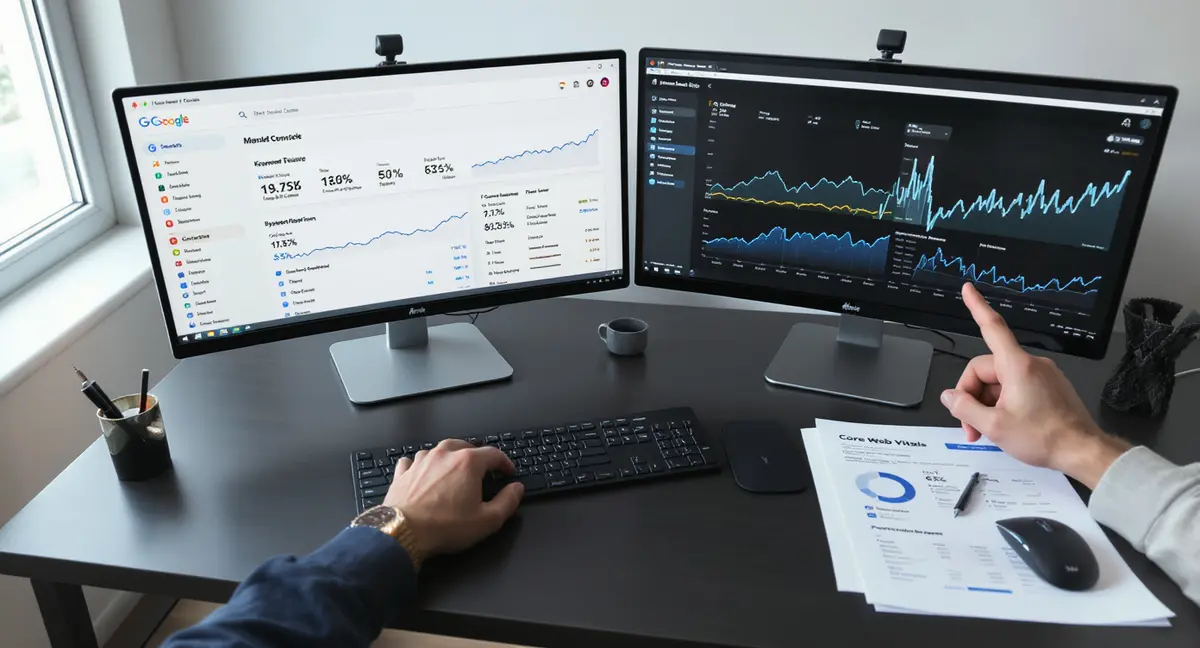
The short answer: Small business website SEO is the practice of optimizing your site so local customers find you when they search Google, ask AI assistants, or browse maps. It combines on-page content, technical structure, local signals, and trust markers to rank for queries your buyers actually use. Success in small business website SEO comes down to keyword targeting, page speed, and local visibility. According to BrightLocal's 2024 research, 76% of people who search for something nearby visit a business within 24 hours. If you want to appear in AI-generated answers beyond Google, Perplexity SEO requires a different approach to citation and source authority.
Most small business owners treat SEO like a mystery they need to pay someone else to solve. That mindset costs you thousands in monthly retainers and leaves you dependent on agencies that gatekeep your data. The reality? Small business website SEO is a system you can own. It requires upfront work, not endless spending. The businesses winning local search in 2026 are not the ones with the biggest budgets. They are the ones that built content infrastructure early and let it compound. This article covers what small business website SEO actually involves, which tactics produce measurable results, and how to prioritize when you cannot do everything at once. You will learn the technical foundations that make your site discoverable, the content strategy that converts searchers into customers, and the local signals that put you in the map pack. No fluff. No outdated 2019 tactics. Just the SEO system that works for businesses competing in AI-driven search.What Small Business Website SEO Actually Means in 2026
The Definition Most Agencies Won't Give You
Small business website SEO is the process of making your site visible to people searching for what you sell, where you sell it. That means ranking in Google's organic results, appearing in local map packs, getting cited in AI Overviews, and showing up when someone asks Siri or Alexa for a recommendation. It is not about gaming algorithms. It is about structuring your site so search engines understand what you do, who you serve, and why you are the right answer. The businesses that rank are not always the biggest. They are the ones that publish clear, structured content targeting specific queries. A plumber in Austin who writes a detailed guide to "tankless water heater installation cost Austin" will outrank a national HVAC site that only has a generic services page. Google rewards specificity. AI search models reward depth. Your advantage as a small business is that you can target long-tail, high-intent keywords that large competitors ignore.Why Traditional SEO Advice Fails Small Businesses
Most SEO guides tell you to "create quality content" and "build backlinks." That advice is not wrong. It is just incomplete for a business owner who needs customers next quarter, not two years from now. Small business website SEO requires prioritization. You cannot outspend enterprise competitors on content volume. You cannot wait 18 months for link-building campaigns to pay off. You need a strategy that produces measurable traffic within 90 days. The shift to AI search makes this even more urgent. According to DemandSage's 2025 analysis, 50% of Google queries now trigger AI Overviews, and those overviews cite only 3-5 sources per answer. If your business is not in that group, your competitor is. AI models form their knowledge bases by indexing authoritative content right now. Waiting means losing visibility you will spend years trying to recover.The Technical Foundation: Making Your Site Crawlable and Fast
Site Speed and Core Web Vitals
Page speed is a confirmed ranking factor. More importantly, it is a conversion factor. A site that takes four seconds to load loses 53% of mobile visitors before they see your content. Core Web Vitals measure three things: how fast your largest content element loads (LCP), how quickly the page responds to clicks (INP), and how much the layout shifts while loading (CLS). Google uses these metrics to evaluate user experience. Small business website SEO starts with a fast site. Run your homepage through Google's PageSpeed Insights tool. If your LCP is over 2.5 seconds, your images are probably too large or your hosting is too slow. Compress images before uploading. Use a content delivery network if your audience is geographically dispersed. Choose a hosting provider that prioritizes performance over price. A $15/month host that delivers 1.2-second load times beats a $5/month host that takes 4 seconds.Mobile-First Design and Structured Data
Google indexes the mobile version of your site first. If your site is not mobile-friendly, you do not rank. That means readable text without zooming, tap targets spaced far enough apart, and navigation that works on a 5-inch screen. Test your site on an actual phone. If you have to pinch-zoom to read your service descriptions, your mobile experience is broken. Structured data tells search engines what your content means. Schema markup for local businesses includes your business name, address, phone number, hours, and service area. Schema for articles includes the headline, author, and publish date. Schema for FAQs lets Google pull your answers directly into search results. According to Search Engine Journal, pages with schema markup rank an average of four positions higher than pages without it. Add schema using JSON-LD format in your site's header. Google's Rich Results Test tool will tell you if it is working.| Factor | What it is | Impact |
|---|---|---|
| Page speed (LCP) | Time until largest content element loads | High – affects rankings and conversions |
| Mobile usability | Readable text, working navigation on phones | High – Google indexes mobile-first |
| Schema markup | Structured data that defines content meaning | Medium – improves rich result eligibility |
| HTTPS security | SSL certificate for encrypted connections | Medium – required for trust and rankings |
| XML sitemap | File listing all pages for crawlers | Medium – ensures complete indexing |
How Do You Choose Keywords That Actually Convert?
Search Intent and Buyer Stage
Not all keywords are created equal. Someone searching "what is SEO" is researching. Someone searching "SEO agency Austin" is ready to hire. Small business website SEO prioritizes keywords that match buyer intent. Informational queries build authority. Commercial queries drive revenue. Your content strategy needs both, but you start with commercial keywords because they produce customers. Use a keyword research tool to find queries your audience actually uses. Look for keywords with 100-1,000 monthly searches, not 50,000. High-volume keywords are competitive. Low-volume long-tail keywords are winnable. A dentist in Portland should target "emergency tooth extraction Portland" before targeting "dentist." The first query has clear intent and low competition. The second has high intent but impossible competition.Local Modifiers and Service-Specific Queries
Local modifiers are geographic terms added to service keywords. "Plumber" is generic. "Plumber in Denver" is local. "Emergency plumber Denver 24 hour" is hyper-local and high-intent. According to Google, 46% of all searches have local intent. That percentage is higher for service businesses. If you install HVAC systems, cut hair, or repair cars, most of your customers are searching with location modifiers. Build service pages for every combination of service and location you serve. If you are a roofer covering three cities, you need three location-specific pages. Each page should include the city name in the title tag, H1, first paragraph, and at least two H2 headings. Include local proof points like neighborhoods served, local supplier partnerships, and city-specific permits or certifications. Small business website SEO wins by being the most relevant local answer, not the most authoritative national answer.Content Strategy: What to Publish and When
Service Pages vs. Educational Content
Your site needs two types of content. Service pages describe what you sell and convert visitors into leads. Educational content answers questions your audience is asking and builds topical authority. A law firm needs service pages for "personal injury lawyer" and "car accident attorney." It also needs educational content like "how long does a personal injury claim take" and "what to do after a car accident." Service pages should be direct. State what you do, who you serve, what it costs (if possible), and how to contact you. Include testimonials, case studies, and clear calls to action. Educational content should be thorough. Answer the question fully. Include data from authoritative sources. Structure content with H2 headings that match related queries. According to HubSpot's 2024 State of Marketing report, companies that blog get 55% more website visitors than companies that do not.Publishing Frequency and Topic Clusters
Consistency beats volume. One quality article per week produces better results than ten mediocre articles published in a single month. Small business website SEO is a compounding system. Each piece of content you publish increases your site's topical authority. Over time, Google recognizes you as an expert in your niche. That recognition translates into higher rankings for competitive keywords. Organize content into topic clusters. A topic cluster is a pillar page covering a broad subject, linked to multiple supporting articles covering specific subtopics. A financial advisor might create a pillar page about "retirement planning" and link to supporting articles about "401k rollovers," "Roth IRA contribution limits," and "Social Security claiming strategies." This structure signals topical depth to search engines and makes it easier for visitors to find related content.See How Your Business Shows Up in AI Search
Get a free AI visibility scan. See exactly where you rank on ChatGPT, Perplexity, and Google AI, and what to do about it. Get Your Free Scan. Before hiring anyone to handle this work, read small business SEO reviews to understand what separates legitimate partners from agencies that lock you into long-term contracts.
Is Local SEO Different From Regular SEO?
Google Business Profile Optimization
Local SEO is the subset of small business website SEO focused on map pack rankings and location-based queries. The single most important local ranking factor is your Google Business Profile. According to Whitespark's 2024 Local Search Ranking Factors survey, GBP optimization is the top-weighted factor for local pack rankings. Businesses with complete profiles are 70% more likely to attract location visits, according to Google. Claim your GBP if you have not already. Fill out every section: business name, address, phone number, website, hours, categories, services, and description. Upload high-quality photos of your location, team, and work. Respond to every review, positive or negative. Post updates weekly. The businesses that rank in the map pack are the ones treating their GBP as a living asset, not a set-it-and-forget-it listing.Citations, Reviews, and NAP Consistency
Citations are online mentions of your business name, address, and phone number. They appear on directories like Yelp, Yellow Pages, industry-specific sites, and local chamber listings. Citations build local authority. More importantly, they build consistency. Google cross-references your business information across hundreds of sources. If your address is "123 Main St" on your website but "123 Main Street" on Yelp, that inconsistency weakens your local signal. Reviews are a direct ranking factor. BrightLocal's 2024 research found that 87% of consumers read online reviews before visiting a local business. Reviews signal trust to Google and influence click-through rates in search results. Ask every satisfied customer for a review. Make it easy by sending a direct link to your GBP review page. Respond to reviews within 48 hours. The response does not have to be long. It just has to show you are listening.What Should You Measure to Know SEO Is Working?
Organic Traffic and Conversion Tracking
Traffic is a vanity metric if it does not produce customers. Small business website SEO is successful when it generates leads, calls, form submissions, and sales. Set up Google Analytics 4 to track conversions. Define what a conversion means for your business. For a service company, it might be a contact form submission or a phone call. For an ecommerce site, it is a completed purchase. Google Search Console shows which queries drive traffic to your site. Check it monthly. Look for queries where you rank on page two. Those are opportunities. A small improvement in content or internal linking can move you from position 11 to position 5. That jump changes your traffic. According to Backlinko's 2024 analysis, position 1 in Google gets 27.6% of clicks. Position 5 gets 9.5%. Position 11 gets less than 1%.Ranking Position and Competitive Benchmarking
Track your rankings for your top 10-20 target keywords. Use a rank tracking tool or manually search Google in an incognito window. Do not obsess over daily fluctuations. Look at trends over 30-60 days. If you are moving from position 25 to position 15, your strategy is working. If you are stuck at position 50, you need more content depth, better technical SEO, or stronger local signals. Benchmark against competitors. Search your primary keywords and see who ranks in positions 1-3. What are they doing that you are not? Longer content? More internal links? Better schema markup? More reviews? Small business website SEO is not about copying competitors. It is about identifying gaps you can fill. If every competitor has a generic services page and you publish a detailed guide with local pricing data, you win.The Bottom Line
Small business website SEO is not a mystery. It is a system. You make your site technically sound so search engines can crawl it. You publish content targeting queries your customers actually use. You optimize for local visibility so you show up in map packs and voice search. You measure what matters: traffic that converts into revenue. The businesses winning in 2026 are the ones that started building content infrastructure in 2024 and 2025. They own their visibility. They are not paying $3,000 per month for SEO they cannot measure. They built a system that compounds. If you are still renting your visibility from an agency, you are losing ground to competitors who own theirs.Frequently Asked Questions
How long does small business website SEO take to show results?
Most businesses see measurable traffic increases within 90-120 days if they publish consistently and target the right keywords. Competitive keywords take longer. Local queries with low competition can rank in 30-60 days. SEO is a compounding system, not a quick fix. Choosing the right approach starts with understanding what the best SEO small business strategies look like for your specific industry and budget. If you prefer to outsource this work, a small business SEO expert can execute these tactics without the overhead of a full agency.
Can I do small business website SEO myself or do I need to hire someone?
You can own the system if you are willing to learn the fundamentals and commit to consistent publishing. Many small businesses hire help for the technical setup and then manage content internally. The key is ownership, not dependency. For a step-by-step implementation plan, the small business SEO checklist walks you through every technical and content task in priority order.
What is the difference between SEO and local SEO?
Local SEO focuses on map pack rankings and location-based queries. It prioritizes Google Business Profile optimization, citations, and reviews. Traditional SEO focuses on organic rankings for broader keywords. Small businesses need both, but local SEO usually produces faster results.
How do I measure ROI from small business website SEO?
Track conversions in Google Analytics 4. Define what a conversion means for your business: form submissions, phone calls, purchases, or appointments. Compare the cost of producing content to the revenue generated by organic traffic. SEO ROI improves over time as content compounds.
What does it take to own my visibility infrastructure instead of renting it?
Ownership means controlling your content, your publishing process, and your data. You need a content management system you control, a publishing workflow, and the ability to measure results without agency gatekeeping. Platforms like Strategyc's Content & Visibility Engine install owned systems rather than offering monthly retainers.