SEO Vs PPC: Which Channel Drives Growth in 2026?
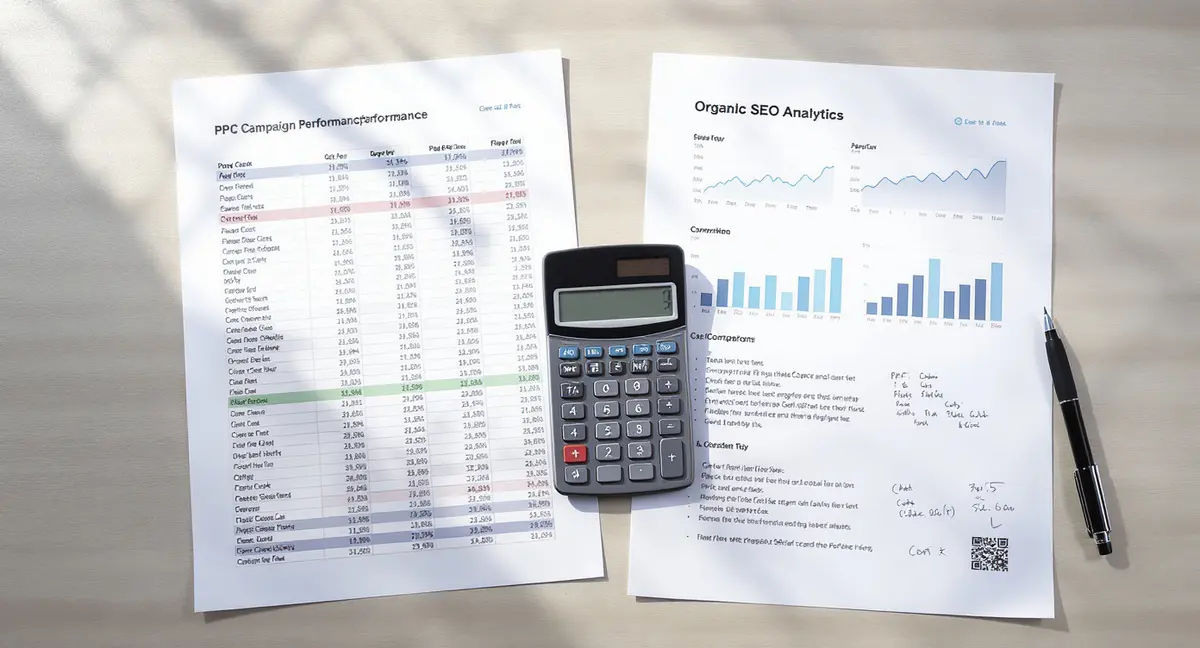
The SEO vs PPC debate is not about which channel is "better." It is about which one fits your business model, timeline, and how you want to own your visibility. Most businesses treat this as a binary choice when the real question is: do you want to rent traffic or build equity in your search presence? If you're building that long-term foundation, start with an SEO checklist that reflects what actually moves rankings in 2026.
Organic search drives 53% of all website traffic, while paid search accounts for 15% (Backlinko, 2026). That gap tells you where the volume lives. But PPC converts at 1.5x the rate of organic clicks (New Media Campaigns, 2024). Volume versus conversion. Long-term versus immediate. Ownership versus dependency.
The SEO vs PPC framework breaks down when you look at how search results actually work in 2026. Google shows ads, local packs, AI Overviews, organic listings, and shopping results on the same page. Your competitor is not choosing one channel. They are showing up everywhere. The businesses winning search visibility are not picking sides. They are building systems that perform across every result type.
This article breaks down how SEO and PPC work, what each costs, when to use them, and how to stop renting visibility you should own.
How SEO and PPC Show Up in Search Results
SEO vs PPC starts with understanding where each appears on the page. Paid ads sit at the top of search results, marked with a small "Sponsored" label. Organic results appear below the ads, earned through content quality, site authority, and relevance signals Google's algorithm evaluates. Between them, you might see local map packs, shopping carousels, or AI-generated answer boxes.
Organic results are 8.5x more likely to be clicked than paid ads (New Media Campaigns, 2024). Users scroll past ads to find what they trust. That click-through advantage compounds over time. A page ranking #1 organically for a high-intent keyword generates traffic every day without additional spend. The same visibility through PPC requires paying for every single click.
What SEO Earns You in the SERP
SEO places your content in the organic results section. When Google evaluates your page, it looks at content depth, backlinks from authoritative sites, page speed, mobile usability, and how well your content matches search intent. Sites with original research earn 4x more backlinks than those without (Backlinko). That authority signal pushes you higher in rankings.
Ranking organically means you control the asset. The page, the content, the traffic source, it all lives on infrastructure you own. If you stop publishing, your existing pages keep ranking. The traffic does not disappear the moment you stop paying. SEO builds equity. It compounds. A well-optimized article published in 2024 can still drive leads in 2026 without additional investment.
What PPC Buys You in the SERP
PPC puts your ad at the top of the page, above organic results. You bid on keywords, write ad copy, set a daily budget, and Google charges you every time someone clicks. The ad disappears the moment your budget runs out or you pause the campaign. According to Google Ads, PPC lets you reach customers immediately and customize campaigns on the fly.
PPC is visibility you rent. It performs as long as you keep paying. For businesses that need leads today, a product launch, a seasonal promotion, a new market entry, PPC delivers. You can test messaging, target specific demographics, and measure cost-per-acquisition in real time. But the SEO vs PPC cost structure is fundamentally different. PPC is an operating expense. SEO is a capital investment.
The Real Cost Difference Between SEO vs PPC
Cost is where the SEO vs PPC comparison gets misunderstood. PPC has a clear price: you pay per click. SEO has no per-click cost, but it requires upfront investment in content, technical optimization, and authority building. The question is not which is cheaper. The question is which cost structure matches your business model. Measuring that return requires tracking metrics beyond traditional keyword rankings, which is where understanding AI SEO ROI becomes essential.
The average cost-per-click in Google Ads varies by industry. Legal services can pay $50+ per click. Home services average $15-30. E-commerce might be $1-3. If you are spending $3,000/month on PPC and getting 200 clicks, you are paying $15 per visitor. Over 12 months, that is $36,000 in ad spend. When you stop paying, the traffic stops. That $36,000 bought temporary access, not an asset.
SEO Investment: Upfront Work, Long-Term Returns
SEO requires time and resources upfront. You need content that answers what your audience is searching for, technical infrastructure that loads fast and works on mobile, and backlinks that signal authority. For most businesses, meaningful SEO results take 6-12 months. That is not a flaw. That is the nature of building something that lasts.
The ROI curve for SEO looks different than PPC. Month one might generate zero incremental traffic. Month six might show a 20% increase. Month twelve could double organic visitors. The traffic you earn in month twelve keeps coming in month thirteen, fourteen, and beyond without additional spend. SEO leads have a 14.6% close rate compared to 1.7% for outbound (Search Engine Journal). The cost-per-lead drops over time because the content keeps working.
PPC Spend: Predictable, But Perpetual
PPC costs are predictable. You set a budget, track spend daily, and know exactly what you are paying for traffic. The problem is that the cost never stops. Every click costs money. Every lead requires ad spend. If your competitor outbids you, your ad drops lower or stops showing. You are not building equity. You are paying rent.
Businesses spending $1,500-5,000/month on PPC see consistent traffic as long as the budget holds. But that $60,000/year in ad spend does not create a compounding asset. It buys access. When budget cuts happen or priorities shift, the traffic disappears. The SEO vs PPC cost question is notably about whether you want to own your traffic source or lease it.
Time to Results: Immediate vs Compounding
The SEO vs PPC timeline difference is the most visible trade-off. PPC can drive traffic within hours of launching a campaign. SEO typically takes months to show meaningful results. That is not a weakness. It is a feature of how authority and trust work in search.
PPC delivers immediately because you are buying placement. You are not earning it. Google shows your ad as soon as your campaign goes live and your bid is competitive. For businesses that need leads this week, a law firm handling time-sensitive cases, a contractor with open capacity, an e-commerce store running a flash sale, PPC makes sense. You cannot wait six months for organic rankings to build.
Why SEO Takes Longer and Why That Matters
SEO takes time because Google evaluates trust signals that cannot be faked overnight. Backlinks from authoritative sites. Consistent publishing history. User engagement signals like time on page and bounce rate. Content that demonstrates expertise. These signals accumulate. A brand-new site publishing its first article will not outrank a site with 200 published pieces and 500 backlinks.
But that delay creates a moat. If SEO were easy and fast, every competitor would do it. The six-month ramp-up is what makes SEO defensible. Once you rank, displacing you requires your competitor to invest the same time and resources. According to BrightEdge, organic search drives 53% of trackable website traffic. That majority share exists because organic results compound. PPC stops the moment you stop paying. That shift in how search results display is part of a broader transformation in the future of SEO that most businesses are still ignoring.
When Immediate Visibility Justifies the Cost
There are scenarios where PPC is the right move. Product launches. Market tests. Seasonal businesses that need traffic in a compressed window. Competitive keywords where organic rankings would take years to achieve. PPC lets you buy your way to the top while you build the long-term SEO foundation.
The mistake is treating PPC as a permanent strategy. Paying $3,000/month for traffic works when you are testing a market or covering a gap while SEO ramps up. It does not work as a ten-year plan. The SEO vs PPC decision is not either-or. It is about sequencing. Use PPC to generate leads today. Use SEO to own the traffic source tomorrow.
Traffic Quality and Conversion Behavior
Click volume is not the same as lead quality. The SEO vs PPC comparison has to account for user intent, trust signals, and how each channel influences conversion behavior. Organic traffic and paid traffic do not behave the same way once they land on your site.
Organic results are 8.5x more likely to be clicked than paid ads (New Media Campaigns, 2024). That click-through preference reflects trust. Users know ads are paid placements. They scroll past them to find content they believe is genuinely relevant. But paid search results convert at 1.5x the rate of organic clicks (New Media Campaigns, 2024). That conversion lift happens because PPC traffic is often further down the funnel, people clicking ads are ready to buy.
Why Organic Traffic Builds Long-Term Trust
Organic rankings signal authority. When your business appears in position one or two for a high-intent search, users assume Google vetted you. They do not see a "Sponsored" label. They see a result that earned its place. That perceived endorsement matters. Visitors from organic search spend more time on site, visit more pages, and are more likely to return.
SEO traffic also captures users at every stage of the buyer journey. Someone searching "how to improve website speed" is early-stage. Someone searching "WordPress performance optimization service" is late-stage. SEO lets you show up for both. PPC typically targets bottom-funnel keywords because the cost-per-click is only justified when conversion intent is high. That leaves the awareness and consideration stages uncovered.
Why PPC Traffic Converts Faster
PPC captures high-intent searches. When someone clicks an ad for "emergency plumber near me," they are not browsing. They need a plumber now. That urgency drives conversion. PPC also lets you control the entire experience, ad copy, landing page, offer. You can A/B test headlines, calls-to-action, and pricing in real time. Organic content does not offer that level of control.
The trade-off is volume. PPC converts better per click, but organic search delivers far more clicks. The opportunity from organic search is 5.66x that of paid search (New Media Campaigns, 2024). You are choosing between higher conversion rates on lower volume (PPC) or lower conversion rates on massive volume (SEO). For most businesses, the math favors SEO once the content engine is running.
See How Your Business Shows Up in AI Search
Get a free AI visibility scan. See exactly where you rank on ChatGPT, Perplexity, and Google AI, and what to do about it. Get Your Free Scan. Understanding what is AI SEO helps explain why traditional optimization tactics no longer deliver the same results they did two years ago.
How SEO and PPC Work Together
The most successful visibility strategies do not pick one channel. They use PPC data to inform SEO and use SEO authority to improve PPC performance. The SEO vs PPC framing is a false binary. The real question is how to make them reinforce each other.
PPC gives you keyword data immediately. You can see which search terms convert, which ad copy resonates, and which landing pages perform. That data tells you what to write about for SEO. If a PPC campaign for "commercial HVAC repair" converts at 8%, you know that topic has demand. Build an SEO content cluster around it. Use the ad copy that worked as your headline framework. PPC becomes your research lab for SEO.
Using PPC to Validate SEO Investments
SEO requires upfront investment before you see results. PPC lets you test demand before committing resources. If you are considering a content series on "AI search optimization," run a small PPC campaign targeting that keyword. If the cost-per-lead is acceptable and traffic converts, the SEO investment is validated. If the campaign flops, you saved months of content work.
PPC also covers gaps while SEO builds. You might rank #1 for "property management software" but sit on page three for "HOA accounting tools." Run PPC for the second keyword while you build content to rank organically. You are not choosing between channels. You are using each where it performs best.
How SEO Authority Improves PPC Performance
Google Ads uses Quality Score to determine ad rank and cost-per-click. Quality Score factors in landing page relevance, expected click-through rate, and ad relevance. A site with strong organic authority, backlinks, published content, domain age, tends to score higher. That means lower cost-per-click for the same ad position.
If your site ranks organically for related keywords, your PPC campaigns benefit. A business ranking #2 organically for "SEO services" will likely see better Quality Scores when running PPC for "SEO consultant." Google's algorithm recognizes the site as relevant to that topic cluster. The SEO vs PPC relationship is not competitive. It is complementary.
When to Choose SEO, PPC, or Both
The SEO vs PPC decision depends on your timeline, budget, and whether you want to own your visibility infrastructure. There is no universal answer. The right choice is the one that matches your business model and growth stage.
If you need leads this month and have budget to spend, PPC makes sense. If you are building a business for the next five years and want to own your traffic sources, SEO is the foundation. If you have both budget and patience, run PPC to generate leads today while building SEO to own the channel tomorrow.
SEO Makes Sense When You Want to Own the Asset
SEO is the right move when you can invest upfront and wait for compounding returns. Local service businesses, SaaS companies, professional services firms, and e-commerce brands all benefit from organic visibility that does not disappear when budgets tighten. SEO builds equity. The content you publish this year generates traffic next year and the year after.
Businesses that blog get 55% more website visitors (marketing automation platform, 2024). That lift happens because every published article is a potential entry point. A single well-optimized guide can rank for dozens of long-tail keywords and drive traffic for years. PPC cannot replicate that compounding effect. When you stop paying, the traffic stops.
PPC Makes Sense When You Need Speed or Testing
PPC works when you cannot wait six months for results. Product launches. Competitive markets where organic rankings are dominated by established players. Seasonal businesses that need traffic in a compressed window. PPC also works as a testing mechanism. You can validate demand, test messaging, and measure conversion rates before committing to long-term SEO. The question of is SEO dead misses the point entirely when organic search still drives the majority of trackable website traffic.
The cost is the constraint. If your customer lifetime value supports $50 cost-per-acquisition and PPC delivers that, keep running ads. But if you are paying $3,000/month indefinitely, you are choosing dependency over ownership. The SEO vs PPC question becomes: how long are you willing to rent traffic instead of owning it?
The Bottom Line
SEO vs PPC is not a binary choice. It is a question of cost structure, timeline, and ownership. PPC buys immediate visibility. SEO builds long-term equity. PPC stops when you stop paying. SEO compounds as long as you keep publishing.
The businesses winning search visibility in 2026 are not choosing one channel. They are using PPC to cover gaps and validate demand while building SEO systems that generate traffic without ongoing spend. Organic search drives 53% of all website traffic (Backlinko, 2026). That majority share exists because organic results compound. PPC delivers speed and control, but it is infrastructure you rent, not own.
If visibility is critical to your growth, treat it like infrastructure. Build systems that keep working after the engagement ends. Use PPC where it makes sense. Invest in SEO where you want ownership. Stop paying rent on traffic you should own.
Frequently Asked Questions
Which is better for small businesses: SEO or PPC?
SEO is better for small businesses with limited budgets and long-term growth goals. Organic rankings build equity that compounds over time without ongoing spend. PPC works when you need immediate leads and have budget to sustain monthly ad spend. Most small businesses benefit from SEO as the foundation with selective PPC for high-intent keywords.
How long does it take to see results from SEO compared to PPC?
PPC delivers traffic within hours of launching a campaign. SEO typically takes 6-12 months to show meaningful results. That delay reflects how Google evaluates authority signals like backlinks, content depth, and user engagement. PPC is faster but stops when you stop paying. SEO takes longer but compounds.
Can I build SEO infrastructure in-house or do I need to hire an agency?
You can build SEO in-house if you have time and technical capacity. Most businesses lack both. The alternative to hiring an agency is installing an owned content system, infrastructure you control that keeps producing results after the initial build. Agencies create dependency. Installed systems create ownership.
What does it cost to own my visibility infrastructure instead of renting it?
Renting visibility through PPC costs $1,500-$5,000+/month indefinitely. Owning it through SEO requires upfront investment in content, technical optimization, and authority building. The cost is higher initially but drops to near-zero once the system is running. Ownership means the traffic keeps coming without ongoing spend.
Should I run SEO and PPC at the same time?
Yes, if budget allows. Use PPC to generate leads immediately and validate keyword demand. Use SEO to build long-term organic visibility. PPC data informs what to write about for SEO. SEO authority improves PPC Quality Score and lowers cost-per-click. The channels reinforce each other when used strategically.