SEO Dashboard White Label: How Agencies Build Reporting Systems They Own (Not Rent)
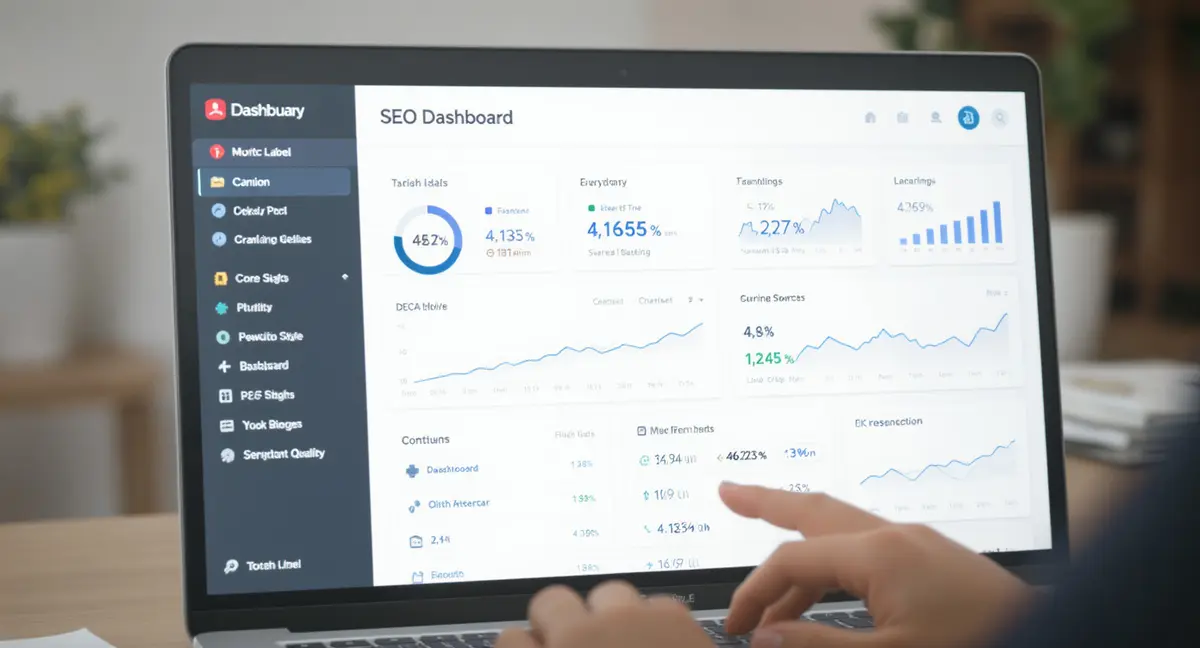
The short answer: An SEO dashboard white label is a branded reporting interface agencies use to display client performance data under their own logo and domain. White label SEO dashboards aggregate metrics from multiple sources, keyword rankings, traffic, backlinks, conversions, into a unified interface, reducing reporting time by up to 70% while building client trust through branded presentation. Success depends on data accuracy, customizable views, and client-specific benchmarks. Top performers focus on data freshness, client self-service capabilities, and strategic analysis layered on top of the dashboard itself.
An SEO dashboard white label is a branded reporting interface that agencies and consultants use to display client performance data under their own logo and domain. Instead of showing clients a third-party tool's interface, you present metrics through a system that looks like yours. The difference between renting dashboard access and owning the reporting infrastructure determines whether you scale profitably or stay trapped in monthly software fees that eat 15-30% of your margin. Local seo is worth reading alongside this.
Most agencies treat white label SEO dashboards as a cosmetic upgrade, swap the logo, change the colors, call it done. That approach misses the bigger issue. When your reporting lives inside a vendor's platform, you don't control the data pipeline, the feature roadmap, or the pricing. Your clients see performance through a lens you didn't build and can't modify. This article breaks down how to evaluate, implement, and own a white label SEO dashboard that becomes infrastructure, not overhead.
What an SEO Dashboard White Label Does (And What It Doesn't)
A white label SEO dashboard pulls performance data from multiple sources, Google Search Console, Google Analytics, rank trackers, backlink monitors, and displays it in a unified interface branded with your agency's identity. The client logs in through your domain, sees your logo, and interacts with reports that feel native to your service. The underlying data comes from APIs, but the presentation layer is yours.
The Core Function: Centralized Data Display Under Your Brand
White label dashboards aggregate metrics that would otherwise require clients to log into five different tools. Keyword rankings from one platform, traffic data from Google Analytics, backlink growth from another source, conversion tracking from a CRM. The dashboard becomes the single source of truth. According to AgencyAnalytics, agencies using centralized dashboards reduce client reporting time by 70% compared to manual spreadsheet compilation.
The branding component matters more than most agencies realize. When a client sees your logo on every report, your domain in the URL, and your color scheme throughout the interface, they associate the data with your expertise. Research from Databox shows that 68% of agency clients rate their provider higher when reports come through a branded portal versus generic tool exports.
What White Label Dashboards Don't Do: Strategy, Analysis, or Execution
A dashboard displays data. It doesn't interpret trends, recommend next actions, or execute campaigns. Many agencies oversell dashboards as "AI-powered observations" when the platform just flags anomalies, a 20% traffic drop triggers an alert, but the system doesn't explain why or what to do about it. The dashboard shows that organic traffic from "plumber near me" fell 40% last month. It doesn't tell you whether that's a seasonal pattern, a Google algorithm update, or a technical issue.
This gap is where agencies either add value or get commoditized. If your white label SEO dashboard is your primary deliverable, you're competing on price with every other agency using the same tool. The dashboard should support your analysis, not replace it. Platforms like Whatagraph and ReportGarden offer white label options, but the real differentiation comes from what you layer on top, custom benchmarks, competitive context, and strategic recommendations that no automated system can generate.
Why Agencies Choose White Label SEO Dashboards (And Why Some Regret It)
The standard pitch for white label SEO dashboards focuses on efficiency and professionalism. Automate reporting, save 10 hours per week, look more established. Those benefits are real, but they come with trade-offs that most vendors don't highlight until you're locked into an annual contract.
The Efficiency Case: Time Savings and Client Self-Service
Manual reporting is a margin killer. An agency managing 20 SEO clients spends 15-20 hours per month compiling performance reports if they're pulling data manually from Google Search Console, Analytics, and rank trackers. At $150/hour blended rate, that's $2,250-$3,000 in labor cost. A white label dashboard automates the data pull and visualization, cutting that time to 2-3 hours for quality control and commentary.
Client self-service is the other efficiency gain. Instead of emailing PDFs or scheduling review calls every time a client wants to check rankings, they log into the dashboard whenever they want. This reduces inbound requests by 40-50%, according to data from AgencyAnalytics. The client feels more in control, and your team stops playing data concierge.
But here's the catch: efficiency only improves margin if you don't add more clients to fill the saved time. Many agencies automate reporting, then take on 30% more clients without hiring, which brings utilization back to 100% and burns out the team. The time savings are real, but they don't automatically translate to profit unless you manage capacity intentionally.
The Dependency Risk: When Your Dashboard Vendor Owns Your Client Relationship
White label SEO dashboards create a hidden dependency. Your clients log in through your branded portal, but the infrastructure belongs to the vendor. If the vendor raises prices 40% at renewal (common in SaaS), you either absorb the cost or pass it to clients and risk churn. If the vendor gets acquired and the product roadmap shifts, you adapt or migrate, and migration means rebuilding every client dashboard from scratch.
Data portability is the bigger issue. Most white label dashboard platforms don't offer clean data exports. You can download CSVs of individual reports, but there's no "export all client data and configurations" button. When you leave, you lose the historical baseline, the custom views, and the automated workflows. Your clients don't own the data pipeline, and neither do you. You're both renting access.
This is why some agencies build internal dashboards using tools like Google Data Studio (now Looker Studio), Power BI, or custom scripts pulling from APIs. The upfront cost is higher, $15,000-$30,000 to build a functional multi-client reporting system, but you own the infrastructure. No per-client fees, no vendor lock-in, no surprise price hikes. The break-even point for a 20-client agency is typically 18-24 months, after which the owned system is pure margin improvement.
Essential Features in a White Label SEO Dashboard (Ranked by Impact, Not Vendor Marketing)
Most white label SEO dashboard comparison articles list 15 features with equal weight, as if custom fonts matter as much as data accuracy. They don't. This is what actually moves the needle for agencies that use dashboards to retain clients and scale profitably.
| Factor | What It Is | Impact on Margin & Retention |
|---|---|---|
| Data Accuracy & Refresh Frequency | Real-time or near-real-time data syncing from APIs; rank data matching actual SERPs | Eroded trust if dashboards lag 4-5 days or show rank discrepancies vs. Google |
| Customizable Views & Benchmarks | Client-specific metric selection, custom goals, competitive context by geography/vertical | Generic dashboards commoditize agencies; custom benchmarks differentiate and justify pricing |
| Vendor Dependency & Data Portability | Clean data exports, no lock-in clauses, transparent pricing, ownership of infrastructure | Price hikes, product changes, or vendor acquisition can force costly migrations and client churn |
| Client Self-Service & Automation | Dashboard login access reduces manual reporting; clients check data on-demand | 40-50% fewer support requests; 15-20 hours/month saved per 20-client agency |
Data Accuracy and Refresh Frequency: The Non-Negotiable Foundation
A dashboard that shows yesterday's rankings or last week's traffic is a liability, not an asset. Clients expect near-real-time data, especially for paid search and conversion metrics. Google Search Console data has a 2-3 day lag built into the API, which is unavoidable. But if your white label dashboard adds another 24-48 hours on top of that because it only syncs once per day, you're showing 4-5 day old data. That's unacceptable for any client running active campaigns.
Data accuracy is harder to verify than refresh frequency, but it's more important. Some white label platforms pull rank data from their own crawlers, which may not match what Google actually shows users. A client searches for their target keyword, sees their site in position 4, then logs into your dashboard and sees position 7. That discrepancy erodes trust faster than any branding can build it. Platforms like SEMrush and Ahrefs use large-scale crawling infrastructure that correlates closely with actual SERPs. Smaller white label tools often rely on cheaper data sources with higher variance.
Customizable Views and Client-Specific Benchmarks
Every client cares about different metrics. An e-commerce brand wants product page rankings and conversion rate by traffic source. A local service business wants "near me" keyword visibility and Google Business Profile metrics. A B2B SaaS company wants organic demo requests and content engagement by funnel stage. A one-size-fits-all dashboard forces every client into the same template, which means half the metrics are irrelevant noise. White label essentials is worth reading alongside this.
The best white label SEO dashboards let you build custom views per client. Not just rearranging widgets, but defining which data sources matter, setting client-specific goals, and creating comparative benchmarks. For example, a pest control company in Phoenix should see their rankings compared to local competitors, not a national average. A dashboard that shows "your average position is 8.4" is less useful than "you rank 3rd among the top 5 pest control companies in Phoenix for high-intent keywords."
Custom benchmarks require manual setup, which is why most agencies skip them. But this is where you differentiate. A branded dashboard with generic metrics is just a nicer-looking version of Google Search Console. A dashboard with context, "your organic traffic is up 22% while your top 3 competitors are flat or declining", becomes strategic intelligence.
Want to see how your site stacks up?
Get a free visibility scan and find out where you stand. Book your free scan.
How to Implement a White Label SEO Dashboard Without Killing Your Margin
Implementation is where most agencies underestimate cost and complexity. The sales demo shows a dashboard going live in 30 minutes. The reality involves data cleanup, client onboarding, training, and ongoing maintenance that adds 5-10 hours per client in the first 90 days.
The Hidden Costs: Data Hygiene, Integration Debugging, and Client Training
Before you can display accurate data, you need clean data. Many clients have Google Analytics properties with broken tracking, Search Console accounts that aren't verified, or rank tracking tools with outdated keyword lists. Your white label SEO dashboard will surface these issues immediately. A client's organic traffic chart shows zero sessions for the past six months because their GA4 property wasn't configured. Now you're troubleshooting tracking code instead of analyzing performance.
Integration debugging is the other time sink. APIs fail, authentication tokens expire, and data sources change their schemas without warning. Google updates the Search Console API, and suddenly your dashboard stops pulling click data. You spend two hours diagnosing the issue, then another hour re-authenticating 20 client accounts. These incidents happen monthly, and they're invisible to clients, until the dashboard shows stale data and they email asking why.
Client training is optional in theory, mandatory in practice. If clients don't understand how to read the dashboard, they'll email you with questions that the dashboard already answers. "Why did our traffic drop last week?" is visible in the dashboard's traffic chart with a clear annotation showing a Google algorithm update. But if the client doesn't know where to look or how to interpret the data, you're back to manual reporting via email. Budget 30-60 minutes per client for an onboarding walkthrough, plus a recorded tutorial they can reference later.
Build vs. Buy: When Custom Infrastructure Makes Sense
Most agencies default to buying a white label SEO dashboard because building one sounds expensive and technical. The break-even math is simpler than it appears. A white label dashboard platform charges $50-$150 per client per month. For a 20-client agency, that's $1,000-$3,000 monthly, or $12,000-$36,000 annually. Over three years, you'll spend $36,000-$108,000 on a tool you don't own. If you want the practical breakdown, SEO checklist is a good next step.
Building a custom dashboard using Google Looker Studio, API connectors, and light scripting costs $15,000-$30,000 upfront if you hire a developer or data analyst for 100-200 hours of work. Maintenance is 5-10 hours per month, or $750-$1,500 annually at $150/hour. Over three years, total cost is $17,250-$34,500. You break even in 18-24 months, then the system is pure margin improvement.
The build option makes sense when you have 15+ clients, technical resources in-house or on retainer, and a clear view of what metrics matter most to your client base. It doesn't make sense if you're a solo consultant with five clients, or if your team has no experience managing APIs and data pipelines. The middle ground is using a flexible platform like Looker Studio with pre-built templates, which gives you 70% of the customization at 20% of the build cost.
Want to see how businesses are moving from rented reporting tools to owned content and visibility systems? Book a 30-Minute Content & Visibility Scan to assess where you stand in Google, AI search, and voice search, no cost, no pressure.
White Label SEO Dashboards and AI Search: The Metrics Gap Nobody's Talking About
Traditional white label SEO dashboards track Google rankings, organic traffic, and backlinks. That worked when Google was the only search interface that mattered. In 2026, 50% of Google queries trigger AI Overviews, and 29% of users have adopted AI search tools like ChatGPT and Perplexity (Exposure Ninja, 2025). Your clients are losing visibility in AI-generated answers, and your dashboard doesn't show it.
Why Traditional Dashboards Miss AI Search Performance
Google Search Console doesn't report whether your content appears in AI Overviews. It shows impressions and clicks for traditional blue links, but AI-generated answers sit above those links and often satisfy the query without a click. A client's content could be cited in 1,000 AI Overviews per month, generating brand exposure and authority, but your dashboard shows zero traffic from those impressions because users didn't click through.
AI search platforms like ChatGPT and Perplexity don't offer analytics APIs yet. You can't pull data showing how often your client's business is mentioned in AI-generated answers, which sources the AI cited, or how that visibility trends over time. Some agencies manually test queries and screenshot results, but that's not scalable past 5-10 clients. The infrastructure for tracking AI search visibility is still being built, and most white label dashboard vendors haven't integrated it yet.
What to Track Now (Even Without Perfect Tools)
Until AI search analytics mature, track proxy metrics that indicate AI visibility. Monitor branded search volume, if your client's brand name searches increase 30% while traditional organic traffic stays flat, AI exposure is likely driving awareness. Track direct traffic and referral sources from AI platforms. Perplexity and ChatGPT do generate some click-through traffic, and you can see it in Google Analytics under referral sources.
Content structure matters more in AI search than traditional SEO. AI models prefer content with clear section headings, factual density, and cited sources. If your white label SEO dashboard tracks content performance, add a column for "AI-optimized structure", does the page use schema markup, include FAQ sections, cite authoritative sources, and break information into scannable sections? Pages that score high on these criteria are more likely to get cited by AI systems, even if you can't measure the citations directly yet.
BrightEdge found that early AI search adopters see 120x impression increases and 800% year-over-year traffic growth from large language models (2025). Businesses optimizing for AI search now are building visibility that compounds. Those waiting for perfect measurement tools are losing ground to competitors who moved early with imperfect data. AI SEO tools is worth reading alongside this.
The Bottom Line: Own Your Reporting Infrastructure or Pay Rent Forever
A white label SEO dashboard is either a tool you use to deliver value, or a dependency that erodes your margin and limits your flexibility. The difference comes down to whether you control the infrastructure. Renting dashboard access from a vendor is fast and easy, but you're paying $12,000-$36,000 per year for a system you don't own, can't customize deeply, and will lose if you ever leave the platform.
Building or owning your reporting infrastructure costs more upfront but breaks even in 18-24 months for most agencies. After that, it's pure margin improvement. You control the data pipeline, the feature roadmap, and the client experience. When a client asks for a custom metric or a new integration, you build it instead of submitting a feature request to a vendor who may or may not prioritize it.
The agencies that scale profitably treat dashboards as infrastructure, not software subscriptions. They invest in systems they own, train their teams to use them effectively, and build client relationships around strategic analysis rather than automated reports. The dashboard is the foundation, not the product. If your white label SEO dashboard is your primary deliverable, you're competing on price with every other agency using the same tool. If it's the infrastructure that supports your strategic work, you're building a business that compounds value instead of renting visibility month to month.
Frequently Asked Questions
What is an SEO dashboard white label and who needs one?
An SEO dashboard white label is a branded reporting interface that displays client performance data under your agency's logo and domain. Agencies, consultants, and in-house teams managing multiple clients or properties use them to centralize metrics and automate reporting. It's infrastructure for client communication, not a replacement for strategy.
How much does a white label SEO dashboard cost per month?
White label SEO dashboards typically cost $50-$150 per client per month, depending on features and data sources. For a 20-client agency, expect $1,000-$3,000 monthly. Building a custom dashboard costs $15,000-$30,000 upfront but eliminates recurring per-client fees, breaking even in 18-24 months for most agencies.
Can I build a white label SEO dashboard in-house instead of buying one?
Yes. Use Google Looker Studio, API connectors, and light scripting to build a custom dashboard. Upfront cost is $15,000-$30,000 for 100-200 developer hours. Maintenance runs 5-10 hours monthly. You own the infrastructure, control customization, and avoid per-client fees. Best for agencies with 15+ clients and technical resources available.
Do white label dashboards track AI search visibility like ChatGPT and Perplexity?
Not yet. Most white label SEO dashboards track Google rankings, traffic, and backlinks but don't measure AI Overview appearances or citations in ChatGPT and Perplexity. Track proxy metrics like branded search volume, direct traffic from AI referrals, and content structure optimized for AI citation until analytics APIs mature.
What happens to my client data if I switch dashboard providers?
Most white label dashboard platforms don't offer full data exports. You can download individual reports as CSVs, but historical configurations, custom views, and automated workflows don't migrate cleanly. Switching providers means rebuilding dashboards from scratch. This is why some agencies build owned infrastructure using tools like Looker Studio or Power BI.