SEO Best Practices That Still Work in 2026
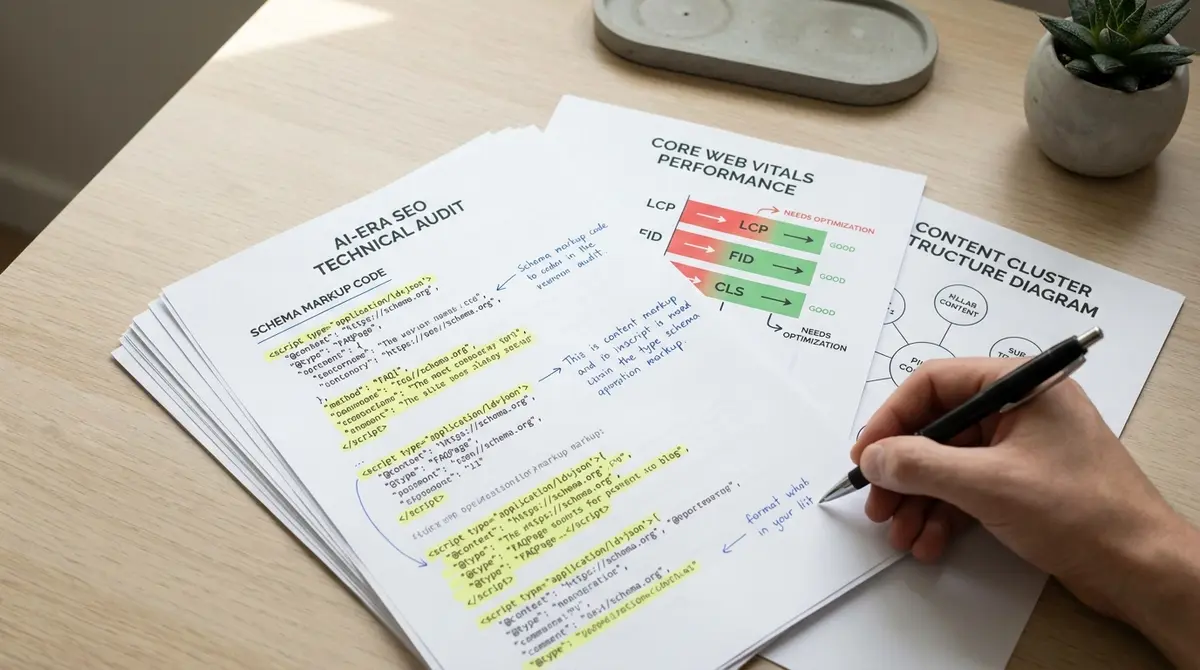
The short answer: SEO best practices in 2026 center on structured content that serves both traditional search engines and AI platforms like ChatGPT, Perplexity, and Google AI Overviews. Effective SEO best practices combine technical foundations (crawlability, mobile speed, schema markup), topical authority through content clusters, and E-E-A-T signals that AI models use to select sources. Three variables move the needle: content structure optimized for AI extraction, technical performance under Core Web Vitals, and authoritative citations that build trust. According to Search Engine Journal, organic search drives 53% of all trackable website traffic, making these practices essential infrastructure. The businesses winning organic visibility in 2026 are the ones who rebuilt their content systems around these realities, including specific tactics for Perplexity SEO that increase citation rates in AI-generated answers.
Why Most SEO Advice Is Already Outdated
SEO best practices from even 18 months ago miss the fundamental shift happening right now. Google's AI Overviews appear in 50% of queries, causing a 61% drop in organic click-through rates for traditional results (DemandSage, 2025). When someone searches for business information, they increasingly get an AI-generated answer citing 3-5 sources. If your content is not structured for AI extraction, you are invisible.
The gap between what most businesses think SEO means and what actually drives visibility has never been wider. Traditional SEO best practices focused on keyword density and backlink counts. AI-era SEO requires factual density, clear section-based formatting, schema markup, and expert attribution. A study from Princeton and Georgia Tech published at KDD 2024 found that content optimized for AI visibility using these techniques improved citation rates by 30-40%.
This is what changed. Search engines now use large language models to understand context and intent, not just keyword matching. Voice assistants like Siri and Alexa pull answers from structured data, not meta descriptions. ChatGPT and Perplexity cite sources that demonstrate first-hand expertise and provide specific, verifiable information. The businesses winning organic visibility in 2026 are the ones who rebuilt their content systems around these realities.
The AI Search Visibility Problem
Most businesses discover they have an AI visibility problem when a competitor starts appearing in ChatGPT answers and voice search results while they do not. AI platforms select sources based on content structure, not domain age or backlink count. They favor articles with clear headings, bulleted lists, FAQ sections, and schema markup that makes information easy to extract and verify.
Early adopters of AI-optimized content are seeing 120x impression increases and 800% year-over-year traffic growth from large language models (enterprise SEO platform research, 2025). More importantly, visitors arriving from AI search convert at 27% compared to 2.1% from traditional search (SingleGrain, 2025). These users come with higher intent because the AI already pre-qualified the information.
What Google Still Cares About
Google's March 2024 Core Update specifically targeted low-quality AI-generated content, rewarding sites with first-hand expertise and original research. The Helpful Content Update from September 2023 prioritized content created for humans, not search engines. Core Web Vitals (Largest Contentful Paint, Interaction to Next Paint, Cumulative Layout Shift) remain confirmed ranking factors.
The common thread is user experience backed by technical performance. Pages that load in under 2.5 seconds, respond to interactions within 200 milliseconds, and maintain visual stability during loading rank higher. Sites with original research get four times more backlinks than those without (Backlinko). Google's algorithm updates consistently reward content that demonstrates experience, expertise, authority, and trustworthiness.
How to Structure Content for Both Search Engines and AI
Content structure determines whether AI platforms can extract and cite your information. SEO best practices in 2026 require formatting that works for both traditional crawlers and large language models. This means clear hierarchical headings, short paragraphs under 3-4 sentences, bulleted lists for scannable information, and FAQ sections that answer specific questions.
The difference shows up in how AI platforms cite sources. When ChatGPT or Perplexity references a business, they pull from content with clear section breaks and factual statements they can verify. Articles structured as long narrative blocks without headings or lists get skipped. The AI cannot easily extract discrete facts to cite.
Consider how voice assistants answer questions. When someone asks Siri "What are the best practices for local SEO," the assistant pulls from content with a direct answer in the first paragraph, followed by a numbered or bulleted list. Schema markup tells the voice assistant which content block contains the answer. Without that structure, your content does not get selected.
Heading Hierarchy That AI Can Parse
Use H1 for the page title, H2 for major sections, H3 for subsections within each H2. Never skip levels (H1 to H3 without an H2 between). AI models use heading tags to understand content hierarchy and extract relevant sections. A page about SEO best practices should have H2s like "Technical SEO Foundations," "Content Optimization," and "Link Building Strategies," with H3s breaking down specific tactics under each.
Include your target keyword in at least 2-3 H2 headings naturally. Phrase at least two headings as questions that match how people actually search. Instead of "Keyword Research Methodology," write "How Do You Find Keywords That Actually Drive Traffic?" Voice search queries are conversational, and question-format headings align with how AI platforms match content to user questions.
Schema Markup for AI and Voice Search
Schema markup is structured data that tells search engines and AI platforms what your content means, not just what it says. FAQ schema marks up question-and-answer pairs so voice assistants can pull direct answers. Article schema identifies the headline, author, publish date, and main content. Local business schema provides address, hours, and contact information for map results. Track these metrics using the best SEO reporting systems to identify which technical improvements actually move rankings.
Test your schema implementation with Google's Rich Results Test. Pages with valid schema markup are more likely to appear in AI Overviews and voice search results because the structured data makes information extraction reliable. According to Search Engine Journal, sites using schema markup rank an average of four positions higher than those without it.
Technical SEO Foundations That Still Matter
Technical SEO best practices create the foundation for everything else to work. If search engines cannot crawl your site, index your pages, or load your content quickly, no amount of keyword optimization will help. The technical layer includes site speed, mobile usability, crawlability, indexability, and security.
Core Web Vitals are confirmed ranking factors. Largest Contentful Paint measures how long the main content takes to load (target under 2.5 seconds). Interaction to Next Paint measures responsiveness to user interactions (target under 200 milliseconds). Cumulative Layout Shift measures visual stability during loading (target under 0.1). Pages that fail these metrics rank lower, even with strong content.
Mobile usability is non-negotiable. Google uses mobile-first indexing, meaning it crawls and ranks the mobile version of your site first. If your mobile site is slow, hard to work through, or missing content that appears on desktop, your rankings suffer. According to Google's own data, 53% of mobile users abandon sites that take longer than 3 seconds to load.
Crawlability and Indexability Basics
Check if your pages are indexed using the site: operator in Google (site:yourdomain.com). If important pages are missing, check your robots.txt file to ensure you are not accidentally blocking crawlers. Use Google Search Console's URL Inspection Tool to see exactly how Google views a specific page and whether it is indexable.
Submit an XML sitemap to Google Search Console and Bing Webmaster Tools. The sitemap lists all important URLs on your site and helps search engines discover new content faster. Update your sitemap whenever you publish new pages. For large sites, break sitemaps into smaller files (under 50,000 URLs each) and use a sitemap index file.
Manage duplicate content with canonical tags. If the same content appears at multiple URLs (example.com/page and example.com/page?ref=email), use a canonical tag to tell search engines which version to index. Duplicate content dilutes ranking signals and confuses search engines about which page to show in results.
Site Speed and Performance Optimization
Compress images before uploading them. A 3MB hero image that could be 300KB without visible quality loss slows your page by seconds. Use modern formats like WebP that compress better than JPEG. Implement lazy loading so images below the fold only load when users scroll to them.
Minimize HTTP requests by combining CSS and JavaScript files where possible. Each external file requires a separate server request, adding latency. Enable browser caching so returning visitors do not have to re-download unchanged resources. Use a content delivery network to serve static assets from servers geographically closer to users.
Reduce server response time by upgrading hosting if needed. Shared hosting plans often struggle under traffic spikes. Managed WordPress hosting or cloud hosting platforms provide better performance for content-heavy sites. According to Backlinko, the average first-page Google result loads in 1.65 seconds.
Building Topical Authority Through Content Clusters
Topical authority means being recognized as a thorough source on a subject, not just ranking for individual keywords. SEO best practices in 2026 require content clusters: a pillar page covering a broad topic, supported by cluster pages diving deep into specific subtopics, all interlinked to demonstrate expertise.
A pillar page on "Local SEO" might be 3,000-4,000 words covering the fundamentals. Cluster pages would cover "Google Business Profile Optimization," "Local Citation Building," "Review Management," and "Local Link Building" in depth. Each cluster page links back to the pillar, and the pillar links to all clusters. This structure signals to search engines that you have complete coverage.
AI platforms favor sites with topical authority because they can cite multiple related pages as evidence of expertise. When ChatGPT answers a question about local SEO, it is more likely to cite a site with 10 interconnected articles on the topic than a site with one generic overview. Depth and breadth both matter.
How to Plan a Content Cluster
Start by identifying your core topic. What subject does your business need to own in search results? For a commercial real estate firm, it might be "commercial property investment." For a dental practice, it might be "cosmetic dentistry." The pillar topic should be broad enough to support 8-12 cluster pages.
Research subtopics by looking at "People Also Ask" boxes in Google search results for your core topic. Each question represents a potential cluster page. Use Google Search Console to find queries where you rank on page 2-3. These are opportunities to create dedicated cluster pages that could rank on page 1. If your team lacks the technical expertise to implement these foundations, working with the best SEO consultant for your industry can prevent costly mistakes during migration.
Map internal links before you start writing. The pillar page should link to every cluster page in a relevant context, not just in a bulleted list at the bottom. Each cluster page should link back to the pillar and to 2-3 related cluster pages. This creates a web of topical relevance that search engines reward.
Content Depth vs Content Volume
One complete 3,000-word article outperforms ten shallow 300-word posts. According to research from Backlinko analyzing 11.8 million Google search results, the average first-page result contains 1,447 words. Longer content tends to rank higher because it covers topics more thoroughly and attracts more backlinks.
Depth means answering follow-up questions within the article. If you are writing about keyword research, do not just explain what it is. Cover how to do it, what tools to use (categories, not specific brand names), common mistakes, and how to apply the research to content creation. Anticipate what the reader will ask next and answer it before they have to search elsewhere.
Update existing content rather than always creating new pages. A well-maintained article from 2024 that gets updated quarterly with new data and examples will outrank a newer article that never gets touched. Google rewards freshness, but freshness does not require a new URL. It requires new information.
E-E-A-T Signals That Build Trust
Experience, Expertise, Authoritativeness, and Trustworthiness are not direct ranking factors, but they influence what content Google chooses to rank. SEO best practices require demonstrating E-E-A-T through author credentials, cited sources, original research, and transparent business information.
Author bios matter more than most businesses realize. An article about tax strategy written by a CPA carries more weight than the same article with no author attribution. Include credentials, relevant experience, and links to professional profiles. For Your Money or Your Life topics (finance, health, legal), author expertise is critical.
Cite reputable sources for factual claims. When you state a statistic, name the source and link to it. AI platforms verify facts by checking citations. Content with authoritative citations gets selected for AI Overviews more often than unsourced claims. According to a study published at KDD 2024, citation density correlates with AI visibility.
First-Hand Experience and Original Data
Google's Helpful Content Update explicitly rewards first-hand experience. An article about "How to Choose a CRM" written by someone who has implemented CRMs for 50 clients is more valuable than one written by someone who read other articles about CRMs. Include specific examples, case details, and lessons learned from actual work.
Original research sets you apart. Survey your customers, analyze your industry data, or compile information that does not exist elsewhere. Sites with original research get four times more backlinks than those without (Backlinko). Even a simple survey of 100 customers about their biggest challenge provides data no competitor has.
Trust Signals and Transparency
Display clear contact information, including a physical address if you have one. Sites with complete contact pages rank higher for local and commercial queries. Include an about page that explains who runs the business and what qualifies them to provide the service or information.
Use HTTPS, not HTTP. Security is a confirmed ranking factor, and browsers now warn users when they visit non-secure sites. Get an SSL certificate from your hosting provider (most include it free). The padlock icon in the address bar is a basic trust signal users expect.
Maintain an active, moderated review presence. For local businesses, Google Business Profile reviews directly impact local pack rankings. For all businesses, reviews on third-party platforms signal trustworthiness. Respond to reviews, both positive and negative, to show you are engaged and accountable.
See How Your Business Shows Up in AI Search
Get a free AI visibility scan. See exactly where you rank on ChatGPT, Perplexity, and Google AI, and what to do about it. Get Your Free Scan.
Internal Linking Architecture That Distributes Authority
Internal links pass authority from one page to another on your site, helping important pages rank higher. SEO best practices require a deliberate internal linking strategy, not random links scattered throughout content. The goal is to create clear pathways that guide both users and search engines to your most valuable pages.
Link from high-authority pages to pages you want to rank. Your homepage typically has the most authority. If you want a service page to rank, link to it from the homepage navigation and from relevant blog posts. The more internal links pointing to a page, the more important search engines consider it.
Use descriptive anchor text that tells users and search engines what the linked page is about. Instead of "click here," use "local SEO checklist" or "technical audit process." Avoid over-optimization (using the exact same keyword anchor text 50 times), but do make anchor text relevant and specific. Professional services firms face unique challenges in building topical authority, which is why the best SEO for lawyers focuses on demonstrating expertise through case studies and original research rather than generic content.
Pillar-Cluster Linking Patterns
Every cluster page should link back to its pillar page in the introduction or first section. The pillar page should link to each cluster page in a relevant context, not just in a list. When you mention a subtopic on the pillar page, link to the cluster page that covers it in depth.
Cluster pages should link to related cluster pages within the same topic. An article about "Google Business Profile Optimization" should link to "Local Citation Building" and "Review Management" when those topics come up naturally. This creates a web of topical relevance that reinforces your authority on the subject.
Avoiding Internal Link Mistakes
Do not link to the same page multiple times from one article. One contextual link is better than five scattered links. Multiple links to the same destination dilute the value of each link and look spammy. Choose the most relevant mention and link there.
Fix broken internal links immediately. Use Google Search Console to identify 404 errors and redirect or update the links. Broken links waste crawl budget and create poor user experience. Set up 301 redirects when you delete or move pages so existing links continue to work.
Avoid deep link depth. Important pages should be reachable in 3 clicks or fewer from the homepage. If a page requires 5-6 clicks to reach, search engines and users are less likely to find it. Flatten your site architecture by linking to important pages from high-level navigation.
Keyword Research That Matches Search Intent
Keyword research identifies what your audience searches for and what they expect to find. SEO best practices require understanding search intent, not just search volume. A keyword with 10,000 monthly searches is worthless if the searchers want something different than what you offer.
Search intent falls into four categories: informational (learning something), navigational (finding a specific site), commercial (researching before buying), and transactional (ready to buy). Match your content type to intent. Informational queries need educational articles. Transactional queries need product or service pages with clear calls to action.
Study the current top 10 results for your target keyword. What format are they using? If the top results are all listicles, Google has determined that searchers want a list format for that query. If they are all long-form guides, searchers want full coverage. Match the dominant format or provide something demonstrably better.
Finding Keywords You Can Actually Rank For
Target keywords where you have a realistic chance of ranking. If you are a new site competing against established brands, focus on long-tail keywords with lower competition. Instead of "SEO," target "SEO for commercial real estate investors" or "technical SEO checklist for WordPress."
Use Google Search Console to find keywords where you already rank on page 2-3. These are opportunities to improve existing content and move to page 1. Add more depth, update outdated information, improve formatting, and build internal links to those pages.
Look for question-based keywords that match your expertise. "How do I optimize for voice search?" and "What is schema markup?" are queries where a well-structured article can rank quickly. Question keywords often have lower competition and higher conversion rates because they indicate specific intent.
Keyword Integration Without Over-Optimization
Use your target keyword in the H1, the first paragraph, 2-3 H2 headings, and naturally throughout the content. Aim for 0.5-1% keyword density. Higher density looks like keyword stuffing and can trigger penalties. Lower density may not signal relevance strongly enough.
Include semantic variations and related terms. If your target keyword is "content marketing," also use "content strategy," "editorial planning," and "content creation." Google understands these are related concepts. Using only the exact keyword repeatedly sounds unnatural and limits your ability to rank for related searches.
Never sacrifice readability for keyword placement. If forcing the keyword into a sentence makes it awkward, rewrite the sentence or skip that instance. Users who bounce because the content reads poorly hurt your rankings more than missing one keyword mention helps.
Measuring What Actually Drives Results
SEO best practices require tracking the right metrics, not vanity numbers. Traffic is meaningless if it does not convert. Rankings are irrelevant if they are for keywords your customers do not search. Focus on metrics that connect to business outcomes: organic conversions, revenue from organic traffic, and ranking for high-intent keywords.
Set up goal tracking in Google Analytics to measure conversions from organic traffic. Define what a conversion means for your business: form submissions, phone calls, purchases, or demo requests. Track which pages and keywords drive conversions, not just traffic. A page with 100 visitors and 10 conversions is more valuable than a page with 1,000 visitors and 2 conversions.
Use Google Search Console to monitor impressions, clicks, and average position for target keywords. Impressions show how often you appear in search results. Clicks show how often users choose your result. Average position shows where you rank. Track these over time to see if your SEO efforts are improving visibility. Planning and executing a content cluster strategy requires following content calendar best practices that ensure consistent publishing across pillar and cluster pages.
Attribution and ROI Measurement
Only 8% of marketers feel confident they can measure ROI from their marketing efforts (Firework, 2025). The problem is attribution. Organic traffic often touches multiple channels before converting. Someone might find you through organic search, leave, come back through email, and convert through a direct visit. Which channel gets credit?
Use multi-touch attribution models that give partial credit to each touchpoint. Google Analytics offers several models: first-click (credits the first interaction), last-click (credits the final interaction), and linear (credits all interactions equally). For content-driven businesses, first-click or linear models better reflect how organic search contributes to conversions.
Track assisted conversions to see how organic search influences conversions even when it is not the final touchpoint. A user who discovers you through organic search, reads three articles, and then converts through a paid ad represents organic value even though the paid ad gets last-click credit.
When to Expect Results
SEO is a 6-12 month investment before you see major results. New content takes 3-6 months to rank. Building topical authority through content clusters takes 6-12 months. If someone promises page 1 rankings in 30 days, they are either targeting extremely low-competition keywords or using tactics that will get you penalized.
Early wins come from optimizing existing content and fixing technical issues. You can see ranking improvements in 4-8 weeks by updating old articles, fixing broken links, improving site speed, and adding schema markup. New content takes longer because it has to earn authority through backlinks and user engagement.
Compound growth is the real value. An article that ranks on page 1 continues driving traffic for years with minimal maintenance. According to HubSpot's State of Marketing 2024, companies that blog get 55% more website visitors than those that do not. That traffic compounds over time as you publish more content and build more topical authority.
The Bottom Line
SEO best practices in 2026 require a system, not a campaign. The businesses winning organic visibility are the ones who built content infrastructure optimized for both traditional search engines and AI platforms. That means structured content with clear headings and schema markup, technical foundations that pass Core Web Vitals, topical authority through content clusters, and E-E-A-T signals that build trust.
The shift to AI search is not coming. It is here. Half of Google queries now trigger AI Overviews. ChatGPT, Perplexity, and voice assistants are citing 3-5 sources per query. If your content is not structured for AI extraction, you are invisible in the fastest-growing search channels. Early adopters are seeing 120x impression increases and 800% traffic growth from AI platforms.
Most businesses are still paying monthly retainers for SEO services that stop working the moment they stop paying. That is not ownership. That is rent. The alternative is installing a content system you own permanently, optimized for how search actually works in 2026. The businesses that make that shift now will own their visibility for years. The ones that wait will keep renting.
Frequently Asked Questions
What are the most important SEO best practices for 2026?
The most critical SEO best practices are structured content optimized for AI platforms, technical performance meeting Core Web Vitals standards, topical authority through content clusters, and E-E-A-T signals including author credentials and cited sources. AI search visibility now drives the majority of new organic traffic growth.
How long does it take to see results from SEO?
Expect 6-12 months for meaningful results from new content and topical authority building. Early wins from technical fixes and content updates can show in 4-8 weeks. SEO is a compound investment where results accelerate over time as you build more content and authority.
Can I build an SEO system in-house or do I need an agency?
You can build SEO infrastructure in-house if you have the technical resources and content production capacity. The question is ownership versus dependency. Agencies typically operate on monthly retainers where results stop when payments stop. An installed content system you own continues producing results permanently after the initial build.
How do I measure ROI from organic content?
Track organic conversions and revenue in Google Analytics using goal tracking and multi-touch attribution models. Monitor which keywords and pages drive conversions, not just traffic. Only 8% of marketers feel confident measuring marketing ROI (Firework, 2025), largely because they track vanity metrics instead of business outcomes.
What is the difference between SEO for Google and SEO for AI search?
Google SEO focuses on keywords, backlinks, and user experience signals. AI search optimization requires structured content with schema markup, clear section-based formatting, factual density with citations, and FAQ sections. AI platforms select sources based on how easily they can extract and verify information, not traditional ranking factors.