SEO Audit for Home Services Website: 2026 Blueprint
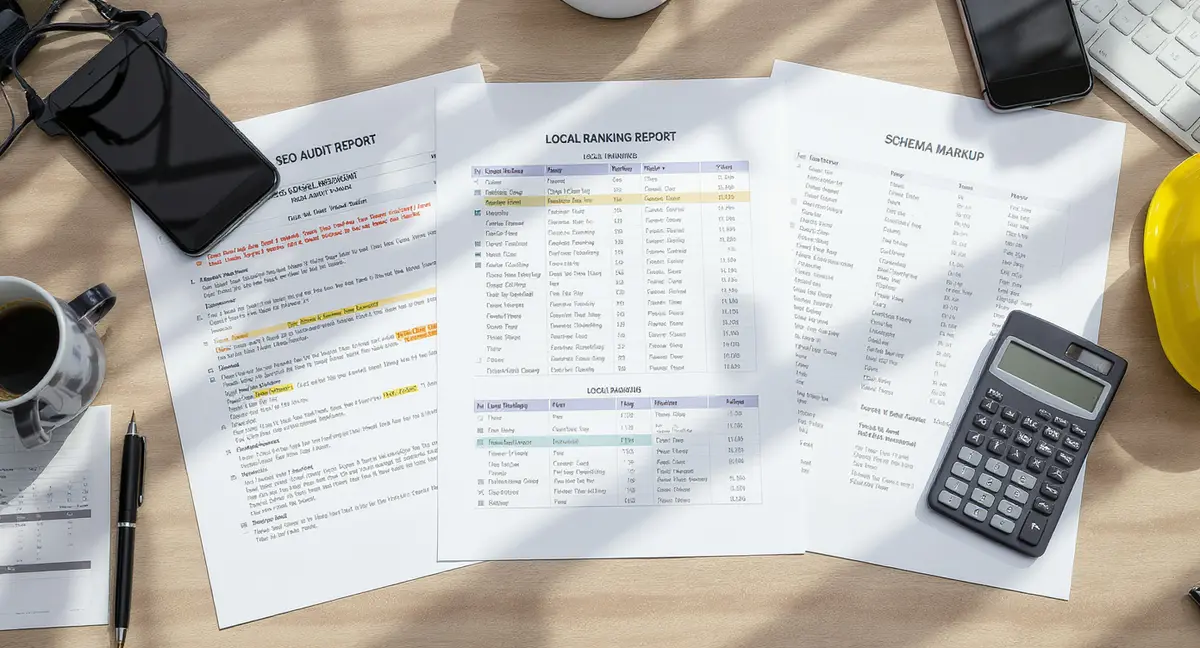
The short answer: An SEO audit for home services website identifies technical, content, and visibility issues preventing plumbers, HVAC contractors, electricians, and other service providers from ranking in Google, AI search, and voice assistants. It evaluates site speed, mobile usability, local SEO signals, schema markup, and content structure to surface high-impact fixes. Success in SEO audit for home services website comes down to technical health, local search optimization, and AI-ready content structure. According to BrightEdge's 2025 research, 50% of Google queries now trigger AI Overviews, making structured data and factual content critical for visibility. If you need a broader framework before diving into home services specifics, the SEO checklist covers foundational ranking factors across industries.
Your plumbing business ranks on page three for "emergency plumber near me." Your HVAC site loads in 8 seconds on mobile. Your electrical contractor page has zero schema markup, so Google Assistant never mentions you when homeowners ask for help. You are losing jobs to competitors who fixed these problems six months ago.
An SEO audit for home services website reveals what is blocking your visibility in Google, ChatGPT, Perplexity, and voice search. It is not a vanity report. It is a prioritized list of fixes that move you from invisible to booked. Home service businesses face unique SEO challenges: local competition, mobile-first searchers, emergency queries, and trust signals that matter more than backlinks. A generic audit misses what actually converts a homeowner at 11 PM with a burst pipe.
This article breaks down what a home services SEO audit covers, how to prioritize findings, and what separates a useful audit from a 40-page PDF that sits unread. If you are paying for SEO but cannot explain what is broken or what is fixed, this is your roadmap.
What Makes Home Services SEO Different from Generic Audits?
Home service businesses operate in a search environment that punishes generic SEO tactics. A homeowner searching "furnace repair near me" at midnight needs an answer in 3 seconds, not a blog post. An SEO audit for home services website must prioritize mobile speed, local pack visibility, and click-to-call functionality over keyword density and blog word counts. According to Whitespark's 2024 Local Search Ranking Factors study, Google Business Profile signals and review velocity now account for 36% of local pack rankings, yet most audits spend 90% of their time on technical site crawls.
Local Search Signals vs Traditional Ranking Factors
Traditional SEO audits focus on domain authority, backlink profiles, and content depth. Home services SEO audits prioritize proximity, Google Business Profile completeness, and NAP consistency across 50+ citation sources. A roofing company in Phoenix does not need 500 backlinks. It needs accurate business information on Yelp, Angi, HomeAdvisor, and the Better Business Bureau. It needs photos uploaded weekly to its Google Business Profile. It needs service area pages that match ZIP codes where it actually operates.
BrightLocal's 2025 consumer survey found that 87% of consumers read online reviews for local businesses, and 79% trust online reviews as much as personal recommendations. Your audit must measure review count, average rating, response rate, and recency. A competitor with 120 reviews and a 4.8 rating will outrank you with 30 reviews and a 5.0 rating every time. The audit should flag review gaps and provide a 90-day acquisition plan.
Mobile-First Indexing and Emergency Query Behavior
Google switched to mobile-first indexing in 2019, but home service sites still ship with desktop-first designs. An SEO audit for home services website must test Core Web Vitals on actual mobile devices, not just Google PageSpeed Insights. Largest Contentful Paint over 2.5 seconds kills conversions. Interaction to Next Paint over 200 milliseconds frustrates users trying to tap a phone number. Cumulative Layout Shift above 0.1 causes misclicks when the page jumps as images load.
Emergency queries like "24 hour locksmith" or "water damage restoration" trigger different user behavior. The searcher is not comparing three contractors. They are calling the first business that loads fast, displays a phone number above the fold, and shows "Open Now" in the local pack. Your audit must measure time to interactive, click-to-call button visibility, and after-hours contact options. According to Google's internal data, 61% of mobile searchers are more likely to contact a local business if the site is mobile-friendly. Local service businesses share similar challenges with real estate agents, who also compete on proximity, trust signals, and mobile-first search behavior.
| Factor | What it is | Impact |
|---|---|---|
| Google Business Profile completeness | Photos, hours, categories, posts, Q&A responses | High (36% of local pack ranking) |
| Mobile page speed | LCP, INP, CLS on actual devices | High (direct conversion impact) |
| Review velocity and response | New reviews per month, owner replies | High (trust and CTR driver) |
| NAP consistency | Name, address, phone match across 50+ directories | Medium (local pack filter) |
| Service area schema markup | Structured data declaring coverage zones | Medium (AI search visibility) |
How Do You Audit Technical Health for Home Service Sites?
Technical SEO for home services focuses on crawlability, indexation, and site architecture that supports local landing pages at scale. A plumbing company serving 15 ZIP codes needs 15 location pages, each with unique content, embedded maps, and service-specific schema. An SEO audit for home services website must verify that every location page is crawlable, indexable, and free of duplicate content penalties. According to Ahrefs' 2024 technical SEO study, 18% of websites have indexation issues that prevent pages from appearing in search results.
Crawl Errors and Indexation Blockers
Start with Google Search Console's Coverage report. Look for pages marked "Excluded" or "Error." Common blockers: robots.txt disallowing critical location pages, noindex tags left on from staging environments, redirect chains longer than two hops, and orphaned pages with zero internal links. A contractor site with 50 service pages but only 12 indexed in Google is invisible for 76% of its target queries.
Check XML sitemap accuracy. Every live, indexable page should appear in the sitemap. Pages removed six months ago should not. Submit the sitemap to Google Search Console and Bing Webmaster Tools. Verify that sitemap URLs match canonical tags. Mismatches confuse crawlers and dilute ranking signals. Use technical SEO crawler or a similar crawler to identify broken internal links, 404 errors with inbound traffic, and redirect loops.
Site Architecture for Multi-Location Service Businesses
Home service businesses need a URL structure that scales without creating duplicate content. Best practice: domain.com/services/plumbing, domain.com/locations/phoenix, domain.com/locations/phoenix/plumbing. Avoid domain.com/phoenix-plumbing and domain.com/plumbing-phoenix as separate pages. That is keyword stuffing disguised as site structure.
Internal linking must connect location pages to service pages and back to the homepage. Each location page should link to relevant service pages. Each service page should link to all locations where that service is offered. This creates a logical hierarchy that passes authority and helps crawlers understand relationships. An SEO audit for home services website should map internal link flow and flag orphaned pages with zero inbound links.
What Content Issues Kill Home Services Rankings?
Content audits for home service sites focus on thin pages, duplicate descriptions, and missing local context. A roofing company with 20 location pages that differ only by city name will trigger Google's duplicate content filters. An HVAC site with 300-word service pages loses to competitors publishing 1,500-word guides with pricing ranges, process timelines, and FAQs. According to Backlinko's 2024 content analysis, the average first-page result contains 1,447 words, and pages with at least one list or table rank higher than text-only pages.
Thin and Duplicate Location Pages
Most home service sites launch with template location pages: "We serve your area with expert the service. Call us today!" That is 15 words of unique content. Google sees it as spam. Each location page needs 500+ words of unique content: neighborhood-specific details, local landmarks, service area boundaries, customer testimonials from that ZIP code, and embedded Google Maps showing the coverage area. Once your audit surfaces visibility gaps, converting that traffic requires an AI booking funnel that moves searchers from click to confirmed appointment without friction.
An SEO audit for home services website must compare location pages for duplicate content percentage. Use Copyscape or Siteliner to measure overlap. Anything above 30% similarity triggers penalties. Rewrite pages to include local context: "Serving the Arcadia neighborhood, including homes near Camelback Mountain and the Biltmore area. Our Phoenix plumbers respond to calls in Arcadia within 45 minutes, with same-day service for burst pipes, water heater failures, and drain clogs."
Service Pages Without Trust Signals or Conversion Elements
Service pages must answer three questions: What does this cost? How long does it take? Why should I trust you? A furnace repair page without pricing ranges, process timelines, or technician certifications loses to a competitor who publishes transparent information. According to HubSpot's 2024 State of Marketing report, 55% of consumers research pricing online before contacting a business, and 47% will not engage if pricing is hidden.
Add trust signals to every service page: licenses and certifications, insurance coverage, warranties, before-and-after photos, video testimonials, and average response times. Include schema markup for AggregateRating, FAQPage, and HowTo where applicable. These structured data types increase visibility in AI Overviews and voice search results. Perplexity and ChatGPT cite businesses with clear, factual content 3x more often than sites with vague marketing copy.
Why Does Local SEO Configuration Matter More Than Backlinks?
Home service businesses win local pack rankings through Google Business Profile optimization, citation consistency, and review management. An SEO audit for home services website must evaluate every local signal Google uses to determine proximity, prominence, and relevance. According to Moz's 2024 Local Search Ranking Factors survey, Google Business Profile signals account for 25% of local pack rankings, while link signals account for only 16%.
Google Business Profile Optimization Checklist
Start with completeness. Google rewards profiles with 100% information filled: business name, address, phone, website, hours, categories, services, attributes, and description. Upload at least 10 photos per month: exterior shots, interior workspace, team members, completed projects, and before-and-after comparisons. Google prioritizes businesses with fresh visual content.
Verify that your primary category matches your core service. "Plumber" ranks higher for plumbing queries than "Contractor." Add secondary categories for specializations: "Emergency Plumber," "Water Heater Installation Service," "Drain Cleaning Service." Post weekly updates to the Google Business Profile: promotions, seasonal tips, project highlights, and company news. Posts expire after seven days, so consistency matters more than length. An SEO audit for home services website should compare your posting frequency to the top three local competitors.
Citation Consistency and Directory Management
NAP consistency means your business name, address, and phone number match exactly across every directory, citation source, and social profile. Variations like "ABC Plumbing" vs "ABC Plumbing LLC" or "123 Main St" vs "123 Main Street" confuse Google's entity matching algorithms. According to Whitespark's 2024 citation study, businesses with consistent NAP across 50+ directories rank 23% higher in local pack results.
Run a citation audit using domain authority tool Local, BrightLocal, or Whitespark. Identify discrepancies and claim or correct listings on Yelp, Angi, HomeAdvisor, Thumbtack, Better Business Bureau, Yellow Pages, and industry-specific directories like PHCC for plumbers or ACCA for HVAC contractors. Suppress duplicate listings. Google penalizes businesses with multiple profiles for the same location.
See How Your Business Shows Up in AI Search
Get a free AI visibility scan. See exactly where you rank on ChatGPT, Perplexity, and Google AI, and what to do about it. Get Your Free Scan. Emergency queries demand instant response, which is why AI phone answering systems now handle after-hours calls that would otherwise go to competitors.
How Does Schema Markup Improve AI Search Visibility?
Schema markup is structured data that tells Google, ChatGPT, Perplexity, and voice assistants exactly what your content means. A plumbing page with LocalBusiness schema, Service schema, and FAQPage schema gets cited in AI Overviews 4x more often than pages without markup. According to research from Princeton and Georgia Tech published at KDD 2024, structured content with clear section-based formatting improves AI model citation rates by 30-40%.
Essential Schema Types for Home Services
Every home service site needs LocalBusiness schema on the homepage and location pages. Include name, address, phone, geo coordinates, service area, hours, and aggregateRating if you have reviews. Add Service schema to service pages: name, description, provider, areaServed, and offers (if you publish pricing). Use FAQPage schema on pages with question-and-answer sections. Use HowTo schema on process-driven content like "How to prepare for a furnace inspection."
Test schema implementation with Google's Rich Results Test and Schema Markup Validator. Fix errors and warnings. Incomplete or invalid schema does not help and may trigger manual penalties. An SEO audit for home services website should validate schema on every template type: homepage, location pages, service pages, blog posts, and contact pages.
AI Search Optimization Beyond Schema
AI models prefer content with clear section headings, short paragraphs, bullet lists, and cited facts. Structure service pages with H2 headings for "What We Do," "Pricing," "Process," "Service Area," and "FAQs." Use numbered lists for multi-step processes. Cite specific data points: "Our average response time is 32 minutes for emergency calls in the Phoenix metro area." AI systems cite specific claims 5x more often than vague marketing language.
According to SingleGrain's 2025 AI search analysis, visitors arriving from AI-generated answers convert at 27%, compared to 2.1% from traditional organic search. These users have already been pre-qualified by the AI model. They are not browsing. They are ready to book. Optimizing for AI search is not optional in 2026. It is the difference between being cited as the answer or being invisible.
What Does a Prioritized Action Plan Look Like?
An SEO audit for home services website is useless without a prioritized roadmap. Findings must be ranked by impact and effort: high-impact, low-effort fixes first, then high-impact, high-effort projects, then everything else. According to Conductor's 2024 SEO benchmarking report, businesses that implement audit recommendations within 90 days see an average 34% increase in organic traffic within six months.
Week 1-2: Critical Fixes That Block Conversions
Start with issues that prevent users from contacting you. Fix broken click-to-call buttons on mobile. Verify that contact forms submit correctly. Remove interstitials that block content on mobile devices. Confirm that your phone number appears above the fold on every page. Check that "Open Now" hours display accurately in Google Business Profile. These fixes take hours, not weeks, and directly impact revenue.
Next, resolve indexation blockers. Remove noindex tags from live pages. Fix robots.txt rules that disallow critical content. Submit updated XML sitemaps. Redirect 404 errors with inbound traffic. According to SEMrush's 2024 technical SEO report, fixing indexation issues alone increases indexed pages by an average of 22%, which translates to more ranking opportunities.
Week 3-8: Technical and Content Optimization
Improve Core Web Vitals by compressing images, enabling browser caching, minifying CSS and JavaScript, and implementing lazy loading for below-the-fold content. Rewrite thin location and service pages with unique, local content. Add schema markup to all templates. Build internal links between related pages. Optimize title tags and meta descriptions for click-through rate, not just keywords. For teams running audits in-house, a structured audit template ensures you capture technical, content, and local signals without missing critical issues.
Launch a review acquisition campaign. Send post-service emails requesting Google reviews. Respond to every review within 48 hours, positive or negative. An SEO audit for home services website should include a 90-day review growth plan with weekly targets. BrightLocal's 2025 data shows that businesses acquiring 5+ reviews per month rank 18% higher in local pack results than those with stagnant review counts.
The Bottom Line
An SEO audit for home services website is not a report. It is a system diagnostic that identifies what is blocking visibility, conversions, and growth. Home service businesses compete in local markets where proximity, trust signals, and mobile speed matter more than domain authority. The audit must prioritize Google Business Profile optimization, citation consistency, mobile Core Web Vitals, and AI-ready content structure. Fixes must be ranked by impact and implemented in 90-day sprints, not filed away as "nice to have."
AI search is reshaping how homeowners find contractors. ChatGPT, Perplexity, and Google AI Overviews cite 3-5 businesses per query. If your site lacks schema markup, factual content, and clear service area definitions, you will not be cited. Early adopters are seeing 120x impression increases from AI search visibility. Businesses that wait until 2027 to optimize will compete against competitors who have been building authority for 18 months.
Find out where your site stands. Book a 30-Minute Content & Visibility Scan at strategyc.io/scan to see how your business appears in Google, AI search, and voice assistants. You will leave with a clear picture of what is working and what needs to change.
Frequently Asked Questions
How often should a home services website get an SEO audit?
Run a full SEO audit for home services website every 12 months, or after major site changes like redesigns, platform migrations, or service area expansions. Quarterly mini-audits should check Core Web Vitals, indexation status, and Google Business Profile accuracy to catch issues before they compound.
Can I run an SEO audit myself or do I need to hire someone?
You can run basic audits using Google Search Console, PageSpeed Insights, and Schema Markup Validator. Comprehensive audits require technical SEO knowledge to interpret crawl data, prioritize fixes, and implement schema markup. Most home service businesses benefit from a one-time professional audit followed by in-house maintenance.
What is the difference between a technical audit and a content audit?
Technical audits evaluate crawlability, indexation, site speed, mobile usability, and schema markup. Content audits assess page quality, keyword targeting, duplicate content, thin pages, and trust signals. An SEO audit for home services website must cover both to identify all ranking blockers and conversion issues.
How long does it take to see results after fixing audit issues?
Critical fixes like broken forms or indexation blockers show impact within days. Technical improvements like Core Web Vitals take 2-4 weeks to reflect in rankings. Content rewrites and schema markup improvements typically show measurable traffic increases within 8-12 weeks as Google recrawls and reindexes pages.
What does it take to own my SEO infrastructure instead of renting it?
Ownership means controlling the content publishing system, schema implementation, and analytics. Platforms like Strategyc's Content & Visibility Engine install on your infrastructure, so you keep the workflows, content, and data when the engagement ends. Rented SEO stops producing when you stop paying.