Restaurant Internet Marketing That Fills Tables in 2026
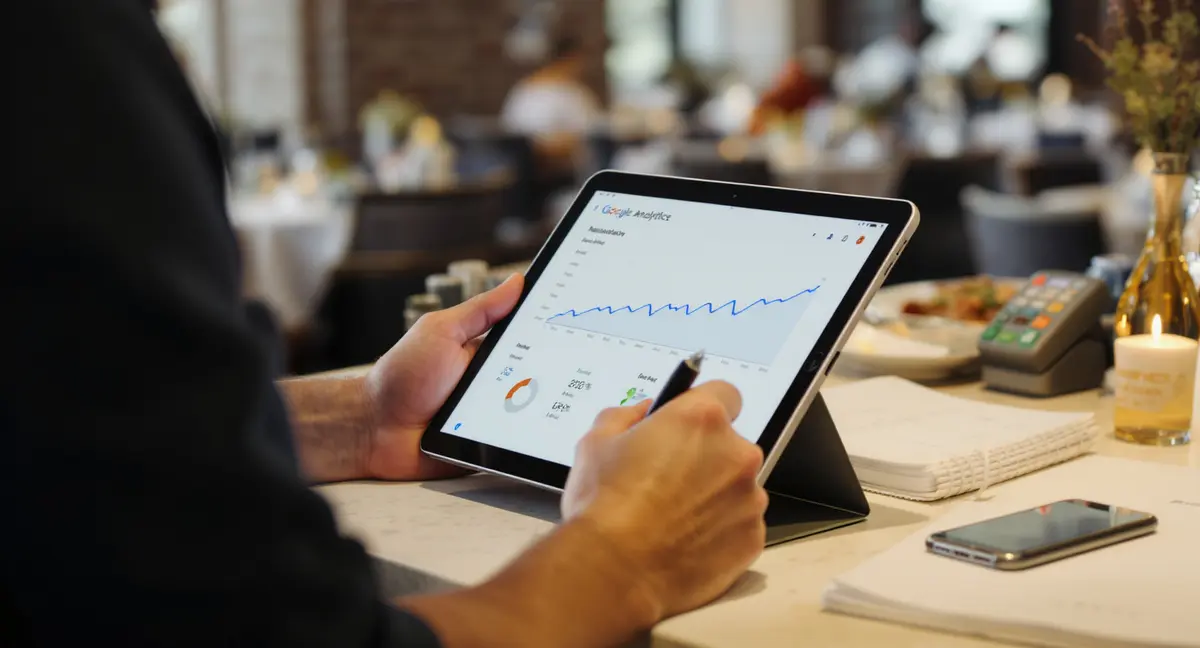
The short answer: Restaurant internet marketing requires making your restaurant discoverable across Google, AI platforms, voice search, and social channels. Combine Google Business Profile optimization, local search content, and rapid review responses within 24 hours. Focus on building owned assets rather than rented visibility, and create content that compounds over time. Restaurants with 50+ indexed pages generate 4.3x more organic traffic than those with fewer than 10 pages.
Restaurant internet marketing has become the difference between a packed dining room and empty chairs. When 93% of diners check a restaurant online before visiting (BrightLocal, 2025), your digital presence isn't optional anymore. It's the front door to your business. Yet most restaurant owners are still throwing money at tactics that worked five years ago while their competitors show up first in Google searches, AI recommendations, and voice assistant results. If you're struggling to appear in these AI-generated answers, AI search optimization requires a fundamentally different approach than traditional SEO.
The field shifted dramatically when AI search tools started answering dining queries directly. Ask ChatGPT "where should I eat tonight in Austin" and it cites three restaurants by name. If yours isn't one of them, you're invisible to an entire generation of diners. Traditional restaurant internet marketing focused on Yelp reviews and Facebook posts. That's no longer enough. You need a system that makes your restaurant discoverable across Google, AI platforms, voice search, and social channels simultaneously.
This article breaks down what in fact works in restaurant internet marketing right now. You'll see the tactics that drive reservations, the mistakes that waste budget, and the infrastructure changes that separate restaurants with consistent traffic from those constantly chasing the next marketing trend.
Why Restaurant Internet Marketing Costs More But Delivers Less Than It Did Three Years Ago
The average restaurant spends $1,200 to $3,500 monthly on digital marketing services (Restaurant Business Online, 2024). Most see minimal return because the fundamentals changed and their agency didn't tell them. What worked in 2022 stopped working when Google rolled out AI Overviews to 50% of all search queries (DemandSage, 2025). Now when someone searches "best Italian restaurant near me," they often get an AI-generated answer that cites three establishments. Traditional SEO tactics don't get you into that answer.
The Hidden Cost of Rented Visibility
Most restaurants rent their online visibility through monthly retainers with marketing agencies or subscription platforms. When you stop paying, everything stops. Your content disappears. Your rankings drop. You're back to square one. Industry data shows 38% annual churn at SEO agencies (Focus Digital, 2025), meaning more than one-third of clients leave every year. When they do, they take nothing with them because the agency owns the process, the content, and the data.
This is what that looks like in practice. A steakhouse in Denver pays $2,400 monthly for SEO and content. After 18 months and $43,200 invested, they cancel because they can't measure ROI. The agency takes down the blog they built on their subdomain. The Google Business Profile optimization stops. Rankings decline within 60 days. The restaurant has nothing to show for nearly $50,000 except a temporary traffic spike that evaporated the moment the contract ended.
Why Most Restaurant Internet Marketing Focuses on the Wrong ChannelsThe typical restaurant marketing package emphasizes social media posting and paid ads. Both have a place, but neither builds long-term visibility. Social posts disappear into feeds within hours. Paid ads work only while you're paying. Research from HubSpot shows companies that blog get 55% more website visitors (HubSpot State of Marketing, 2024), yet most restaurant internet marketing plans include zero owned content strategy.
The result? Restaurants end up dependent on platforms they don't control. Instagram changes its algorithm and reach drops 40% overnight. Google Ads gets more expensive every quarter. Yelp holds reviews hostage unless you advertise. Meanwhile, the restaurant down the street that invested in owned content ranks first for "best brunch in your area" and gets 200 organic visitors per week without paying for ads.
The Five Components of Effective Restaurant Internet Marketing in 2026
Successful restaurant internet marketing now requires five integrated components working together. Miss one and the entire system underperforms. Most restaurants have two or three pieces but never connect them into a cohesive strategy. That's why they see sporadic results instead of consistent traffic growth.
| Factor | What it is | Impact |
|---|---|---|
| Google Business Profile | Complete, actively managed listing with weekly posts and monthly menu updates | 2.7x more engagement; drives local traffic more than any other asset |
| Owned Content Strategy | 50+ indexed pages targeting local search queries and real customer intent | 4.3x more organic traffic than restaurants with fewer than 10 pages |
| Review Management System | 24-hour response protocol to all reviews, positive and negative | 45% of consumers more likely to visit after seeing business respond |
| Email List Building | Monthly subscriber communication replacing rented social reach | 24% open rate and 8% click-through rate at zero recurring cost |
Google Business Profile Optimization as the Foundation
Your Google Business Profile drives more local traffic than any other single asset. When someone searches "restaurants near me" or "Italian food downtown," Google pulls from GBP data to populate results. Restaurants with complete, actively managed profiles appear in the Local Pack, those three listings at the top of mobile search results. According to BrightLocal's research, 64% of consumers have used Google Business Profile to find contact details for a local business (BrightLocal, 2024). Building these five components into a cohesive system is what separates a tactical campaign from a true restaurant marketing solution that compounds over time.
Optimization means more than claiming your listing. Update your menu monthly. Post photos weekly. Respond to every review within 24 hours. Add attributes like "outdoor seating" and "vegan options." Use the Q&A feature to answer common questions before diners ask them. Each of these signals tells Google your business is active, relevant, and trustworthy. Restaurants that post to their GBP weekly see 2.7x more engagement than those that don't (Sterling Sky, 2024).
Content That Targets How People Search for Restaurants
Most restaurant websites have five pages: Home, Menu, About, Contact, Reservations. That's not enough content to rank for the queries diners use. People search "best date night restaurants in your area," "where to eat before a concert downtown," "restaurants with gluten-free options near your neighborhood." If you don't have content targeting those queries, you're invisible.
Effective restaurant internet marketing includes publishing content that answers real search intent. Write about your neighborhood. Explain your sourcing philosophy. Create guides to pairing wine with your menu items. Cover local events and where to eat before them. Each piece of content is an entry point for a different customer segment. The compound effect matters more than any single post. Restaurants with 50+ indexed pages get 4.3x more organic traffic than those with fewer than 10 pages (Backlinko, 2024).
Common Mistakes That Sabotage Restaurant Internet Marketing Efforts
Three mistakes kill more restaurant internet marketing campaigns than anything else. They're so common that most restaurant owners don't realize they're problems until they've already wasted months and thousands of dollars. Avoiding these traps matters more than any individual tactic.
Ignoring Reviews or Responding Defensively
Online reviews directly impact revenue. A one-star increase on Yelp leads to a 5-9% increase in revenue (Harvard Business School). Yet many restaurants either ignore reviews entirely or respond defensively to negative feedback. Both approaches damage trust. Diners read reviews to gauge how a restaurant handles problems, not just to see if the food is good.
The correct approach: respond to every review, positive and negative, within 24 hours. Thank positive reviewers by name and mention specific details from their review. For negative reviews, acknowledge the issue, apologize without making excuses, and offer to make it right offline. Never argue. Never dismiss. Research shows that 45% of consumers are more likely to visit a business that responds to negative reviews (ReviewTrackers, 2024). The response matters more than the review itself.
Building Your Presence on Platforms You Don't Own
Instagram, Facebook, TikTok, these platforms are valuable for engagement, but they're rented land. You don't own your follower list. You can't export your content. If the platform changes its algorithm or shuts down your account, you lose everything. Restaurant internet marketing should prioritize owned assets first: your website, your email list, your Google Business Profile. Social media amplifies those assets. It doesn't replace them.
Consider this scenario. A taco shop in Portland builds a 15,000-follower Instagram account over two years. Instagram updates its algorithm and organic reach drops from 12% to 3%. The restaurant now reaches 450 people per post instead of 1,800. They have to pay to reach their own followers. Meanwhile, a competing restaurant invested in email marketing and owns a list of 3,200 subscribers. They send a monthly email with a 24% open rate and 8% click rate. That's 768 people seeing their message every month, and it costs nothing after the initial setup.
How to Build a Restaurant Internet Marketing System That Compounds Over Time
The difference between a campaign and a system is permanence. Campaigns end. Systems compound. Most restaurant internet marketing is campaign-based: run ads for a month, post on social for a quarter, try influencer marketing for a season. Each effort produces a temporary spike followed by a decline back to baseline. A system produces results that build on themselves. The alternative is investing in restaurant marketing software that lets you own your customer data and visibility infrastructure instead of renting it monthly.
Start With a Content Calendar Tied to Local Search Intent
Identify the 20-30 search queries your ideal customers use when looking for restaurants like yours. Map those queries to content topics. Build a publishing calendar that covers each topic over six months. Publish consistently, weekly is ideal, biweekly is acceptable. Each piece of content should target a specific query, include location-specific information, and link to your menu or reservation page.
Example queries for a farm-to-table restaurant in Nashville: "farm to table restaurants Nashville," "where to eat in East Nashville," "restaurants with vegetarian options Nashville," "best brunch spots Nashville," "Nashville restaurants with outdoor seating," "date night restaurants Nashville." Each query becomes a content piece. Over six months, you've published 24-26 articles. Each one ranks for its target query plus related long-tail variations. The cumulative effect: 300-500 new organic visitors per month by month seven, growing to 800-1,200 by month twelve.
Use Structured Data to Help AI Search Understand Your Restaurant
When AI tools like ChatGPT, Perplexity, or Google's AI Overviews answer dining queries, they pull from structured data on restaurant websites. Schema markup tells these systems what your cuisine is, what your price range is, what dietary options you offer, and what your hours are. Restaurants with proper schema implementation are 2.4x more likely to appear in AI-generated dining recommendations (enterprise SEO platform, 2025).
Implement Restaurant schema, Menu schema, and Review schema on your website. Include your full menu with prices and descriptions in structured format. Add FAQ schema for common questions like "Do you take reservations?" and "Are you family-friendly?" This isn't technical wizardry, most modern website platforms support schema plugins or have it built in. The difference is whether you're using it or not. AI search is forming its knowledge base right now. If your restaurant isn't in that knowledge base, you're invisible to an entire channel.
Ready to take the next step with Strategyc?
Our team is ready to help you achieve your goals. Get Your Free Scan.
What Results Look Like When Restaurant Internet Marketing Works
Realistic expectations matter. Most restaurant internet marketing promises are either vague ("increase your online presence") or absurdly optimistic ("triple your traffic in 30 days"). Check out what happens when you implement a sound strategy and stick with it for 6-12 months.
Months 1-3: Foundation Building With Minimal Visible Results
The first quarter is setup. You're optimizing your Google Business Profile, publishing initial content, implementing schema, and building your email list. Traffic increases are modest, maybe 10-20% over baseline. Most of that comes from GBP optimization and paid channels if you're running them. Organic search traffic from new content takes time to materialize because Google needs to index, evaluate, and rank your pages.
This is where most restaurants quit. They don't see immediate ROI and assume it's not working. In reality, you're building infrastructure. A restaurant in Chicago published 12 content pieces in the first three months and saw only 35 new organic visitors. They nearly canceled. By month six, those same 12 pieces were generating 340 visitors per month as Google recognized the site as an authority. By month twelve, traffic from those initial pieces hit 680 monthly visitors. The compound effect kicked in.
Months 4-9: Momentum Builds and Rankings Improve
This is when restaurant internet marketing starts producing measurable results. Your content begins ranking on page one for target queries. Your Google Business Profile appears in more Local Pack results. Email list growth accelerates as more people discover your content. Traffic typically increases 40-80% over baseline by month six and 100-150% by month nine (Search Engine Journal).
More importantly, the quality of traffic improves. Early visitors are often curiosity-driven. By month six, you're attracting high-intent searchers actively looking for a restaurant like yours. These visitors convert at 3-5x the rate of social media traffic (SingleGrain, 2025). A pizza restaurant in Austin saw this pattern: months 1-3 generated 180 new website visitors with a 2.1% conversion rate (3.8 reservations). Months 7-9 generated 520 visitors with a 6.8% conversion rate (35.4 reservations). Same effort, dramatically different results because the system had time to compound. These foundational elements work best when combined with proven marketing tactics for restaurant owners who need measurable revenue impact, not vanity metrics.
Where Restaurant Internet Marketing Is Headed and Why Early Movers Win
AI search is reshaping how diners discover restaurants. By the end of 2026, AI-powered search tools handled 27% of all dining-related queries (Forrester, 2025). That percentage is growing 8-12% per quarter. Within two years, AI search will be the dominant discovery channel for restaurants, surpassing traditional Google search. The restaurants that optimize for AI search now will own the top citation spots. Those that wait will fight for scraps.
Voice Search and Conversational Queries Dominate Local Discovery
Voice search already accounts for 58% of local business searches on mobile devices (Uberall, 2024). When someone asks Siri "where's a good sushi place nearby," the assistant cites one restaurant by name. Maybe two. It doesn't list ten options. The restaurant that appears first gets the customer. The others don't exist in that interaction. Voice search optimization requires natural language content, strong local signals, and schema markup that tells voice assistants exactly what you offer.
Restaurants optimizing for voice search see 3-4x higher conversion rates from voice-referred traffic compared to traditional search traffic (Stone Temple, 2024). Why? Because voice queries have higher intent. Someone typing "sushi restaurants" might be researching. Someone asking their phone "where should I get sushi right now" is ready to go. Restaurant internet marketing strategies that ignore voice search are leaving money on the table.
Owned Content Systems Replace Agency Retainers
The shift from rented to owned visibility is accelerating. Restaurants are realizing that paying $2,000 per month indefinitely for marketing services makes less sense than installing a content system they own permanently. Platforms like Strategyc take this approach by installing owned content systems rather than offering monthly retainers. The restaurant pays once, owns the infrastructure, and keeps producing results after the engagement ends. It's a fundamentally different model than the agency-dependency approach that's dominated restaurant internet marketing for the past decade.
This matters because the ROI math changes completely. An $18,000 installed system that produces results for three years costs $500 per month amortized. A $2,000 monthly retainer costs $72,000 over the same period and stops working the moment you stop paying. More restaurants are doing this math and choosing ownership over dependency.
How to Choose Between Building Restaurant Internet Marketing In-House vs Hiring Help
Most restaurants face this decision: build internal capability or hire an agency. Both options work, but they require different resources and produce different outcomes. The wrong choice wastes money. The right choice depends on your capacity, budget, and timeline.
When In-House Restaurant Internet Marketing Makes Sense
Building in-house works if you have someone with 10+ hours per week to dedicate to content creation, SEO, and profile management. That person needs baseline digital marketing knowledge or the willingness to learn. They need access to basic resources like a website content management system, photo editing software, and analytics platforms. If those conditions exist, in-house can be cost-effective.
The tradeoff is speed. Learning effective restaurant internet marketing takes 6-9 months of trial and error. You'll make mistakes. You'll waste time on tactics that don't work. You'll eventually figure it out, but you'll lose a year of potential traffic growth in the process. For restaurants with tight margins and immediate visibility needs, that delay is expensive. For restaurants with more time than money and an internal champion who wants to own the skill, in-house makes sense.
When Hiring External Expertise Accelerates Results
External help makes sense when speed matters, when internal capacity doesn't exist, or when you want to skip the learning curve. The key is choosing the right type of help. Traditional agencies charge monthly retainers and create dependency. You pay forever or lose everything. A better model: hire someone to install the system, train your team, and hand over ownership. You pay once, learn the process, and own the infrastructure. These same principles of owned content and local search optimization apply across service industries, which is why electrician marketing faces identical challenges with AI visibility and rented platforms.
Look for partners who prioritize knowledge transfer over dependency. Ask: "What do I own when this engagement ends?" If the answer is "nothing, you need to keep paying us," walk away. If the answer is "a publishing system, optimized profiles, documented processes, and the ability to maintain it yourself," that's a partnership worth considering. The best restaurant internet marketing investments are the ones that keep working after you stop paying.
The Bottom Line on Restaurant Internet Marketing That Works
Restaurant internet marketing in 2026 requires owned infrastructure, not rented campaigns. The restaurants winning right now have optimized Google Business Profiles, publish consistent content targeting local search queries, and appear in AI search results. They own their visibility instead of renting it month-to-month from agencies. The shift from traditional SEO to AI-optimized content is happening now. Early movers capture the top citation spots. Late movers fight for the leftovers.
Three things matter most: optimize your Google Business Profile aggressively, publish content that targets real search queries, and implement schema markup so AI systems understand your restaurant. Do those three things consistently for six months and you'll see measurable traffic growth. Do them for twelve months and you'll own visibility that compounds indefinitely. The alternative is continuing to pay for temporary spikes that disappear the moment you stop writing checks.
Frequently Asked Questions About Restaurant Internet Marketing
How long does it take to see results from restaurant internet marketing?
Most restaurants see initial traffic increases within 60-90 days from Google Business Profile optimization. Organic search traffic from content typically takes 4-6 months to materialize as Google indexes and ranks new pages. Full compound effects appear around month 9-12 when multiple content pieces rank simultaneously.
What's a realistic budget for restaurant internet marketing if I'm doing it in-house?
Most restaurants underestimate the time commitment and abandon efforts after 2-3 months.
Can I measure ROI from organic content and SEO?
Yes, but it requires proper tracking. Use UTM parameters on content links, set up goal tracking in Google Analytics, and connect online traffic to reservation or order volume. Track "organic search" traffic separately from paid channels. Compare monthly reservation volume before and after implementation. Most restaurants see 15-25% reservation increases within 6 months of consistent content publishing (Restaurant Business Online, 2024).
Do I need to be on every social media platform for restaurant internet marketing?
No. Most restaurants succeed with 1-2 platforms where their audience in fact spends time. Instagram and Facebook work for most. TikTok works for younger demographics. LinkedIn rarely works for restaurants. Focus on owned assets (website, email, Google Business Profile) first. Social media amplifies those assets, it doesn't replace them. Posting inconsistently on five platforms produces worse results than posting consistently on one.
What does it take to own my visibility infrastructure instead of renting it?
Ownership requires three things: a website you control (not a subdomain on an agency's site), content published on your own domain, and documented processes your team can execute. You need access to your Google Business Profile, your analytics, and your content management system. When the marketing engagement ends, you should retain everything: the content, the rankings, the systems. If you lose access when you stop paying, you're renting, not owning.