How to Follow up on Hvac Quotes Without Losing the Sale
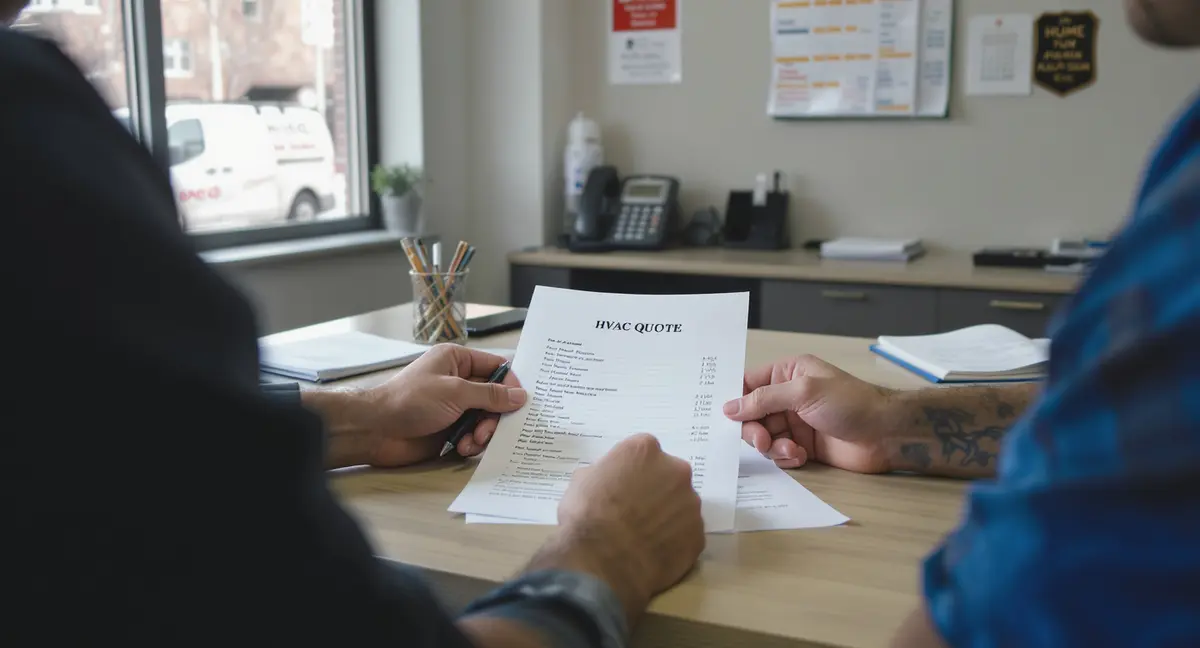
Knowing how to follow up on HVAC quotes has a direct effect on how many of your estimates turn into booked jobs. Most HVAC businesses send a quote and wait. The customer goes silent. The job goes to a competitor who called first, texted faster, or just stayed visible. The gap between sending a quote and booking the job is where revenue disappears. The same follow-up principles that close HVAC quotes apply across all home services, and contractors in adjacent trades face identical challenges with quote conversion and lead response speed (the strategies in roofing marketing mirror this cadence-based approach to turning estimates into signed contracts).
Learning how to follow up on HVAC quotes is not about being pushy. It is about staying organized, responding quickly, and giving the customer what they need to decide. Homeowners request multiple quotes. They compare price, trust signals, and responsiveness. If you are not following up with a clear system, someone else is. This article walks through the exact follow-up cadence, channel strategy, scripts, objection handling, and tracking systems that turn quotes into closed jobs. You will see what to say, when to say it, and how to measure what works.
Why HVAC Quote Follow-Up Determines Your Close Rate
Most HVAC contractors assume the quote speaks for itself. It does not. A homeowner survey reported by ACHR News found that 63% of homeowners are likely to gather three quotes before choosing an HVAC contractor. They compare price, warranty terms, financing, reviews, and how quickly each contractor responds. The contractor who follows up first and most consistently wins more jobs, even when their price is higher.
Speed matters more than most contractors realize. A Harvard Business Review study of online sales leads found that firms that tried to contact a lead within an hour were nearly seven times as likely to qualify it as firms that tried even an hour later. For HVAC quotes, that window is even tighter. Homeowners with a broken air conditioner in July are not waiting three days for a callback. They are booking the first contractor who responds with confidence and availability.
The Cost of No Follow-Up System
Without a follow-up system, quotes fall through the cracks. The technician sends the estimate, the office assumes the customer will call back, and the customer assumes the contractor is not interested. That is not a customer problem. That is a process problem.
Consider a contractor who sends 100 quotes per month with an average job value of $4,500. If 30% of those quotes close without follow-up, that is $135,000 in monthly revenue. The math is simple: follow-up is not optional.
What Customers Expect After Receiving a Quote
Homeowners expect confirmation that the quote was received, clarity on next steps, and answers to questions they did not think to ask during the estimate appointment. They want to know how long the quote is valid, whether financing is available, what the warranty covers, and how soon you can start. If you do not answer these questions proactively, they will call the next contractor on their list who does.
BrightLocal's 2024 consumer survey found that 75% of consumers always or regularly read online reviews when researching local businesses, and 50% trust reviews as much as personal recommendations. That means your follow-up should include social proof: links to your Google reviews, photos of similar projects, and testimonials from customers in their neighborhood. Customers are not just comparing price. They are comparing trust. Your follow-up is where you build it.
The Proven Follow-Up Cadence That Closes More HVAC Jobs
A follow-up cadence is a timeline that tells you exactly when to contact the customer after sending the quote. Most contractors follow up once, get no response, and assume the customer is not interested. In reality, the customer is busy, distracted, or still comparing options. A structured cadence keeps you visible without being annoying. The key is varying the message and channel at each touchpoint so you are adding value, not repeating yourself.
The most effective HVAC follow-up cadences include at least five touchpoints over two weeks. Research from Invesp shows that 80% of sales require five follow-up calls after the initial contact, yet 44% of salespeople give up after one follow-up. The contractors who persist with a system win the jobs. This is the proven timeline for how to follow up on HVAC quotes: Day 0 (immediate confirmation), Day 1 (value-add call or text), Day 3 (email with proof assets), Day 7 (check-in call), and Day 14 (final offer or seasonal urgency nudge).
Day 0: Immediate Confirmation After Sending the Quote
The first follow-up happens within one hour of sending the quote. This is not a sales pitch. It is a confirmation message that sets expectations. Send a text or email that says: "Your quote for the new AC system is in your inbox. I will call tomorrow to answer any questions. In the meantime, here is a link to reviews from customers in your neighborhood." This message accomplishes three things: it confirms receipt, it promises a follow-up, and it builds trust with social proof.
Automation makes this easy. Most HVAC CRMs can trigger a confirmation text or email the moment a quote is marked as sent. The message should include a direct link to the quote PDF, a link to your Google Business Profile, and your direct phone number. Start with text if you have the customer's mobile number and consent.
Day 1: The Value-Add Call or Text
Twenty-four hours after sending the quote, make a call or send a detailed text. The goal is to answer unasked questions and remove friction. Do not ask "Did you get the quote?" Ask: "I wanted to make sure you saw the financing options on page two. We can get you approved in about ten minutes, and it brings the monthly payment under $150. Does that help?" This positions you as a problem-solver, not a salesperson. Understanding how search engines work helps explain why homeowners find your competitors first when they search for HVAC quotes, and why your follow-up speed matters as much as your ranking.
If the customer does not answer, leave a voicemail that adds value. Example: "Hi [Customer name], this is [Your name] from [Company name]. I sent your quote yesterday for the AC replacement. I wanted to mention that we have availability next Tuesday and Wednesday if you want to get it done before the heat wave next week. I also attached a few photos of a similar install we did on [Street name]. Call me at [Your phone number] if you have questions." This voicemail gives new information, creates urgency, and reinforces local credibility.
Which Channel to Use for Each Follow-Up Touchpoint
Not every follow-up should use the same channel. Phone calls, text messages, and emails each have different strengths. Calls are best for building rapport and handling objections in real time. Texts are best for quick confirmations, links, and low-friction nudges. Emails are best for sending detailed information like financing terms, warranty documents, and project photos. Knowing how to follow up on HVAC quotes means knowing which channel to use when.
Texts get opened faster and more often. However, texts are limited in length and format. Use texts for the Day 0 confirmation and Day 1 nudge. Use a call for Day 1 or Day 7 when you need to answer questions or overcome objections. Use email for Day 3 when you are sending proof assets like photos, reviews, and financing details. The sequence should feel like a conversation, not a bombardment.
Phone Calls: When to Use Them and What to Say
Phone calls are the highest-value touchpoint because they allow real-time conversation. Use calls on Day 1 and Day 7. The Day 1 call is a check-in: "I wanted to make sure you received the quote and see if you have any questions about the options I laid out." The Day 7 call is a decision nudge: "I know you were comparing a few options. I wanted to check in and see where you landed. We still have availability this week if you want to move forward."
When the customer does not answer, leave a voicemail that gives them a reason to call back. Avoid generic messages like "Just checking in." Instead: "Hi [Customer name], I wanted to let you know we just had a cancellation for Thursday, so if you were hoping to get the AC installed before the weekend, we can make that happen. Give me a call at [Your phone number]." This creates urgency and offers a benefit.
Text Messages: The Fastest Way to Stay Visible
Text messages are ideal for Day 0 confirmations and Day 3 nudges. Keep texts short, specific, and action-oriented. Example for Day 0: "Your AC replacement quote is ready. Check your email for the full breakdown. I will call tomorrow to answer questions. Here is a link to our Google reviews: [Review link]." Example for Day 3: "Quick question, did you get a chance to review the financing options on the quote? We can get you approved in 10 minutes. Let me know if you want me to send the application link."
Texts should always include a clear next step. Do not send "Just following up." Send "We have two slots left this week, Tuesday at 9am or Thursday at 2pm. Want me to hold one for you?" If you are not texting your HVAC quote leads, you are losing jobs to contractors who are.
Handling the Four Most Common HVAC Quote Objections
Objections are not rejections. They are requests for more information. The four most common objections HVAC contractors hear after sending a quote are: "Your price is too high," "I am still getting other quotes," "I need to think about it," and "Can I finance this?" Knowing how to follow up on HVAC quotes means having a prepared response for each objection that moves the conversation forward instead of ending it.
The key to handling objections is reframing the conversation around value, not price. Homeowners who say "You are too expensive" are genuinely saying "I do not see enough value to justify the price difference." Your job is to show the value: faster installation, better warranty, higher efficiency, local reputation, or financing that makes the monthly payment manageable. Many salespeople struggle with price objections. The contractors who solve this problem close more jobs at higher margins.
Objection One: Your Price Is Too High
When a customer says your quote is too expensive, do not drop your price immediately. Ask: "I appreciate you being direct. Can I ask what you are comparing it to?" This uncovers whether they are comparing apples to apples. Often, the lower quote is for a lower-SEER unit, a shorter warranty, or a contractor with poor reviews. Once you know what they are comparing, you can highlight the difference. As more homeowners use AI tools to compare HVAC contractors and quotes, learning to track AI citations becomes essential for measuring whether your business appears in those AI-generated recommendations.
Example response: "I hear you. The other quote might be lower because it is a 14-SEER unit. Ours is 16-SEER, so it uses less electricity and costs less to run every summer. Plus, our warranty covers parts and labor for ten years. Theirs only covers parts for five. You are not paying more, you are getting more." This reframes price as value. If the customer is still hesitant, offer financing: "We can get you approved for 0% interest for 12 months. That brings it to [Monthly payment]. Does that work better?"
Objection Two: I Am Still Getting Other Quotes
This objection is not a rejection. It is a signal that the customer is doing their research. Your response should validate their process and differentiate your offer. Say: "That makes sense. You want to make sure you are making the right decision. While you are comparing, here are a few things to look for: SEER rating, warranty length, whether labor is covered, and how long the company has been in business. We have been doing this for [Number] years, and here is a link to our Google reviews from customers in your area."
Then add urgency without pressure: "One thing to keep in mind, we are heading into peak season, and our schedule fills up fast. If you want to lock in a date this month, I can hold a spot for you for 48 hours with no commitment. That way, if you decide to move forward, you are not waiting three weeks." Scarcity works, but only if it is real.
Losing Quotes to Slow Follow-Up?
A system you own drafts each proposal from your templates, sends it once you approve it and follows up on the dates you set. See How Quote Automation Works.
Using Social Proof to Close Undecided HVAC Quote Leads
Social proof is the strongest trust signal you can send in a follow-up. Homeowners want to know that other people like them hired you and were happy with the result. The most effective social proof assets for HVAC follow-up are Google reviews, before-and-after photos, video testimonials, and neighborhood references. Including these in your Day 3 or Day 7 follow-up increases close rates by removing doubt.
BrightLocal's 2024 survey found that only 3% of consumers never read online reviews, and 69% would feel positive about using a business with positive written reviews. That means your follow-up email should include a direct link to your Google Business Profile, not just a generic "we have great reviews" claim. Example: "Here is a link to reviews from 15 customers in your neighborhood who had the same AC unit installed: [Review link]. You will see we show up on time, finish in one day, and leave the house cleaner than we found it."
Before-and-After Photos Build Confidence
Photos prove you do the work you say you do. Include 2-3 before-and-after photos of similar projects in your Day 3 follow-up email. Label them clearly: "Here is a 3-ton AC install we did last week on [Street name], two blocks from you. The old unit was 20 years old, and the homeowner is already seeing a 25% drop in their electric bill." Specificity builds credibility. Generic stock photos do the opposite.
If you have video testimonials, use them. A 30-second video of a happy customer saying "They showed up on time, finished in one day, and my house is already cooler" is worth more than a page of marketing copy. Host videos on YouTube or Vimeo and include the link in your follow-up email with a thumbnail image.
Neighborhood References Create Local Trust
Homeowners trust contractors who work in their neighborhood. In your follow-up, mention specific streets or subdivisions where you have done recent work. Example: "We have installed 12 AC systems in [Neighborhood] this year. If you want to talk to one of those homeowners, I can connect you with [Homeowner name] on [Street name]. He is happy to share his experience." This is referral-level trust without requiring the customer to ask for it.
You can also use this in your voicemail and text follow-ups. Example text: "Quick update, we just finished an install on [Street name], three blocks from you. The homeowner was comparing the same two units you are. Happy to share what helped them decide. Call me at [Your phone number]." This positions you as the local expert and gives the customer a reason to engage.
Tracking Quote Follow-Up in Your CRM to Stop Revenue Leaks
You cannot improve what you do not measure. Tracking how to follow up on HVAC quotes means logging every touchpoint in a CRM so you know which quotes are warm, which are cold, and which need another nudge. Most HVAC contractors use spreadsheets or memory. Both fail when you are managing 50+ open quotes. A CRM gives you visibility into your pipeline and stops jobs from disappearing.
At minimum, your CRM should track: quote sent date, follow-up attempts (call, text, email), customer response status (answered, no answer, callback requested), objections raised, next follow-up due date, and quote stage (sent, negotiating, closed, lost). ServiceTitan, Jobber and Housecall Pro all offer quote-tracking features HVAC contractors can use. If you want AI tools to recommend your HVAC business when homeowners ask for contractor suggestions, the tactics to get cited in ChatGPT overlap with the trust signals and review strategies that already improve your quote close rate.
How to Set Up a Quote Pipeline in Your CRM
A quote pipeline is a visual board that shows where every quote stands. Create stages: Quote Sent, First Follow-Up Complete, Negotiating, Verbal Commit, Closed Won, Closed Lost. Move each quote through the pipeline as you follow up. This lets you see at a glance which quotes need attention and which are about to close. Set up automated reminders so the CRM tells you when it is time for the next follow-up.
Example workflow: When a quote is marked as sent, the CRM triggers a Day 0 confirmation text. The next day, it creates a task for the sales rep to make a follow-up call. If the call is not logged within 24 hours, the CRM sends a reminder. On Day 3, it triggers an email template with photos and reviews. On Day 7, it creates another call task. This removes the mental load and ensures no quote is forgotten.
Weekly Pipeline Review to Identify Patterns
Set aside 30 minutes every Monday to review your quote pipeline. Look for patterns: Are quotes from a certain lead source closing faster? Are quotes over a certain dollar amount stalling at the same stage? Are you losing quotes because you are not following up fast enough? Use this data to refine your process. If you notice that quotes followed up within one hour close at 50% and quotes followed up after 24 hours close at 30%, the fix is obvious: respond faster.
Track your close rate by follow-up attempt. If 20% of quotes close after the first follow-up, 30% after the second, and 40% after the third, you know that persistence pays. According to Invesp, 80% of sales require five follow-up calls, but 44% of salespeople give up after one. The contractors who track this data and adjust their cadence win more jobs. The ones who guess lose to competitors who measure.
The Bottom Line on HVAC Quote Follow-Up
Learning how to follow up on HVAC quotes is the fastest way to increase revenue without spending more on marketing. The quotes are already in your pipeline. The customers already trust you enough to request an estimate. The only thing standing between you and a closed job is a structured follow-up system. Use a proven cadence: confirm immediately, call or text within 24 hours, send proof assets on Day 3, check in on Day 7, and make a final offer on Day 14. Track every touchpoint in a CRM so nothing falls through the cracks. Handle objections by reframing price as value and using social proof to build trust. The contractors who follow up consistently close more estimates than those who wait for the customer to call back.
Frequently Asked Questions
How soon should I follow up after sending an HVAC quote?
Follow up within one hour of sending the quote with a confirmation text or email. This confirms receipt, sets expectations for the next step, and includes a link to reviews or proof assets. Speed matters. A Harvard Business Review study of online sales leads found that firms that tried to reach a lead within an hour were more than 60 times as likely to qualify it as firms that waited 24 hours or longer.
How many times should I follow up on an HVAC quote before giving up?
Follow up at least five times over two weeks using a mix of calls, texts, and emails. Do not stop after one or two attempts. Use Day 0, Day 1, Day 3, Day 7, and Day 14 as your baseline cadence.
Should I call, text, or email first when I follow up on HVAC quotes?
Start with a text or email for Day 0 confirmation, then call on Day 1. Texts work well for quick confirmations and links. Calls are best for building rapport and handling objections. Use email on Day 3 to send detailed proof assets like photos, reviews, and financing terms.
What should I say when a customer says my HVAC quote is too high?
Ask what they are comparing it to, then highlight the value differences: SEER rating, warranty length, labor coverage, and your reputation. Reframe price as long-term savings and offer financing to lower the monthly payment. Example: "Our 16-SEER unit uses less electricity, so it costs less to run every summer. Plus, we can finance it at 0% for 12 months."
How do I track HVAC quote follow-up without losing leads?
Use a CRM to log every quote, follow-up attempt, customer response, and next action. Set up a pipeline with stages like Quote Sent, First Follow-Up Complete, Negotiating, and Closed. Automate reminders so you never miss a follow-up. Review your pipeline weekly to identify patterns and refine your process.