Free SEO Audit: What You Get (And What You Don't)
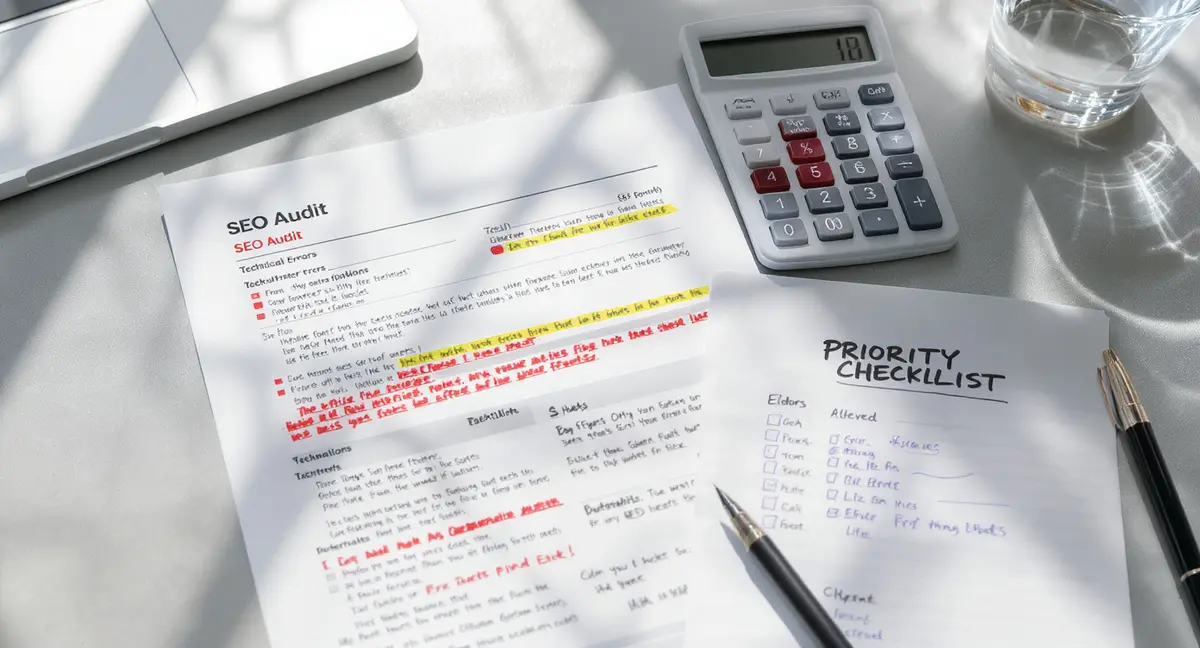
A free SEO audit promises to reveal what's holding your website back from ranking. But most business owners run these scans, download the PDF, and still have no idea what to fix first. The problem isn't the audit, it's what happens after. You get a list of 47 technical errors, zero context about which ones matter, and no roadmap for what to do next. A free SEO audit is a starting point, not a strategy. If your content isn't structured for AI extraction, you're invisible in the channel that's growing fastest, which is why businesses are turning to AI search optimization to bridge the gap between traditional SEO and generative engine visibility.
The gap between "here's what's broken" and "here's how to fix it profitably" is where most SEO investments fail. According to Firework's 2025 research, only 8% of marketers feel confident they can measure SEO ROI. That's because audits show symptoms, not causes. They flag missing alt tags and slow load times but don't explain why your competitor ranks first while you're stuck on page three.
This article breaks down what a free SEO audit actually covers, what it misses, and how to turn diagnostic data into a system that compounds visibility over time. You'll see what the tools check, what they ignore, and how to prioritize fixes that move revenue instead of just checking boxes.
What a Free SEO Audit Actually Checks
Most free SEO audit tools scan your site for technical health markers: crawlability, indexation status, broken links, and page speed. They're looking for the structural issues that prevent Google from reading and ranking your content. Tools like SEOptimer analyze over 100 data points across technical, on-page, and off-page factors. keyword research platform's Site Audit crawls for HTTPS errors, canonicalization problems, and Core Web Vitals failures. These scans catch the obvious blockers, 404 errors, missing meta descriptions, duplicate content, but they stop short of strategy.
A free audit tells you what's broken. It doesn't tell you what's working, what your competitors are doing differently, or which fixes will actually move the needle. Backlinko's 2024 research found that position one in Google gets a 27.6% click-through rate. Position two gets 15.8%. That gap isn't caused by a missing alt tag. It's caused by content depth, topical authority, and user intent alignment, things a free scan doesn't measure.
Technical SEO Checks: The Foundation
Technical audits focus on crawl efficiency and site architecture. They check whether Google can access your pages, whether your XML sitemap is valid, and whether your robots.txt file is blocking important content. They flag redirect chains, orphaned pages with no internal links, and server response codes that signal problems. Core Web Vitals, Largest Contentful Paint (LCP), Interaction to Next Paint (INP), and Cumulative Layout Shift (CLS), are confirmed ranking factors, and most free audits now include performance scores.
The problem is prioritization. A free SEO audit might flag 30 technical issues, but it won't tell you that fixing your mobile load time will drive more traffic than fixing hreflang tags you're not using. enterprise SEO platform data shows organic search drives 53% of all trackable website traffic. If your technical foundation blocks that traffic, nothing else matters. But if your site is already crawlable and fast, obsessing over technical perfection is a distraction from content and authority work.
On-Page and Content Analysis
Free audits scan title tags, meta descriptions, heading structure, and keyword usage. They check for thin content (pages under 300 words), duplicate content across URLs, and missing structured data. Some tools flag keyword stuffing or missing internal links. The HOTH's audit tool, for example, reviews HTML structure, meta tags, and alt text as part of its automated scan. These checks are useful for catching lazy mistakes, pages with no H1, product pages with identical descriptions, blog posts with no meta.
What they don't check: whether your content actually answers the search intent behind your target keywords. A page can pass every on-page test and still rank nowhere because it's targeting the wrong intent or lacks the depth competitors provide. HubSpot's 2024 State of Marketing report found that companies publishing consistent blog content get 55% more website visitors. But "consistent" doesn't mean "thin." B2B buyers consume 3-7 pieces of content before engaging sales, according to Demand Gen Report. A free audit won't tell you if your content earns that engagement or just fills space.
What Free Audits Miss (And Why It Matters)
A free SEO audit is a diagnostic snapshot, not a strategic assessment. It tells you what's broken today but doesn't explain why you're not ranking, why traffic dropped last quarter, or why competitors with worse technical scores outrank you. The missing layer is competitive context, content quality evaluation, and AI search readiness. These gaps are where businesses waste months fixing the wrong things. If you need a more comprehensive framework for evaluating crawl efficiency and site architecture, a technical SEO audit checklist breaks down every diagnostic point that affects how Google reads and ranks your pages.
Search Engine Journal reports that SEO leads close at 14.6%, compared to 1.7% for outbound leads. That conversion advantage only matters if you're visible in the first place. And in 2026, visibility means more than Google's blue links. According to DemandSage, 50% of Google queries now trigger AI Overviews, and those overviews cause a 61% drop in organic click-through rates for traditional results. If your free audit doesn't assess how your content appears in AI-generated answers, you're optimizing for a search field that's already outdated.
Competitive Positioning and Content Gaps
Free tools don't compare your site to the competitors ranking above you. They don't show you what topics your competitors cover that you don't, or which keywords they rank for that you're missing. They don't analyze backlink profiles in depth or identify why a competitor with fewer links outranks you. That context is what separates a checklist from a strategy.
Consider a business ranking fourth for a high-intent keyword. A free SEO audit might show a clean technical profile and solid on-page optimization. What it won't show: the top three results all publish 2,500-word guides with original data, while your page is a 600-word service description. Content Marketing Institute's 2024 research found that the average content marketing budget is 26% of total marketing spend. If you're investing in content that doesn't match competitive depth, that 26% compounds losses instead of gains.
AI Search and Generative Engine Visibility
Most free SEO audit tools were built for traditional search. They check title tags and meta descriptions, elements that matter less when ChatGPT, Perplexity, and Google's AI Overviews pull answers directly from page content without showing the title. enterprise SEO platform's 2025 data shows early AI search adopters are seeing 120x impression increases and 800% year-over-year traffic growth from large language models. Visitors sourced from AI search convert at 27%, compared to 2.1% from traditional organic search (SingleGrain, 2025).
A free audit won't tell you if your content is structured for AI extraction. It won't check for schema markup that helps AI models parse your expertise, or whether your FAQ sections use clear question-answer formatting that LLMs can cite. It won't assess whether your content includes the factual density and citations that AI models prioritize. Research from Princeton and Georgia Tech (KDD 2024) found that structured content with citations improves AI visibility by 30-40%. If your audit doesn't measure this, you're flying blind in the channel that's growing fastest.
How to Run a Free SEO Audit That Actually Helps
Running a free SEO audit is easy. Turning that audit into actionable priorities is hard. The goal isn't to fix every error the tool flags. The goal is to identify the 3-5 issues blocking your most valuable traffic, then build a plan to fix them in order of impact. Start with crawlability and indexation. If Google can't access your pages, nothing else matters. Then move to performance and user experience. Then content and authority.
Use Google Search Console as your baseline. It's free, it shows exactly what Google sees, and it surfaces the issues Google cares about, indexation errors, mobile usability problems, Core Web Vitals failures, and security issues. Pair that with a free audit tool to catch technical details Search Console doesn't flag. Then layer in manual review of your top-performing pages and your competitors' top-ranking content. The combination gives you diagnostic data plus strategic context. Building a repeatable system for prioritizing fixes is easier when you start with a technical SEO audit template that separates critical blockers from low-impact noise.
Step-by-Step: Running Your First Audit
Start by defining what you're auditing and why. Are you diagnosing a traffic drop? Preparing to launch new content? Evaluating whether your current SEO investment is working? Your goal shapes what you prioritize. Enter your URL into a free audit tool, options include browser-based scanners that require no signup or more detailed tools that generate PDF reports. Let the scan complete, then download or review the results.
Focus on three categories first: critical errors, high-impact warnings, and quick wins. Critical errors are blockers, pages returning 404s, noindex tags on important content, or robots.txt blocking your entire site. High-impact warnings are issues that affect rankings but don't completely block visibility, slow page speed, missing alt text on key images, or thin content on high-traffic pages. Quick wins are easy fixes with visible results, updating missing meta descriptions, fixing broken internal links, or compressing oversized images. Fix critical errors immediately. Schedule high-impact warnings for the next 30 days. Batch quick wins into a single afternoon.
Interpreting Results and Prioritizing Fixes
Not all errors are equal. A free SEO audit might flag 50 issues, but five of them drive 80% of the impact. Use traffic data from Google Analytics or Search Console to weight your priorities. A missing meta description on a page that gets 10 visits a month is low priority. A slow load time on a page that gets 1,000 visits and ranks fourth for a high-intent keyword is urgent.
Build a simple impact-versus-effort matrix. Plot each issue on two axes: potential traffic or revenue impact (high, medium, low) and implementation difficulty (easy, moderate, hard). Start with high-impact, easy fixes, these are your quick wins. Then tackle high-impact, moderate-difficulty projects. Save low-impact or high-difficulty items for later, or skip them entirely if they don't serve your core business goals. Ahrefs' 2024 research found that the average SEO agency retainer for small and mid-sized businesses runs $1,500-$5,000 per month. If you're paying for SEO, demand this prioritization framework. If you're doing it yourself, this is how you avoid wasting time on irrelevant fixes.
See How Your Business Shows Up in AI Search
Get a free AI visibility scan. See exactly where you rank on ChatGPT, Perplexity, and Google AI, and what to do about it. Get Your Free Scan.
Free Audits vs Professional SEO Assessments
A free SEO audit is a health check. A professional assessment is a diagnosis with a treatment plan. Free tools catch surface-level issues, broken links, missing tags, slow pages. They don't evaluate content quality, competitive positioning, or whether your entire SEO strategy is aimed at the wrong targets. They don't tell you if your keyword targeting is too broad, too narrow, or three years out of date. They don't assess whether your internal linking structure supports topical authority or whether your site architecture makes sense for how users actually handle.
The difference shows up in outcomes. A business owner runs a free audit, sees 40 warnings, fixes them all, and ranks nowhere. Why? Because the audit didn't reveal that their competitor publishes 10x more content, targets long-tail keywords with higher intent, and earns backlinks from industry publications. Free audits are reactive. Professional assessments are strategic. The first tells you what's broken. The second tells you what to build.
When a Free Audit Is Enough
Free audits work when you have a specific, narrow question. "Is my site mobile-friendly?" "Are there broken links I need to fix?" "Is my XML sitemap formatted correctly?" They're useful for catching obvious mistakes after a site migration or redesign. They're a good quarterly health check for sites that are already performing well. If your SEO strategy is working and you just want to catch new issues before they become problems, a free audit every 90 days is enough. Once you've addressed the technical foundation, the next step is ensuring your entire optimization strategy aligns with what actually moves rankings, which is where a current SEO checklist becomes essential.
They're also enough if you're early-stage and not yet investing in content or SEO. If you're validating a business idea, a free scan tells you whether your site has deal-breaker technical issues. But if you're past product-market fit and SEO is a growth channel you're investing in, free audits become a bottleneck. You'll spend more time interpreting conflicting tool outputs than you'll save by not paying for strategic guidance.
When You Need More Than a Scan
You need a professional assessment when the free audit raises more questions than it answers. When you've fixed the flagged issues and still aren't ranking. When traffic is flat or declining and you don't know why. When you're spending $2,000-$5,000 a month on SEO and can't connect that spend to revenue. When competitors with worse "scores" consistently outrank you. These are strategy problems, not technical problems.
A professional assessment evaluates the full picture: technical health, content quality and topical coverage, competitive gaps, backlink profile, user behavior signals, and how your site performs in both traditional search and AI-generated answers. It includes a prioritized roadmap, what to fix first, what to build next, and what to ignore. Platforms like Strategyc approach this as a Growth Architecture Audit, a paid diagnostic that maps what's working, what isn't, and what to do next before you invest another dollar in content or SEO.
Building a System That Owns Visibility (Not Renting It)
A free SEO audit is a snapshot. It shows where you are today. What it doesn't build is the system that keeps you visible tomorrow, next quarter, and three years from now. Most businesses treat SEO as a service they rent, pay an agency $3,000 a month, get some blog posts and reports, hope it works. When the retainer ends, the work stops. That's not ownership. That's dependency.
Ownership means installing the infrastructure that produces visibility whether or not you're paying someone every month. It means a content system that publishes structured, AI-optimized articles on your schedule. It means internal teams or partners who understand your business well enough to write content that ranks and converts. It means tracking systems that connect content to revenue so you know what's working. The Content & Visibility Engine approach installs this infrastructure in 4-6 weeks, then hands you the keys. You own the workflows, the AI accounts, the content, and the data.
What an Owned Content System Looks Like
An owned system starts with a content architecture designed for how search actually works in 2026, not just Google's traditional blue links, but AI Overviews, ChatGPT, Perplexity, and voice assistants. That means structured articles with schema markup, FAQ sections formatted for AI extraction, factual density with citations, and expert-attributed observations. It means publishing on a consistent schedule, not because an agency contract requires it, but because the system makes it easy.
It includes quality gates built into the workflow. Every article is checked for keyword targeting, internal linking, readability, and citation accuracy before it goes live. The system tracks performance, which topics drive traffic, which pages convert, and which content gets cited in AI-generated answers. Over time, you build a compounding asset. Articles published 12 months ago still drive leads. Topics you covered early become the foundation for topical authority in related areas. Backlinko's research shows that sites with original research earn 4x more backlinks than those without. An owned system makes original research part of your regular publishing rhythm, not a one-off project.
Why Retainers Fail and Systems Compound
The SEO agency model has a structural flaw: when you stop paying, everything stops. The content lives on your site, but the strategy, the workflow, the reporting, and the optimization process all disappear. According to Focus Digital's 2025 research, SEO agencies see 38% annual client churn. That's not because the work is bad. It's because businesses can't measure ROI, can't see what they're paying for, and eventually pull the plug. The challenge isn't just fixing what's broken, it's proving that your SEO investment drives measurable returns, especially when search behaviour shifts toward AI-generated answers and traditional metrics no longer tell the full story of AI SEO ROI.
Systems compound because you own them. An article you publish this month still ranks next year. The internal linking structure you build today supports every future article. The schema markup you implement once works forever. The AI optimization techniques you learn become part of your content process. You're not renting visibility. You're building equity. And when AI search adoption accelerates, which it will, you're already positioned in the knowledge bases those models are forming right now.
The Bottom Line
A free SEO audit is a useful diagnostic tool, but it's not a strategy. It flags technical errors and surface-level issues without explaining what to fix first or why you're not ranking. Most businesses run the audit, get overwhelmed by the list of warnings, and either do nothing or waste time on low-impact fixes. The gap between "here's what's broken" and "here's how to fix it profitably" is where real SEO work happens.
If you're serious about using content and search as a growth channel, start with clarity about where you stand. Run a free audit to catch obvious blockers. Then assess whether you need a strategic evaluation that connects technical health to competitive positioning, content gaps, and AI search readiness. And if SEO is core to your business, stop renting visibility and start building the system you own. Services end. Systems compound.
Frequently Asked Questions
What does a free SEO audit actually tell me?
A free SEO audit scans your site for technical issues like broken links, slow page speed, missing meta descriptions, and crawl errors. It flags problems but doesn't prioritize them or explain which fixes will impact rankings. You get a diagnostic list, not a strategic roadmap.
How is a free audit different from a paid SEO assessment?
Free audits check technical health and surface-level on-page factors. Paid assessments evaluate content quality, competitive gaps, backlink profiles, AI search readiness, and provide a prioritized action plan. The difference is diagnosis versus strategy with implementation guidance.
Can I fix SEO issues myself after running a free audit?
Yes, if the issues are straightforward, updating meta tags, fixing broken links, compressing images. Complex problems like site architecture, content strategy, or competitive positioning require deeper expertise. Most business owners can handle quick wins but struggle with prioritization and strategic fixes.
What does it take to own my visibility infrastructure instead of renting it?
Owning visibility means installing a content system you control, workflows, publishing schedules, quality gates, and performance tracking. It requires upfront investment in infrastructure but eliminates dependency on monthly retainers. You build equity that compounds over time instead of paying rent that stops when the contract ends.
How often should I run a free SEO audit on my site?
Run a free audit quarterly if your site is performing well and you want to catch new issues early. Run one immediately after a site migration, redesign, or major content update. If you're actively investing in SEO, monthly scans help track progress and catch problems before they impact rankings.