Conversion Funnel Optimization: How to Stop Losing 97% of Your Traffic Before It Converts
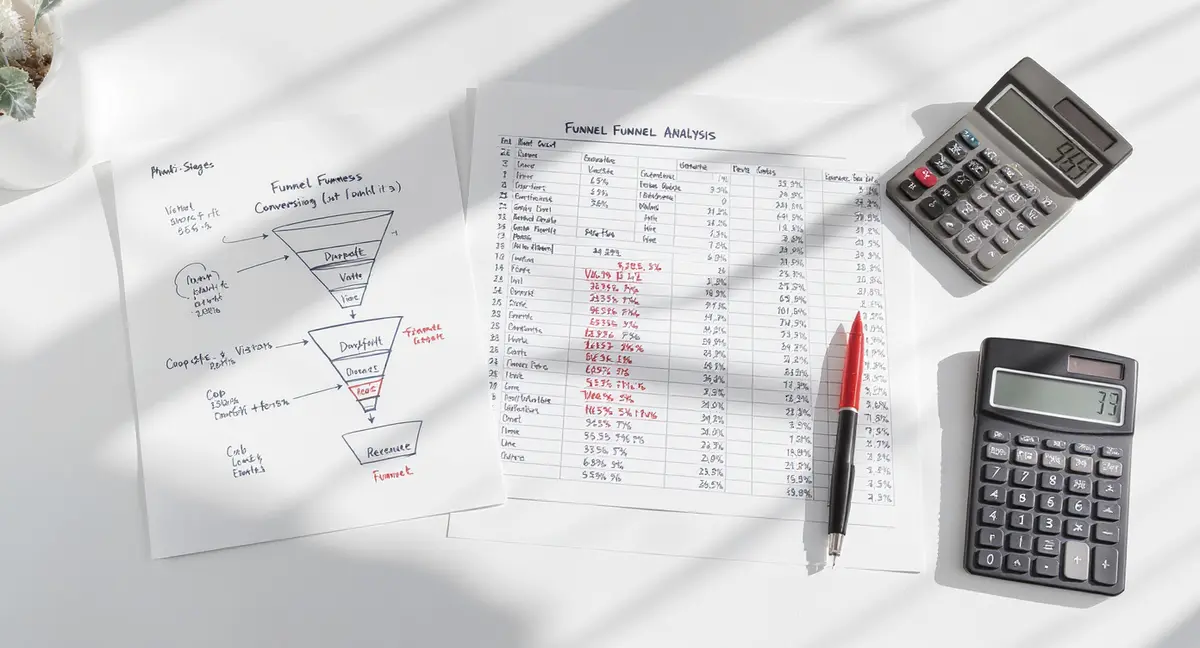
Your website traffic doesn't have a volume problem. It has a conversion funnel optimization problem. The average business loses 97% of visitors before they take any meaningful action. They land, they bounce, they're gone. You're paying to drive traffic into a funnel with holes at every stage. Conversion funnel optimization is the systematic process of identifying where visitors drop off and fixing those leaks before you spend another dollar on acquisition. The same principle applies when prospects research your category through AI tools instead of traditional search engines, which is why AI search optimization has become critical for businesses that want to appear in ChatGPT and Perplexity results.
Most businesses approach this backward. They scale traffic first, then wonder why revenue doesn't follow. The math is simple: 10,000 visitors at 1% conversion generates 100 customers. Double your traffic to 20,000 and you get 200 customers. But fix the funnel to convert at 3%, and those original 10,000 visitors generate 300 customers with zero additional ad spend. Research from Invesp shows the top 10% of companies convert at 11.45% while the bottom 25% convert below 2%. The difference isn't traffic quality. It's funnel architecture.
This article breaks down how conversion funnel optimization works, where businesses lose the most revenue, and what to fix first. You'll see how to diagnose drop-off points, reduce friction at each stage, and build a funnel that compounds results instead of burning budget. The businesses winning right now aren't outspending competitors on ads. They're converting more of what they already have.
What Conversion Funnel Optimization Actually Means
Conversion funnel optimization is the practice of analyzing each stage of the customer process and systematically improving the percentage of people who move from one stage to the next. It's not about redesigning your homepage or running more A/B tests on button colors. It's about understanding where the funnel breaks and why.
The typical funnel has four to six stages depending on business model: awareness (visitor lands), interest (engages with content), consideration (views product or pricing), intent (adds to cart or fills form), and conversion (completes purchase or books call). Each transition is a decision point. Each decision point has friction. Conversion funnel optimization identifies that friction and removes it.
The Difference Between CRO and Funnel Optimization
Conversion rate optimization (CRO) typically focuses on individual page performance. You test headlines, CTAs, form fields, images. Funnel optimization looks at the entire path. A visitor might convert beautifully on your landing page but abandon at checkout because shipping costs appear too late. That's a funnel problem, not a landing page problem.
Data from Baymard Institute shows the average cart abandonment rate is 70.19%. The top reasons: unexpected costs (48%), forced account creation (24%), complicated checkout (18%). Those aren't landing page issues. They're late-stage funnel failures. Conversion funnel optimization treats the process as a system, not a collection of isolated pages.
Why Most Funnels Leak Revenue
Most businesses don't know where the funnel breaks because they're tracking the wrong metrics. They monitor page views, bounce rate, and session duration. Those are traffic metrics, not conversion metrics. The funnel leaks because no one measured the transition rates between stages.
Consider a SaaS business: 10,000 visitors, 2,000 sign up for free trial (20% conversion), 200 book a demo (10% of trials), 40 become paying customers (20% of demos). The funnel converts at 0.4% end-to-end. Most businesses would try to drive more traffic. But if you fix the trial-to-demo step from 10% to 15%, you get 60 customers instead of 40 with the same 10,000 visitors. That's a 50% revenue increase with zero acquisition cost.
How to Map Your Funnel and Find the Leaks
You can't optimize what you haven't defined. The first step in conversion funnel optimization is mapping every stage and measuring the drop-off between them. Most businesses skip this and jump straight to testing. That's why most tests fail.
Start by listing every step a visitor takes from first touch to conversion. For ecommerce: homepage → category page → product page → add to cart → checkout → purchase. For lead gen: landing page → lead magnet download → email sequence → booking form → scheduled call. Each step is a stage. Each stage has an entry count and an exit count. The difference is your leak. Building a systematic conversion optimization strategy means treating these improvements as a repeatable process, not one-off experiments.
Setting Up Funnel Tracking That Actually Works
Google Analytics has built-in funnel visualization, but most implementations are broken. Events aren't firing correctly. Steps are defined inconsistently. Data is incomplete. According to a 2024 study by Littledata, 73% of Google Analytics setups have tracking errors that distort conversion data.
Set up event tracking for every meaningful action: page view, scroll depth, button click, form field interaction, video play, file download. Tag each event with a funnel stage. Use a consistent naming convention. Then build a funnel report that shows stage-to-stage conversion rates. If 5,000 people view your pricing page but only 200 start a trial, your pricing-to-trial conversion rate is 4%. That's your leak.
The Metrics That Matter vs. The Metrics That Distract
Traffic volume is a vanity metric. Time on site is a vanity metric. Page views per session is a vanity metric. The only metrics that matter for conversion funnel optimization are transition rates and revenue per visitor.
Track these: stage entry count, stage exit count, stage conversion rate, cost per stage entry, revenue per stage completion, time to convert. Ignore: total sessions, average session duration, pages per session. HubSpot's 2024 State of Marketing report found that 63% of marketers can't tie their activities to revenue. That's because they're measuring activity instead of outcomes.
Top-of-Funnel Optimization: Traffic Quality Over Volume
The biggest mistake in conversion funnel optimization is assuming all traffic is equal. It's not. A visitor from a targeted organic search query converts at 3-5x the rate of a visitor from a generic paid ad. If your funnel converts poorly, the problem might be who you're letting in, not what happens after they arrive.
Data from enterprise SEO platform shows organic search drives 53% of all trackable website traffic and converts at 14.6% compared to 1.7% for outbound channels. But most businesses chase volume because it's easier to measure. More clicks, more impressions, more reach. None of that matters if the traffic doesn't convert.
Matching Traffic Source to Funnel Intent
Different channels attract different intent levels. Someone searching "best project management software for remote teams" has higher intent than someone clicking a Facebook ad that says "Organize your work better." The search query is specific. The ad is vague. The searcher converts. The clicker bounces.
Segment your funnel by traffic source. Measure conversion rates separately for organic, paid search, paid social, email, referral, and direct. You'll find that one or two channels drive most of your revenue while others burn budget. According to Ruler Analytics, businesses that segment conversion tracking by channel see 27% higher ROI because they stop funding low-intent traffic.
When to Cut Traffic Sources That Don't Convert
If a channel consistently delivers traffic that bounces at 80%+ and converts below 0.5%, stop paying for it. This sounds obvious, but most businesses keep running campaigns because they generate "awareness" or "engagement." Awareness doesn't pay invoices.
Run a simple test: calculate cost per acquisition by channel. If your Facebook ads cost $2,000 to generate 5,000 clicks but only 10 conversions, your CPA is $200. If organic search delivers 2,000 visitors and 60 conversions at zero marginal cost, your CPA is $0. The math is clear. Stop funding the $200 channel and invest in content that drives the $0 channel.
Middle-Funnel Fixes: Where Most Revenue Gets Lost
The middle of the funnel is where interest turns into intent. It's also where most businesses lose the most revenue. Visitors are engaged enough to click deeper but not convinced enough to convert. They're comparing options, reading reviews, checking pricing, looking for reasons to trust you. If those signals aren't there, they leave. Building a systematic conversion optimization strategy means treating these improvements as a repeatable process, not one-off experiments.
Research from Demand Gen Report shows B2B buyers consume 3-7 pieces of content before engaging sales. They're not ready to buy on the first visit. They need education, proof, and reassurance. If your funnel doesn't provide that, they'll find a competitor who does.
Reducing Friction at Every Decision Point
Friction is anything that makes the next step harder, slower, or scarier. Long forms. Unclear pricing. Confusing navigation. Slow page load. Forced account creation. Each friction point costs conversions. According to Forrester, a one-second delay in page load time reduces conversions by 7%.
Audit every step in your funnel and ask: what's stopping someone from moving forward? If your contact form has 12 fields, cut it to 3. If your pricing page hides costs behind a "Request a quote" button, publish transparent pricing. If your checkout requires account creation before purchase, offer guest checkout. Amazon's one-click ordering exists because every additional click is a conversion killer.
Trust Signals That Actually Move the Needle
Generic trust badges don't work. "Trusted by thousands" doesn't mean anything. "Rated 4.8/5 by 2,847 verified buyers on Trustpilot" does. Specificity builds trust. Vagueness triggers skepticism.
The trust signals that improve conversion funnel optimization are: third-party reviews with star ratings visible on product pages, case studies with named companies and specific results, transparent pricing with no hidden fees, security certifications relevant to your industry, money-back guarantees with clear terms. Data from Spiegel Research Center shows displaying reviews can increase conversion rates by 270% for higher-priced items.
Ready to take the next step with Strategyc?
Our team is ready to help you achieve your goals. Get Your Free Scan.
Bottom-Funnel Optimization: Closing the Deal Without Losing Momentum
The bottom of the funnel is where intent becomes action. The visitor is ready to buy, sign up, or book a call. This is the worst possible place to introduce friction, yet most businesses do exactly that. Surprise shipping costs. Multi-page checkout. Unclear next steps. Confusing confirmation.
Baymard Institute's research shows 18% of US online shoppers abandoned a cart in the last quarter because the checkout process was too long or complicated. These aren't people browsing. They added items to cart. They intended to buy. The funnel failed them at the finish line.
Checkout and Form Optimization Tactics That Work
The best checkout process is the shortest one. Remove every unnecessary field, step, and decision. Shopify found that reducing checkout from 5 steps to 1 increased conversions by 35%. Every additional form field reduces completion rates by an average of 11%, according to research by Formstack.
Tactics that improve bottom-funnel conversion: single-page checkout, auto-fill for address and payment, progress indicators if multi-step is unavoidable, guest checkout option, transparent shipping costs before cart, multiple payment methods, mobile-optimized forms, real-time validation to catch errors immediately. The goal is to make completing the action easier than abandoning it.
Recovery Strategies for Abandoned Funnels
Not everyone converts on the first attempt. Cart abandonment emails recover 10-15% of lost sales, according to Moosend. But most businesses either don't send them or send generic reminders that don't address why the person left. Knowing whether your 4% pricing-to-trial rate is good or terrible requires comparing it against conversion funnel benchmarks for your industry and business model.
Effective recovery tactics for conversion funnel optimization: send the first email within 1 hour (urgency matters), include the specific items or offer they abandoned, address common objections (free shipping, money-back guarantee, customer support contact), offer a small incentive if they don't return after 24 hours, segment by abandonment reason if you can track it (left at shipping vs left at payment). Someone who abandoned because of price needs a different message than someone who abandoned because of shipping time.
Testing and Iteration: How to Optimize Without Guessing
Conversion funnel optimization is not a one-time project. It's a continuous process of hypothesis, test, measure, iterate. The businesses that convert at 10%+ didn't get there with one big redesign. They ran hundreds of small tests and compounded the wins.
The mistake most businesses make is testing random things. New headline. Different button color. Longer copy. Shorter copy. None of it is connected to a hypothesis about why the funnel is leaking. According to Invesp, 7 out of 10 A/B tests fail to produce a statistically meaningful result because they're testing the wrong things.
How to Prioritize What to Test First
Start with the biggest leak. If 60% of visitors abandon at the pricing page, test pricing page elements before testing homepage headlines. If 40% of cart users abandon at shipping, test shipping messaging before testing product images.
Use the PIE framework: Potential (how much improvement is possible), Importance (how much traffic goes through this step), Ease (how hard is it to implement the test). Score each test idea on a 1-10 scale for each factor. Multiply the scores. Test the highest-scoring ideas first. A test with 8 Potential, 9 Importance, and 3 Ease scores 216. A test with 5 Potential, 4 Importance, and 9 Ease scores 180. Run the 216 first.
What to Measure and When to Declare a Winner
Statistical significance matters. Running a test for 3 days and declaring a winner because Variation B is up 12% is not optimization. It's noise. Most A/B testing tools will tell you when a test reaches significance, but the standard threshold is 95% confidence with at least 100 conversions per variation.
Track both micro and macro conversions. Macro: completed purchase, booked call, signed contract. Micro: added to cart, downloaded guide, watched demo video. A test might hurt macro conversions but improve micro conversions, signaling that the change works but needs refinement. Optimizely reports that companies running continuous testing programs see 20-30% annual improvement in conversion rates, but only if they measure correctly.
Building a Funnel That Compounds Instead of Leaks
The difference between a leaking funnel and a compounding funnel is ownership. Most businesses rent their funnel infrastructure. They pay agencies to run ads, pay platforms to host landing pages, pay tools to track analytics. When the budget runs out, the funnel stops working. That's not optimization. That's dependency.
A compounding funnel is one you own. The content ranks organically and drives traffic without ad spend. The pages are hosted on your domain and optimized for your audience. The data lives in systems you control. The improvements you make today keep working next year. Conversion funnel optimization works best when the funnel is infrastructure, not a service.
Owned Content vs. Rented Traffic
Rented traffic stops the moment you stop paying. Facebook ads, Google Ads, sponsored posts, influencer partnerships. All rented. The average cost per click across industries is $2.69, according to WordStream. If you drive 10,000 clicks per month, that's $26,900. Stop paying, get zero clicks. Most businesses that struggle with these fixes either lack internal resources or have hired a conversion rate optimization service that runs tests without understanding the underlying funnel mechanics.
Owned content compounds. A well-optimized article that ranks for high-intent keywords drives traffic every month without ongoing cost. marketing automation platform's 2024 research shows companies that blog get 55% more website visitors than those that don't. That traffic doesn't disappear when the budget runs out. It grows as the content ages, earns backlinks, and gains authority. Platforms like Strategyc's Content & Visibility Engine install publishing systems that businesses own permanently, not services that stop when payments end.
Why Systems Beat Services for Long-Term Growth
Services are rented. Systems are owned. An agency that manages your funnel for $3,000 per month will optimize it as long as you keep paying. When you stop, the knowledge walks out the door. The data stays with them. You start over.
A system is infrastructure. You own the content, the pages, the tracking, the process. The optimization work you do in Month 1 keeps producing results in Month 12. According to a 2025 study by Focus Digital, 38% of businesses churn from SEO agencies annually because they can't measure ROI and don't own the work product. Systems compound. Services expire.
The Bottom Line
Conversion funnel optimization is not about driving more traffic. It's about converting more of what you already have. The average business loses 97% of visitors before they take action. Fixing the funnel is worth more than doubling your ad budget.
Start by mapping every stage and measuring drop-off rates. Find the biggest leak. Test solutions based on data, not hunches. Reduce friction at every transition point. Prioritize trust signals and transparency over clever copy. Optimize the bottom of the funnel first because that's where intent is highest. Build systems you own instead of renting services that expire.
The businesses that win long-term don't outspend competitors. They convert better. That starts with treating conversion funnel optimization as infrastructure, not a campaign.
Frequently Asked Questions
What is conversion funnel optimization and why does it matter?
Conversion funnel optimization is the process of analyzing and improving each stage of the customer process to increase the percentage of visitors who complete desired actions. It matters because fixing funnel leaks generates more revenue from existing traffic without increasing acquisition costs.
How do I identify where my funnel is losing the most conversions?
Set up event tracking for every funnel stage and measure transition rates between steps. Calculate the percentage of users moving from awareness to interest, interest to consideration, and consideration to conversion. The stage with the lowest transition rate is your biggest leak.
Can I build conversion funnel optimization in-house or do I need outside help?
You can build it in-house if you have analytics expertise, testing discipline, and time to run continuous experiments. Most businesses lack one of those three. The question is whether you want to own the system or rent the service. Ownership requires upfront investment but compounds over time.
What metrics should I track for effective funnel optimization?
Track stage-specific conversion rates, cost per stage entry, revenue per visitor, time to convert, and abandonment reasons. Ignore vanity metrics like total sessions or pages per visit. Focus on transition rates and revenue outcomes, not activity volume.
How long does it take to see results from conversion funnel optimization?
Small tests can show results in 2-4 weeks if you have sufficient traffic volume. Systemic funnel improvements typically show measurable impact within 60-90 days. Compounding gains from owned content and infrastructure take 6-12 months but continue producing results indefinitely.