Content Optimization Strategy: How to Build a System That Ranks in 2026
Your content optimization strategy determines whether your website earns traffic or disappears into the void. Most businesses publish content hoping Google notices. They don't. In 2026, 50% of Google queries trigger AI Overviews, and those overviews cite only 3-5 brands per query (DemandSage, 2025). If your content isn't optimized for how search engines and AI models extract information, you're invisible. A content optimization strategy isn't about writing more articles. It's about structuring content so Google, ChatGPT, Perplexity, and voice assistants can find it, understand it, and cite it. This article walks through the framework that gets content ranked and keeps it ranked 12 months later. If your content isn't structured for AI extraction, you're already behind the brands that invested in AI search optimization before the shift became obvious.
What Content Optimization Strategy Actually Means in 2026
Content optimization strategy is the systematic process of improving existing and new content to rank higher in search results, earn AI citations, and convert visitors. It's not keyword stuffing. It's not publishing more blog posts and hoping something sticks. A content optimization strategy aligns every piece of content with search intent, user needs, and the technical signals that search engines use to evaluate quality.
The shift from 2023 to 2026 changed the game. Google's March 2024 Core Update specifically targeted low-quality AI-generated content. The Helpful Content Update rewards first-hand expertise over aggregated padding. E-E-A-T (Experience, Expertise, Authoritativeness, Trustworthiness) is now the lens through which Google evaluates content quality. Sites with original research get 4x more backlinks than those without (Backlinko). AI search platforms like ChatGPT and Perplexity prioritize content with factual density, clear structure, and cited sources.
From Single-Asset Tweaks to Portfolio Strategy
Most businesses optimize content one article at a time. They rewrite a title tag, add a keyword, call it done. That's not a content optimization strategy. That's a task list. A strategy looks at your entire content portfolio and asks: which pieces drive traffic, which convert, which rank for valuable queries, and which are dead weight. Then it prioritizes the highest-impact updates.
Portfolio-level optimization means conducting a full content audit, mapping content to search intent, identifying gaps where competitors rank and you don't, and building topical authority across clusters of related keywords. Companies that blog get 55% more website visitors (marketing automation platform State of Marketing, 2024). But only if those blogs are optimized as a connected system, not isolated posts.
Optimization for AI Search and Voice Assistants
AI search changed how content gets discovered. When someone asks ChatGPT or Perplexity a question, the AI model pulls from sources it considers authoritative. Research from Princeton and Georgia Tech shows that content optimized with schema markup, factual density with citations, and clear section-based formatting improves AI visibility by 30-40% (KDD, 2024). AI-sourced visitors convert at 27% compared to 2.1% from traditional search (SingleGrain, 2025).
Voice search follows similar rules. Siri, Alexa, and Google Assistant read structured answers aloud. If your content doesn't have FAQ sections, concise definitions, and schema markup, voice assistants skip it. Optimizing for AI and voice isn't a separate strategy. It's part of the same content optimization strategy that improves Google rankings.
Aligning Content Optimization Strategy with Business Goals
A content optimization strategy without business alignment is just busywork. You need to know what you're optimizing for. Is it organic traffic? Lead generation? Conversion rate? Brand authority? Different goals require different optimization tactics. Optimizing for traffic means targeting high-volume informational keywords. Optimizing for conversions means targeting commercial intent queries and improving CTAs.
B2B buyers consume 3-7 content pieces before engaging sales (Demand Gen Report, 2024). That means your content optimization strategy must map to the buyer path. Top-of-funnel content educates and builds awareness. Middle-of-funnel content compares options and addresses objections. Bottom-of-funnel content pushes decision-making. Each stage requires different keywords, formats, and optimization tactics. Optimizing for traffic means targeting high-volume informational keywords, while optimizing for conversions requires a conversion optimization strategy that targets commercial intent queries and improves CTAs.
Setting SMART Goals for Content Performance
Vague goals produce vague results. "Get more traffic" isn't a goal. "Increase organic traffic to product pages by 40% in six months" is. SMART goals (Specific, Measurable, Achievable, Relevant, Time-bound) give your content optimization strategy a target. Track leading indicators like keyword rankings, click-through rate, and time on page. Track lagging indicators like conversions, revenue, and customer acquisition cost.
SEO leads have a 14.6% close rate compared to 1.7% for outbound (Search Engine Journal). That's the business case for optimization. But you need to measure it. Set up goal tracking in Google Analytics. Tag organic sessions by landing page. Calculate assisted conversions to see how content contributes to revenue even when it's not the final touchpoint.
Mapping Optimization to Revenue and Retention
Content optimization isn't just a top-of-funnel play. Optimized content drives retention and customer lifetime value. Existing customers search for support content, feature guides, and best practices. If your help center and knowledge base aren't optimized, customers leave frustrated and churn increases. Optimizing support content reduces ticket volume and improves satisfaction scores.
Consider a SaaS company optimizing product documentation. Users searching "how to integrate the product with Salesforce" need a clear, step-by-step guide. If that guide ranks and solves the problem, the user stays. If it doesn't exist or ranks poorly, the user churns. A content optimization strategy that includes post-purchase content directly impacts retention and expansion revenue.
Search Intent and Audience Research as the Foundation
Search intent is the reason behind a query. Someone searching "content optimization strategy" wants a framework, not a sales pitch. Someone searching "best content optimization tool" is comparing options. Someone searching "hire content optimization consultant" is ready to buy. Your content optimization strategy must match content to intent, or Google won't rank it.
Google's algorithm prioritizes content that satisfies intent. If the top 10 results for a query are all how-to guides, your product page won't rank. If the top results are comparison articles, your explainer won't rank. Analyze the SERP (search engine results page) for your target keywords. What format dominates? What questions do the top results answer? That's your optimization blueprint.
The Four Intent Categories and How to Optimize for Each
Search intent falls into four categories: informational, commercial, transactional, and navigational. Informational queries seek knowledge ("what is content optimization strategy"). Commercial queries compare options ("content optimization strategy vs SEO strategy"). Transactional queries signal buying intent ("content optimization services"). Navigational queries seek a specific brand or page ("Strategyc content optimization").
Optimize informational content with clear definitions, structured sections, and FAQ schema. Optimize commercial content with comparison tables, pros/cons lists, and decision frameworks. Optimize transactional content with strong CTAs, trust signals, and conversion-focused design. Navigational content should load fast and deliver exactly what the user expects. Mismatched intent kills rankings.
Using Search Console and SERP Analysis to Uncover Intent
Google Search Console shows the queries people actually use to find your site. Filter by impressions and average position. Look for queries where you rank 5-15. Those are opportunities. You're close to page one but not rather there. Optimize the content targeting those queries and you'll move up. Look for queries with high impressions but low CTR. Your title and meta description need work. Optimizing for traffic means targeting high-volume informational keywords, while optimizing for conversions requires a conversion optimization strategy that targets commercial intent queries and improves CTAs.
SERP analysis reveals what Google rewards. Search your target keyword. What do the top three results cover? What format do they use? What questions do they answer? If they all include comparison tables, you need a comparison table. If they all cite statistics, you need statistics. Don't guess what Google wants. Look at what it's already ranking.
Content Audit and Prioritization Framework
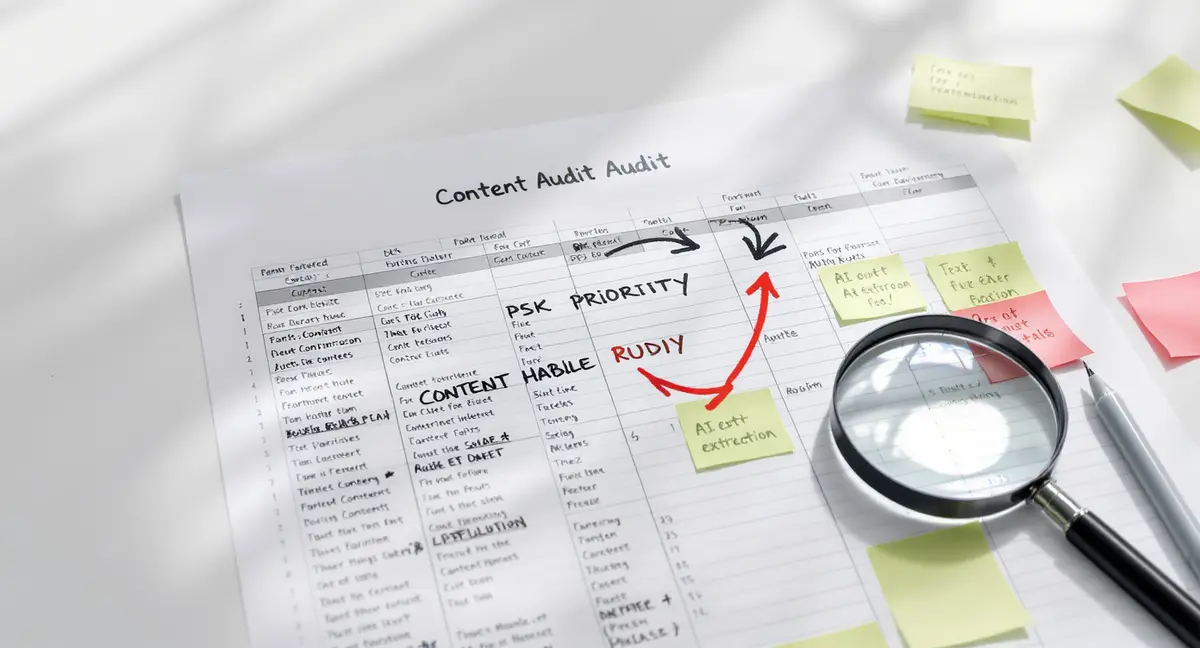
A content audit is the diagnostic step in your content optimization strategy. You can't optimize what you don't measure. Pull every published URL into a spreadsheet. Include traffic, rankings, conversions, engagement metrics, and last updated date. This is your content inventory. Now you know what you have. Next step: figure out what to do with it.
Audit dimensions include traffic performance (which pages drive visits), keyword rankings (which pages rank for valuable queries), conversion performance (which pages generate leads or sales), engagement (bounce rate, time on page, scroll depth), topical coverage (do you have content for all relevant queries in your niche), and E-E-A-T signals (does the content demonstrate expertise and cite sources). Rate each piece of content on these dimensions.
The ROT Method: Redundant, Outdated, Trivial
Not all content deserves optimization. Some content should be deleted. The ROT method categorizes content into three buckets: Redundant (duplicate or overlapping content that confuses Google), Outdated (content with incorrect information or expired relevance), and Trivial (thin content with no value). Redundant content gets consolidated or canonicalized. Outdated content gets updated or deleted. Trivial content gets expanded or removed.
Consider a business with 15 blog posts about "SEO tips." Each post covers similar ground. Google doesn't know which to rank, so none rank well. Consolidate those 15 posts into one complete guide. Redirect the old URLs to the new guide. Now Google has one authoritative page to rank instead of 15 mediocre ones. Traffic increases. That's the ROT method in action.
Prioritization Models: Impact vs Effort
You can't optimize everything at once. Prioritize based on impact and effort. High-impact, low-effort updates go first. These are pages that already rank 5-15 for valuable keywords and need minor tweaks (better title tags, added schema, internal links). High-impact, high-effort updates go second. These are pages targeting high-value keywords but need meaningful rewrites. Low-impact updates go last or not at all.
Build a prioritization matrix. X-axis: effort (hours required). Y-axis: impact (potential traffic or revenue gain). Plot every optimization task on the matrix. Focus on the top-right quadrant first. This framework prevents wasting time on low-value updates. It keeps your content optimization strategy focused on what moves the needle.
Ready to take the next step with Strategyc?
Our team is ready to help you achieve your goals. Get Your Free Scan.
On-Page Content Optimization Framework
On-page optimization is where your content optimization strategy becomes tactical. This is title tags, headings, keyword placement, content structure, internal linking, and multimedia. These elements signal to Google what your page is about and whether it deserves to rank. Get them right and you climb the SERP. Get them wrong and you stay buried. Building a prioritization matrix from scratch takes time, which is why many teams start with proven content strategy templates and adapt them to their audit data.
Title tags are the most important on-page element. Organic CTR for position 1 is 27.6% (Backlinko, 2024). But if your title tag is boring, users click the result below you instead. Write title tags that include the target keyword, promise a clear benefit, and create urgency or curiosity. Keep them under 60 characters so they don't get cut off in search results.
Heading Structure and Keyword Placement
Headings (H1, H2, H3) organize content for readers and search engines. Your H1 should include the primary keyword and clearly state what the page covers. H2s break the content into major sections. H3s break sections into subsections. Use keywords naturally in headings, but don't force them. Google understands semantic relationships. "Content optimization strategy" and "optimizing content for search" are treated as related concepts.
Keyword placement matters, but keyword density is outdated. Modern content optimization strategy focuses on topical coverage, not keyword repetition. Cover the topic comprehensively. Use primary keywords in the introduction, headings, and conclusion. Use secondary keywords and related terms throughout the body. If you're writing about content optimization strategy, also mention SEO, search intent, on-page optimization, and content audits. That's topical authority.
Content Depth, Readability, and Multimedia
Long content tends to rank higher, but only if it's high-quality. The average first-page result is 1,447 words (Backlinko). But length alone doesn't win. Depth wins. Cover the topic thoroughly. Answer related questions. Provide examples. Cite sources. Break up text with bullet lists, numbered steps, and comparison tables. Use short paragraphs (2-4 sentences) and varied sentence length.
Readability affects engagement, which affects rankings. Write at an 8th-grade reading level for general audiences. Use active voice. Cut jargon unless your audience expects it. Add images, charts, and videos to illustrate complex concepts. Optimize images with descriptive file names and alt text. Internal links connect related content and keep users on your site longer. Link to 2-3 related pages per article.
Technical and UX Factors That Amplify Content Optimization Strategy
Content optimization strategy doesn't exist in a vacuum. Technical SEO and user experience either amplify or undermine your content. Core Web Vitals (Largest Contentful Paint, Interaction to Next Paint, Cumulative Layout Shift) are confirmed ranking factors. If your page loads slowly or shifts layout while loading, users bounce. Google notices and ranks you lower.
Page speed is critical. 53% of mobile users abandon sites that take longer than 3 seconds to load (Google). Compress images. Use lazy loading. Minify CSS and JavaScript. Enable browser caching. Use a content delivery network (CDN) to serve assets faster. These technical fixes make your content optimization strategy more effective because users actually see the content you optimized.
Internal Link Architecture and Crawlability
Internal linking distributes authority across your site and helps Google discover content. Every page should be reachable within 3 clicks from the homepage. High-authority pages (like your homepage or top-ranking articles) should link to newer or lower-ranking pages to pass authority. Use descriptive anchor text that includes keywords. Don't use "click here" or "read more."
Crawlability determines whether Google can find and index your content. Check your robots.txt file. Make sure you're not accidentally blocking important pages. Submit an XML sitemap to Google Search Console. Fix broken links. Use canonical tags to prevent duplicate content issues. If Google can't crawl your content, your optimization work is wasted. Portfolio-level optimization means conducting a full content audit, mapping content to search intent, and building the kind of connected system that defines effective content strategy digital marketing in 2026.
Accessibility as SEO: Alt Text, Headings, and Structure
Accessibility and SEO overlap. Alt text describes images for screen readers, but it also helps Google understand what the image shows. Write descriptive alt text that includes keywords when relevant. Heading structure (H1, H2, H3) helps screen readers manage content, and it helps Google understand content hierarchy. Proper HTML structure (closing tags, semantic elements) improves both accessibility and crawlability.
Accessible content is better content. Clear headings, descriptive links, and logical structure benefit all users, not just those using assistive technology. Google's algorithm rewards content that's easy to understand and work through. Accessibility isn't a separate initiative. It's part of a thorough content optimization strategy.
The Bottom Line
A content optimization strategy is the difference between content that ranks and content that disappears. In 2026, optimization means more than keywords and meta tags. It means aligning content with search intent, structuring it for AI citations, auditing performance, prioritizing high-impact updates, and supporting it with solid technical SEO. Businesses that treat content as infrastructure, not a deliverable, see compounding returns. Organic search drives 53% of all trackable website traffic (enterprise SEO platform). Companies that blog get 55% more visitors (marketing automation platform). But only if that content is optimized to be found, understood, and cited by search engines and AI models. Build a content optimization strategy that works 12 months from now, not just today.
Frequently Asked Questions
What is a content optimization strategy?
A content optimization strategy is a systematic process for improving existing and new content to rank higher in search results, earn AI citations, and convert visitors. It includes keyword research, content audits, on-page optimization, technical SEO, and performance tracking aligned with business goals.
How long does it take to see results from content optimization?
Most businesses see improvement within 3-6 months of implementing a content optimization strategy. High-authority sites may see results faster. New sites or highly competitive niches may take 6-12 months. Results compound over time as optimized content earns backlinks and authority.
Can I build a content optimization strategy in-house?
Yes, if you have the expertise and resources. You need someone who understands SEO, content strategy, technical optimization, and analytics. You also need tools for keyword research, rank tracking, and auditing. Many businesses start in-house and install systems they own rather than relying on ongoing agency retainers.
How do I measure ROI from a content optimization strategy?
Track organic traffic, keyword rankings, conversion rate, and revenue from organic sessions. Use Google Analytics to set up goal tracking and calculate assisted conversions. Compare customer acquisition cost from organic search to paid channels. SEO leads close at 14.6% vs 1.7% for outbound, making organic a high-ROI channel.
What does it take to own my content visibility infrastructure?
Owning your visibility infrastructure means controlling the content, workflows, and systems that generate organic traffic. You need a publishing system, keyword research process, content audit framework, and performance tracking. Systems like the Content & Visibility Engine are installed on your infrastructure so you own the process, not rent it monthly.