Why Insurance Agencies Lose Leads to Competitors With Better Content (And How to Fix It)
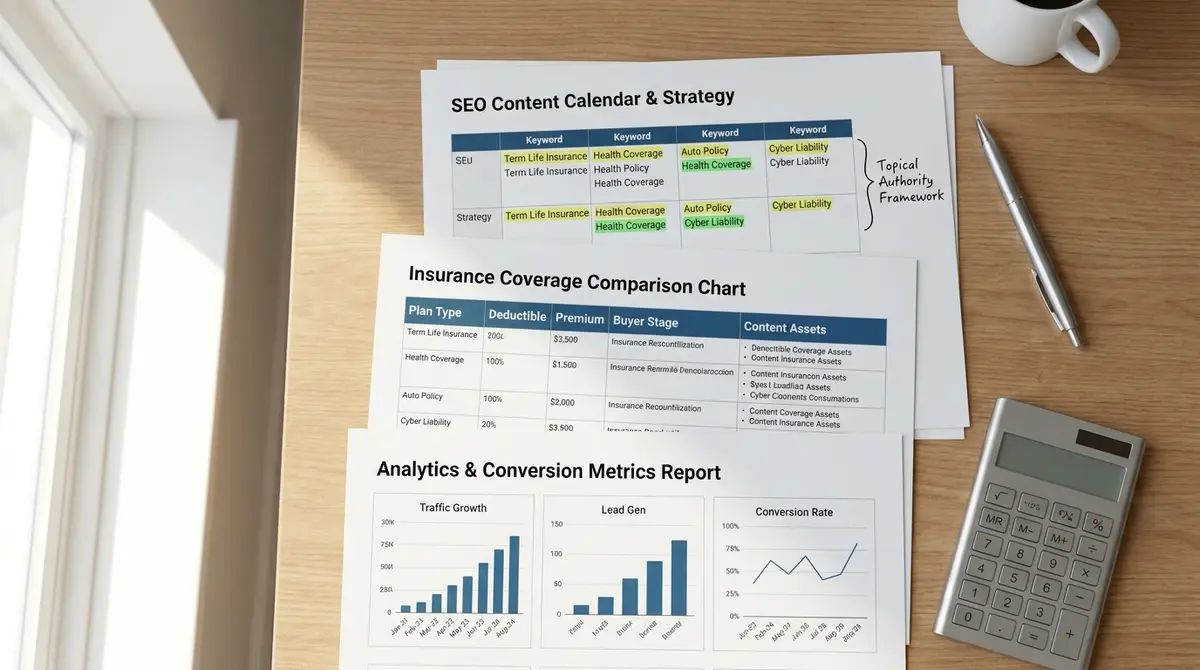
The short answer: Content marketing insurance refers to the strategic use of educational articles, guides, and resources to attract, educate, and convert insurance buyers. The approach combines SEO-optimized blog posts, comparison pages, FAQ content, and coverage explainers designed to answer specific questions at every stage of the buying cycle. Success in content marketing insurance comes down to topical authority, search visibility, and conversion-focused structure. According to Search Engine Journal, SEO leads have a 14.6% close rate versus 1.7% for outbound marketing. The same content-first approach that works for insurance agencies also drives results in roofing marketing, where educational content about materials, warranties, and storm damage outperforms paid ads for long-term lead generation.
Insurance buyers research online before they ever pick up the phone. They compare coverage options, read reviews, and look for answers to specific questions about deductibles, exclusions, and claim processes. If your agency isn't showing up in those searches, your competitor is. Content marketing insurance is the practice of creating educational, search-optimized content that positions your agency as the go-to resource for insurance information. It's not about selling policies in every paragraph. It's about answering the questions your prospects are already asking Google, ChatGPT, and Perplexity. The agencies winning new business in 2026 are the ones publishing consistent, structured content that ranks in search engines and gets cited by AI systems. The agencies losing ground are the ones relying on paid ads, referrals, and hope. This article breaks down what content marketing insurance actually involves, why it works better than traditional advertising for long-term growth, and how to build a system that keeps producing leads after the initial investment.What Content Marketing Insurance Actually Means
Content marketing insurance is not a product you buy. It's a strategy for using educational content to attract insurance buyers at different stages of their decision process. The goal is to show up when someone searches "what does renters insurance cover" or "term vs whole life insurance for new parents" and provide a clear, helpful answer that positions your agency as knowledgeable and trustworthy.Why Insurance Buyers Research Before They Buy
Insurance is a low-trust, high-complexity purchase. People don't impulse-buy life insurance. They research. They compare. They read multiple articles before they request a quote. Data from Demand Gen Report shows B2B buyers consume 3-7 content pieces before engaging sales. The same pattern applies to insurance buyers, especially for commercial lines and life insurance. When someone searches "how much business liability insurance do I need," they're not ready to buy yet. They're educating themselves. If your agency has a well-structured article answering that question, you enter their consideration set. If you don't, a competitor does.The Difference Between Content Marketing and Advertising
Advertising stops working the moment you stop paying. A Google Ads campaign generates clicks while the budget is active. When you pause the campaign, the clicks disappear. Content marketing insurance works differently. An article published today generates traffic this month, next month, and twelve months from now. Each new article adds to the cumulative effect. According to HubSpot's State of Marketing report, companies that blog get 55% more website visitors than those that don't. For insurance agencies, that translates to more quote requests, more applications, and more policy binds without ongoing ad spend.The Three-Stage Content Framework for Insurance Agencies
Insurance buyers move through predictable stages: awareness, consideration, and decision. Content marketing insurance maps content to each stage. Top-of-funnel content attracts people who are just starting to research. Middle-of-funnel content helps them compare options. Bottom-of-funnel content drives them to request a quote.Top-of-Funnel Content: Educational Basics
Top-of-funnel content answers broad questions. "What is term life insurance?" "Do I need renters insurance?" "What does workers comp cover?" These articles attract high search volume but low immediate intent. The goal is visibility and trust-building. Examples include coverage explainers, glossary pages, and "what you need to know" guides. These articles rank for high-volume keywords and introduce your agency to people who aren't ready to buy yet. Over time, they return to your site when they move closer to a decision.Bottom-of-Funnel Content: Conversion-Focused Pages
Bottom-of-funnel content targets people ready to buy. "Compare business liability limits." "How to choose an auto insurance deductible." "Best life insurance for diabetics." These articles have lower search volume but higher conversion rates because the reader is closer to making a decision. Mint Copywriting Studios recommends starting with bottom-of-funnel content rather than brand awareness pieces. The logic is sound: conversion-focused content generates quote requests faster, which justifies continued investment in content marketing insurance. Once you have bottom-funnel pages ranking, expand into middle and top-of-funnel topics.Content Formats That Drive Results for Insurance Agencies
Not all content performs equally. Some formats generate traffic but no conversions. Others convert well but attract limited search volume. The most effective content marketing insurance strategies use a mix of formats tailored to different buyer questions and search behaviors.Blog Posts and Coverage Explainers
Blog posts are the foundation. They rank for specific keywords, answer common questions, and establish topical authority. A well-structured blog post on "what does homeowners insurance cover" can rank for years and generate consistent traffic. The key is specificity. Generic posts like "why you need insurance" don't rank and don't convert. Specific posts like "does renters insurance cover water damage from a burst pipe" rank well and attract readers with clear intent.Comparison Pages and Decision Guides
Comparison pages help buyers evaluate options. "Term vs whole life insurance." "HO3 vs HO5 homeowners policies." "General liability vs professional liability for consultants." These pages rank for high-intent keywords and directly support the decision process. Include side-by-side tables comparing coverage limits, exclusions, typical costs, and ideal use cases. Make the comparison actionable. The reader should leave knowing which option fits their situation.FAQ Pages and Schema Markup
FAQ pages answer clusters of related questions in a scannable format. "How much does renters insurance cost?" "What does it cover?" "Do I need it if I live with roommates?" Each question is an opportunity to rank for a voice search query or appear in a featured snippet. Use FAQ schema markup to help Google and AI systems extract and cite your answers. Research from Princeton and Georgia Tech published at KDD shows that structured FAQ content with schema improves AI visibility by 30-40%.Building Topical Authority in Insurance Niches
Google and AI systems prioritize sources that demonstrate depth in a specific topic area. Publishing one article about auto insurance doesn't establish authority. Publishing 20 articles covering every aspect of auto insurance does. This is called topical authority, and it's the difference between ranking on page three and ranking in the top three results.Pillar Pages and Content Clusters
A pillar page is a thorough guide to a broad topic. "Complete Guide to Homeowners Insurance." "Everything You Need to Know About Medicare Supplement Plans." The pillar page links to cluster content that dives deeper into specific subtopics. For example, a homeowners insurance pillar page might link to cluster articles on "what homeowners insurance doesn't cover," "how to file a homeowners insurance claim," and "how much homeowners insurance do I need." Each cluster article targets a specific keyword and links back to the pillar page. This internal linking structure signals to search engines that your site has detailed coverage of the topic.Local SEO and Location-Specific Content
Insurance is often a local business. People search for "business insurance broker in Denver" or "Medicare agent near me." Local content marketing insurance combines educational content with location-specific pages. Create location pages for each city or region you serve. Include local statistics, state-specific coverage requirements, and examples relevant to that area. Link these pages to your main service pages and blog content. Optimize your Google Business Profile and encourage reviews to reinforce local authority. Book a 30-Minute Content & Visibility Scan to see how your agency currently appears in Google, AI search, and voice search. The scan takes 30 minutes and shows you exactly where you stand compared to competitors in your area.See How Your Business Shows Up in AI Search
Get a free AI visibility scan. See exactly where you rank on ChatGPT, Perplexity, and Google AI, and what to do about it. Get Your Free Scan. Agencies looking to scale their publishing output without sacrificing quality should explore AI content marketing systems that automate research, structure, and optimization while maintaining editorial control.
How to Measure Content Marketing Insurance Performance
Traffic is not the goal. Leads are. The best content marketing insurance strategies track metrics that connect directly to revenue: quote requests, applications started, policy binds, and customer lifetime value. If your content generates 10,000 visitors but zero quote requests, the content isn't working.Quote Requests and Application Starts
Track how many quote requests come from organic search traffic. Use UTM parameters or a CRM integration to attribute leads to specific articles. If a blog post on "how much umbrella insurance do I need" generates 15 quote requests per month, that article is a revenue asset. Compare cost per lead from content marketing insurance to cost per lead from Google Ads or Facebook ads. Organic leads typically have a higher close rate because the prospect has already educated themselves by reading your content.Policy Binds and Revenue Attribution
The ultimate metric is policy binds. How many people who read your content eventually buy a policy? This requires tracking the full customer path from first visit to closed sale. Most insurance agencies don't have this level of attribution, but even directional data is useful. If you know that 20% of your new policies come from people who visited your blog first, you can calculate the revenue value of your content library. That number justifies continued investment in content marketing insurance.Time-to-Conversion and Content Engagement
Insurance buyers don't convert immediately. They read multiple articles, return to your site several times, and compare options before requesting a quote. Track time-to-conversion and pages per session to understand how content influences the buying process. If visitors who read three or more articles convert at twice the rate of visitors who read one, that tells you content depth matters. Focus on creating full resources that keep people on your site longer.Owned Content Systems vs Monthly Retainers
Most insurance agencies pay a marketing company $1,500 to $5,000 per month for SEO and content services. The agency writes articles, publishes them, and sends a monthly report. When the contract ends, the content stops. That's not ownership. That's rent. An owned content system works differently. You install the publishing infrastructure once. You own the workflows, the content library, and the data. The system keeps producing results after the initial investment. Platforms like the Content & Visibility Engine take this approach by installing a structured publishing system optimized for Google, AI search, and voice search on your infrastructure.Why Retainers Create Dependency
Monthly retainers create dependency. You pay every month to keep the content flowing. If you stop paying, the content stops. You don't own the process, the templates, or the strategy. When you switch providers, you start from zero. According to Focus Digital, SEO agencies experience 38% annual churn. That means more than one in three clients leave every year. When they leave, they lose access to the content strategy, keyword research, and publishing workflows they've been paying for.What Ownership Looks Like
Ownership means you control the publishing system. You have the content calendar, the keyword research, the article templates, and the distribution process. You can publish content on your timeline without waiting for an agency to deliver. You can pause, restart, or scale up without renegotiating a contract. The upfront cost is higher, but the long-term economics are better. A $15,000 investment in an owned content system that produces results for three years costs less than $500 per month. A $3,000 monthly retainer costs $108,000 over three years. The retainer stops working the moment you stop paying. The owned system keeps compounding.The Bottom Line
Content marketing insurance is not a nice-to-have. It's infrastructure. Insurance buyers research online before they buy. If your agency isn't showing up in those searches with helpful, structured content, you're losing leads to competitors who are. The agencies that win in 2026 are the ones building content libraries that rank in Google, get cited by AI systems, and convert visitors into quote requests. The agencies that lose are the ones relying on paid ads and hoping referrals keep coming. Start with bottom-of-funnel content that drives conversions. Expand into pillar pages and content clusters that build topical authority. Measure what matters: quote requests, policy binds, and revenue attribution. And consider whether you want to rent your visibility through monthly retainers or own it through an installed content system.Frequently Asked Questions
What is content marketing insurance?
Content marketing insurance is the strategic use of educational articles, guides, and resources to attract and convert insurance buyers. It involves creating SEO-optimized content that answers specific questions about coverage, claims, and policy options at every stage of the buying cycle. Agencies looking to scale their publishing output without sacrificing quality should explore AI content marketing systems that automate research, structure, and optimization while maintaining editorial control. For agencies ready to move beyond content alone, a complete insurance lead marketing system integrates SEO, email sequences, and conversion tracking into a single revenue engine.
How long does it take to see results from content marketing insurance?
Most agencies see measurable traffic increases within 3-6 months. Quote requests typically start appearing within 4-8 months as articles rank and build authority. Full compounding effects appear after 12-18 months when the content library reaches critical mass and internal linking strengthens topical authority. Building topical authority is one component of a broader insurance marketing plan that aligns content, distribution, and measurement into a system designed for compounding growth.
Can I build a content marketing insurance system in-house?
Yes, if you have dedicated resources. You need someone to handle keyword research, content creation, publishing, and performance tracking. Many agencies start in-house but struggle with consistency. An installed system provides the workflows and templates to maintain publishing momentum without hiring a full-time content team.
How do I measure ROI from content marketing insurance?
Track quote requests and policy binds attributed to organic search traffic. Use UTM parameters or CRM integration to connect content visits to revenue. Compare cost per lead from content to cost per lead from paid ads. Calculate the lifetime value of customers acquired through content versus other channels.
What makes content marketing insurance different from regular SEO?
Content marketing insurance focuses on educational content that supports the insurance buying process. Regular SEO might prioritize any keyword that drives traffic. Content marketing insurance targets keywords that align with buyer questions, coverage decisions, and policy comparisons. The goal is qualified leads, not just traffic volume.