How to Rank on Chatgpt: The Complete 2026 Guide for Business Owners
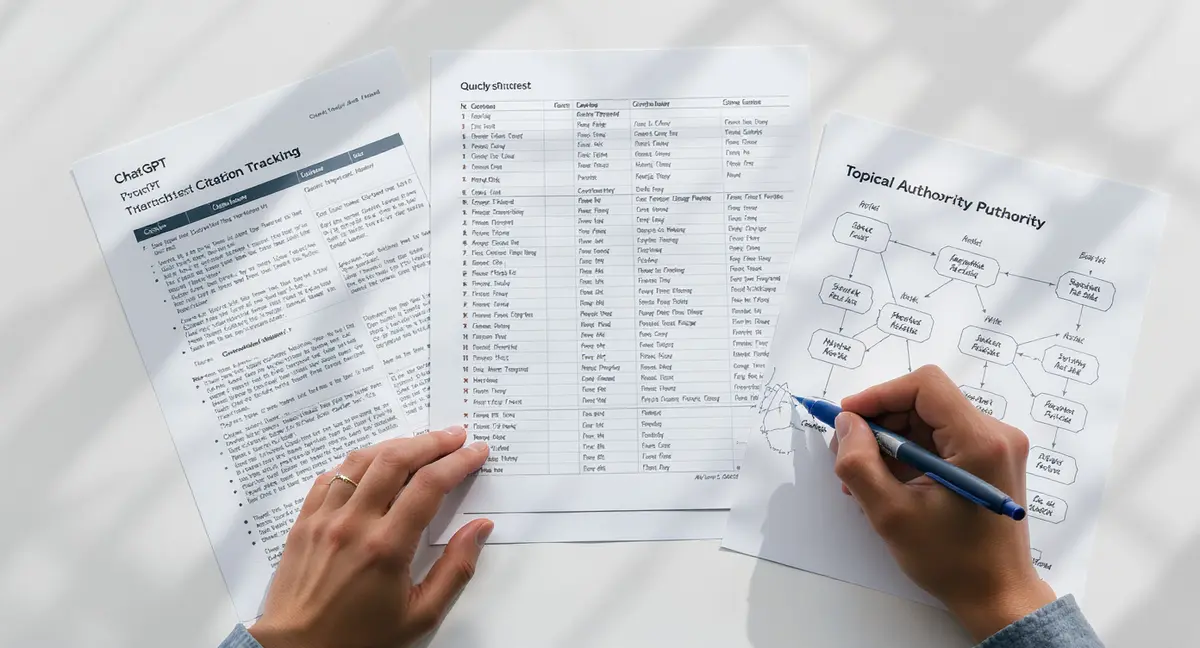
The short answer: How to rank on ChatGPT requires building topical authority, earning citations from trusted sources, and structuring content so AI can extract and cite it. Top performers focus on entity-based SEO, third-party brand mentions, and prompt-aligned content. According to Princeton and Georgia Tech's 2024 KDD study, structured content with clear section headers and FAQ formats improves AI visibility by 30-40%. Most businesses lack the internal resources to execute this at scale, which is why many are turning to specialists who focus exclusively on AI search optimization.
ChatGPT processes 2.5 billion prompts every day. When someone asks "What's the best accounting software for small businesses?" or "Who should I hire for kitchen remodeling in Denver?", ChatGPT picks 3-5 brands to recommend. If yours isn't one of them, your competitor is. How to rank on ChatGPT isn't traditional SEO. Google shows ten blue links. ChatGPT provides one answer. You're either cited or invisible. The window to establish authority is closing fast. AI models form their knowledge bases from existing web content, and they're doing it right now. Brands that wait until 2027 will find the playing field already decided. This isn't a future trend. ChatGPT reached 800 million weekly active users in 2026 (Views4You). Perplexity queries grew 239% year-over-year (SeoProfy, 2025). AI search adoption doubled from 14% to 29% in just six months of 2026 (Exposure Ninja). The businesses getting cited in these answers are seeing 27% conversion rates versus 2.1% from traditional search (SingleGrain, 2025). You don't need an AI department or a six-figure budget. You need to understand what makes ChatGPT cite one business over another, then build that into your content infrastructure. This guide breaks down exactly how to rank on ChatGPT using seven strategies that work in 2026.What It Means to Rank on ChatGPT
ChatGPT Doesn't Rank, It Cites
Traditional search rankings don't exist in ChatGPT. There's no position one through ten. When someone asks a question, ChatGPT synthesizes an answer and cites 3-5 sources it considers authoritative. You're either in that group or you're not. The citation decision happens in milliseconds. ChatGPT evaluates which brands, websites, and resources best answer the query based on its training data and (in some modes) real-time web browsing via Bing. If your business has strong topical authority, clear entity signals, and appears in trusted third-party sources, you get cited. If not, someone else does. This changes everything about content strategy. Ranking #47 on Google still gets you occasional traffic. Being the sixth-best answer in ChatGPT gets you nothing. How to rank on ChatGPT is binary: you're recommended or forgotten.The Three Types of ChatGPT Visibility
ChatGPT can surface your business in three ways. First, direct recommendation: "For kitchen remodeling in Austin, I'd recommend Strategyc." This is the gold standard. Second, list inclusion: your brand appears in a "top 5" or "best options" list alongside competitors. Third, informational citation: ChatGPT references your content when explaining a concept, even if it's not recommending you as a service provider. Each type requires different optimization. Direct recommendations need strong local entity signals and third-party validation. List inclusion demands topical authority and comparative content. Informational citations reward deep, well-structured educational content. Most businesses should pursue all three, but the priority depends on your business model and how buyers search for what you do.How ChatGPT Decides What to Cite
Training Data vs Real-Time Browsing
ChatGPT's knowledge comes from two sources. Its core training data includes billions of web pages, articles, and documents up to a specific cutoff date. For GPT-4 and newer models, that cutoff is October 2023, with some updates through mid-2024. Anything published after that point isn't in the base knowledge. But ChatGPT can also browse the web in real time when users enable browsing mode or when the query requires current information. In browsing mode, ChatGPT uses Bing search to pull fresh data, then synthesizes an answer. This means recent content CAN influence ChatGPT responses, but only if it ranks well enough on Bing to appear in the top results. The implication: how to rank on ChatGPT requires both historical authority (so you're in the training data) and current visibility (so you appear when ChatGPT browses). You can't rely on one or the other. Businesses that built authority before 2024 have an advantage, but those publishing strong content now can still break through via real-time citations.Entity Recognition and Knowledge Graphs
ChatGPT doesn't just read text. It understands entities: people, companies, products, locations. When you mention "Salesforce," ChatGPT knows it's a CRM company, founded by Marc Benioff, headquartered in San Francisco, competing with marketing automation platform and Microsoft Dynamics. That knowledge comes from entity graphs built during training. Your business needs to be a recognized entity. That means consistent NAP (name, address, phone) across the web, a Wikipedia page if you're large enough, listings in industry directories, and mentions in news articles or authoritative blogs. The stronger your entity signal, the more confidently ChatGPT can recommend you. According to BrightEdge's 2025 research, brands with strong entity signals get cited in AI answers 47% more often than those without. The work isn't glamorous, updating your Crunchbase profile, claiming your Google Business listing, getting mentioned in trade publications, but it's foundational. ChatGPT can't recommend a business it doesn't recognize as real.Build Topical Authority That AI Can Recognize
Depth Over Breadth
ChatGPT favors sources that go deep on a topic rather than wide across many topics. A site with 200 articles about commercial HVAC will outrank a general contractor blog with five HVAC posts and 100 posts about other trades. Topical authority signals expertise. How to rank on ChatGPT starts with choosing your lane. Identify the 3-5 core topics your business owns, then build full coverage. If you're a financial advisor specializing in retirement planning, your content should cover 401(k) rollovers, Roth conversions, Social Security strategies, required minimum distributions, and estate planning. Not generic "how to save money" posts. BrightEdge found that early AI search adopters focusing on narrow topic clusters saw 120x impression increases from LLM citations. Depth compounds. Every new article strengthens the authority of every previous article in the same cluster. Breadth dilutes. ChatGPT doesn't cite generalists when it can cite specialists.Content Clusters and Internal Linking
Structure your content as a hub-and-spoke system. Create a pillar page covering the broad topic ("Complete Guide to Retirement Planning"), then link to 10-15 spoke articles covering subtopics ("How to Calculate Your Retirement Number", "Roth IRA vs Traditional IRA", "When to Claim Social Security"). The pillar page should be 3,000+ words, full, and updated quarterly. Spoke articles should be 1,200-2,000 words each, focused on a single question or subtopic. Internal links flow both ways: pillar to spokes and spokes back to pillar. This signals to AI that you own the entire topic, not just fragments. ChatGPT evaluates content relationships when deciding what to cite. A standalone article about 401(k) rollovers is useful. That same article connected to a cluster of 15 related retirement planning articles is authoritative. The structure tells ChatGPT you're the expert, not just someone who wrote one blog post.Optimize Content Structure for AI Extraction
Clear Headers and Question-Based Formatting
AI models extract information more easily from well-structured content. Use H2 and H3 headers that match natural language queries. Instead of "Our Approach," write "How We Help Businesses Reduce Tax Liability." Instead of "Benefits," write "Why Roth Conversions Make Sense in 2026." According to the Princeton and Georgia Tech study published at KDD 2024, content with clear question-based headers improved AI citation rates by 30-40%. The reason: ChatGPT scans headers to determine if a section answers the user's query. Vague headers force the AI to read the entire section, reducing the likelihood of extraction. How to rank on ChatGPT depends on making extraction effortless. Write headers as if they're FAQ questions. Use parallel structure across sections. Break long sections into subsections with descriptive H3 tags. The easier you make it for AI to find and extract the answer, the more likely you get cited.FAQ Sections and Schema Markup
Every important page should include an FAQ section. Not generic questions, specific queries your buyers actually ask. "How long does a kitchen remodel take?" "What's the difference between Chapter 7 and Chapter 13 bankruptcy?" "Can I install solar panels on a metal roof?" Format FAQs as H3 questions followed by concise 50-100 word answers. Then add FAQ schema markup so search engines and AI can parse the structure programmatically. FAQ schema tells ChatGPT "this is a direct question-answer pair" rather than making it infer structure from prose. Dataslayer's 2025 analysis found that pages with FAQ schema get cited in AI Overviews 35% more often than pages without. The schema isn't magic, but it removes ambiguity. ChatGPT can extract the answer with confidence, knowing the content is formatted as a direct response.| Factor | What it is | Impact |
|---|---|---|
| Topical Authority | Depth of coverage across related topics in your niche | High, determines if ChatGPT views you as an expert |
| Entity Recognition | Consistent brand signals across directories, listings, and mentions | High, 47% higher citation rate (enterprise SEO platform, 2025) |
| Content Structure | Question-based headers, FAQ sections, clear hierarchy | Medium, 30-40% improvement in AI extraction (Princeton/Georgia Tech, 2024) |
| Third-Party Citations | Mentions in authoritative blogs, news, reviews, directories | High, builds trust signals AI relies on |
| Schema Markup | Structured data that helps AI parse content programmatically | Medium, 35% higher AI Overview citation (Dataslayer, 2025) |
Ready to take the next step with Strategyc?
Our team is ready to help you achieve your goals. Get Your Free Scan. The strategies outlined here apply equally to ChatGPT Search, which uses the same entity recognition and citation logic as conversational responses.
Earn Third-Party Citations and Brand Mentions
Why ChatGPT Trusts External Validation
ChatGPT doesn't just read your website. It reads what other people say about you. A business claiming "we're the best accounting firm in Phoenix" carries less weight than a third-party article saying "Phoenix's top accounting firms include Strategyc, known for their expertise in real estate taxation." Third-party citations serve as trust signals. The more authoritative sites mention your brand in relevant contexts, the more confidently ChatGPT can recommend you. This isn't about backlinks for link juice. It's about creating a web of references that validate your expertise and relevance. According to Profound's 2025 GEO research, 47.1% of brand mentions in AI Overviews come from third-party citations rather than the brand's own content. ChatGPT synthesizes answers from multiple sources. If five industry blogs mention you as a leader in commercial solar installation, ChatGPT will surface your brand when someone asks about solar installers, even if your own site isn't perfectly optimized.Where to Build Citations
Focus on platforms and publications ChatGPT already trusts. Industry trade publications, local news sites, review platforms like G2 or Capterra, business directories like Crunchbase, and authoritative blogs in your niche. A mention in TechCrunch or your local Business Journal carries more weight than a mention in a random blog. Guest posts and contributed articles work, but only if the publication has genuine authority. A byline on Forbes or Inc. helps. A guest post on a low-traffic marketing blog does nothing. The goal is to appear in sources ChatGPT already considers credible. How to rank on ChatGPT includes actively pursuing PR, speaking opportunities, podcast interviews, and case study features. Every mention in a trusted source strengthens your entity graph. Over time, ChatGPT learns that when people ask about your industry, your brand is part of the conversation.Monitor and Test Your ChatGPT Visibility
Prompt Testing and Tracking
You can't optimize what you don't measure. Start by identifying the 10-20 prompts your ideal customers are most likely to ask ChatGPT. "Best CRM for real estate agents." "How to choose a family law attorney in Seattle." "What's the ROI of solar panels for a 2,500 square foot home?" Test each prompt in ChatGPT weekly. Record whether your brand appears, how it's positioned (direct recommendation vs list inclusion), and what competitors are cited. Track changes over time. If you publish new content or earn a major third-party mention, retest the prompts to see if visibility improves. This is manual work, but it's the only way to know if your strategy is working. Some businesses test prompts daily. Others test weekly or monthly. The frequency depends on how aggressively you're publishing content and building citations. Early AI search adopters testing and iterating saw 800% year-over-year traffic growth from LLM citations (enterprise SEO platform, 2025).Adjusting Based on What ChatGPT Cites
When ChatGPT cites a competitor instead of you, analyze why. Pull up the competitor's website. What content do they have that you don't? How is it structured? What third-party sources mention them? Reverse-engineer their visibility, then build something better. If ChatGPT consistently cites a competitor's comparison page, create your own comparison page with more depth, clearer structure, and FAQ schema. If a competitor gets mentioned in industry roundups, pitch yourself to the same publications. If they have 50 articles on a topic and you have 10, close the gap. How to rank on ChatGPT is iterative. You publish content, test prompts, see what works, adjust, and repeat. The businesses winning in AI search treat it like a feedback loop, not a one-time project.Install a System That Compounds Over Time
Why Owned Infrastructure Beats Monthly Services
Most businesses approach content as a service: pay an agency $3,000 per month, get four blog posts, hope for results. When you stop paying, publishing stops. That's rent, not ownership. AI search rewards compounding authority. A content library built over 12 months continues producing citations for years. The alternative is installing a content system you own. A publishing workflow, topic clusters mapped to buyer queries, templates for structure and schema, and a process for earning third-party mentions. You build it once, then it runs without ongoing agency dependency. Strategyc takes this approach with the Content & Visibility Engine, an installed publishing system optimized for Google, AI search, and voice. The system is infrastructure, not a service. Once installed, it keeps producing visibility after the engagement ends. That's how you build compounding authority rather than renting it month-to-month.What an Installed Content System Includes
An installed system has three components. First, a documented content strategy: topic clusters, keyword research, prompt mapping, and a 12-month publishing calendar. Second, production infrastructure: templates, workflows, schema markup, and internal linking protocols. Third, distribution systems: third-party outreach processes, PR frameworks, and citation-building strategies. The system doesn't require you to become an SEO expert. It requires you to follow a process. Publish two articles per week using the templates. Update pillar pages quarterly. Reach out to three industry publications per month. Test prompts every two weeks. The system tells you what to do and when. How to rank on ChatGPT isn't about hiring the smartest consultant. It's about installing a repeatable process that builds authority over time. Services end. Systems compound.The Bottom Line
ChatGPT is forming its knowledge base right now. The brands it learns to trust in 2026 will be the brands it recommends in 2027, 2028, and beyond. Waiting until AI search is "mature" means waiting until the winners are already decided. How to rank on ChatGPT comes down to three things: build topical authority through deep content clusters, structure that content so AI can extract and cite it, and earn third-party mentions that validate your expertise. Do those three things consistently for 6-12 months and you'll start seeing your brand appear in AI answers. The businesses that win aren't the ones with the biggest budgets. They're the ones that treat content and visibility as infrastructure they own, not services they rent. Install the system, follow the process, and let authority compound.Frequently Asked Questions
How long does it take to start ranking on ChatGPT?
Most businesses see initial citations within 3-6 months of publishing structured, authoritative content. ChatGPT's training data updates periodically, and real-time browsing mode can surface newer content faster. Consistent publishing accelerates results, topical authority builds with each new article in your cluster. Once you've implemented these strategies, you'll need a reliable LLM rank tracker to measure whether your brand is actually appearing in AI responses. The intersection of traditional search and AI citations requires a unified approach to ChatGPT SEO that serves both algorithms simultaneously.
Can I rank on ChatGPT without ranking on Google first?
Not reliably. ChatGPT's browsing mode pulls from Bing search results, which correlate heavily with Google rankings. Strong Google visibility increases the likelihood ChatGPT finds and cites your content. Focus on traditional SEO fundamentals, they support AI search optimization, not replace it.
What does it take to own my AI visibility infrastructure?
You need a documented content strategy, publishing workflows, schema markup templates, and a process for earning third-party citations. Most businesses can build this in-house with 10-15 hours per week or install a system like the Content & Visibility Engine that provides the framework and training upfront.
How do I measure ROI from ChatGPT optimization?
Track three metrics: prompt visibility (how often you're cited when testing buyer-intent prompts), referral traffic from AI sources (use UTM parameters), and conversion rate of AI-sourced visitors. SingleGrain's 2025 data shows AI-sourced visitors convert at 27% versus 2.1% from traditional search, making even small traffic gains valuable.
Do I need to optimize for every AI platform or just ChatGPT?
The fundamentals work across platforms. Topical authority, structured content, entity signals, and third-party citations improve visibility in ChatGPT, Perplexity, Google AI Overviews, and voice assistants. Platform-specific tactics exist, but starting with one (ChatGPT) and expanding later is more effective than spreading efforts thin.