Call Tracking for Contractors: The $47,000 Problem Most Home Service Businesses Don't Know They Have
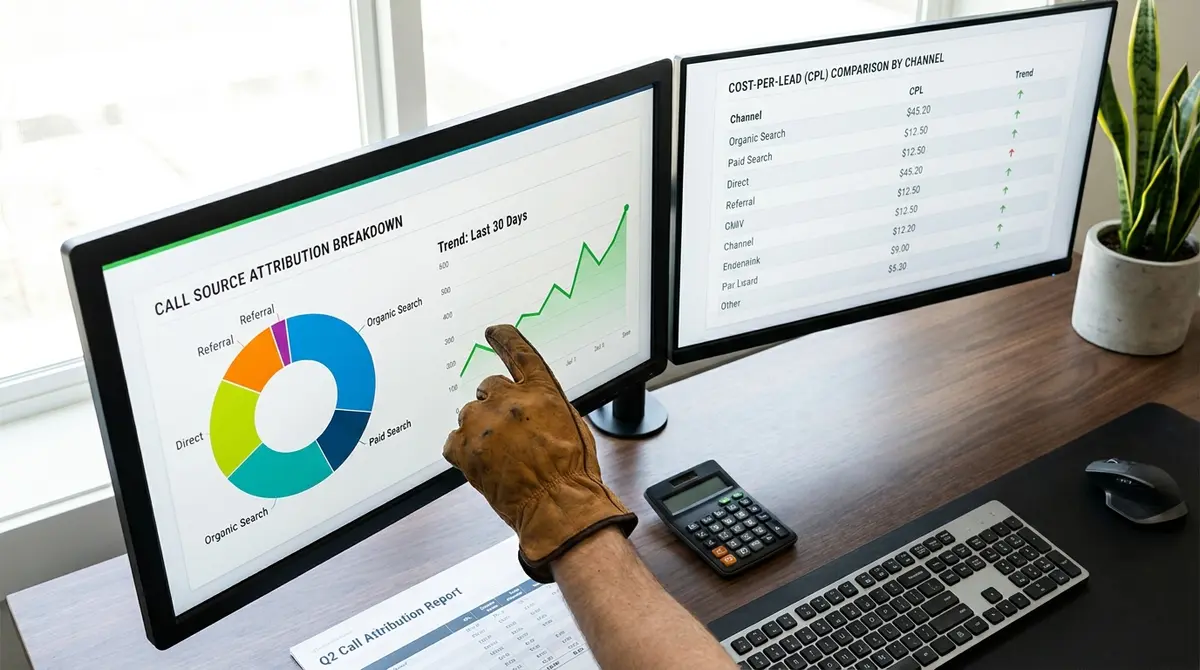
The short answer: Call tracking for contractors assigns unique phone numbers to each marketing channel so you know which ads, listings, and campaigns drive actual calls. The system captures caller ID, call duration, source attribution, and conversation recordings. Three variables move the needle: source-level attribution (which channel sent the call), outcome tracking (booked vs missed), and cost-per-acquisition by channel. If you run a roofing company, the same attribution principles apply across every channel you use, from Local Services Ads to direct mail, which is why roofing marketing in 2026 demands source-level tracking before you scale any campaign.
Most contractors spend thousands on Google Ads, Facebook campaigns, truck wraps, and direct mail without knowing which channels drive booked jobs. You see calls come in. You see jobs close. But you cannot connect the two. That gap costs money, $47,000 per location annually from untracked or mishandled calls, according to Convirza's 2026 home services data. Call tracking for contractors solves attribution. It assigns a unique phone number to every marketing source: one for Google Ads, one for your Google Business Profile, one for Facebook, one for your truck wrap, one for mailers. When a call comes in, the system logs the source, records the conversation, and tracks whether it turned into a booked job. You stop guessing. You start knowing. The decision is not whether to track calls. It is whether you want to keep spending blind or start optimizing based on what actually works. At $7.85 average cost per click and $66.02 average cost per lead across home services (WordStream, 2025), a single recovered or correctly attributed job covers months of tracking software costs. If you are spending $500 or more per month on any form of paid advertising and receiving more than 20 calls per week, call tracking pays for itself. This article breaks down what call tracking for contractors does, how much it costs, how to set it up, and which features matter most for one-truck shops vs multi-location operators.Why Call Tracking for Contractors Exists: The Attribution Gap in Home Services
Home service businesses operate in a multi-channel world. A homeowner sees your truck in the neighborhood, searches your company name on Google, reads reviews, then calls the number on your Google Business Profile. Which channel gets credit for that job? Without tracking, you assume it was organic search. In reality, the truck wrap triggered the search. Call tracking for contractors closes that gap. It reveals the true customer journey by tagging each inbound call with its origin. You know whether the call came from a Google Local Services Ad, a Facebook retargeting campaign, or a yard sign. That knowledge changes budget allocation. Contractors who track calls shift spend away from channels that generate calls but not jobs, and double down on channels that convert.The $47,000 Missed-Call Problem
Convirza's 2026 home services study found the average contractor loses $47,000 per location annually from untracked or mishandled calls. That figure includes calls sent to voicemail during business hours, calls from high-intent sources that were answered but not followed up, and calls from paid campaigns that were never attributed to the correct channel. The breakdown: 23% of inbound calls to home service businesses go unanswered during operating hours (CallRail, 2025). Of the calls that do get answered, 34% receive no follow-up within 24 hours (ServiceTitan, 2024). When you do not know which marketing channel sent a call, you cannot measure whether that channel is worth the spend. You keep paying for ads that drive calls your team does not answer or does not close.Attribution vs Outcome: Two Levels of Tracking
Call tracking for contractors operates at two levels. The first level is attribution: which marketing source sent the call. The second level is outcome: did that call turn into a booked job, and did that job generate revenue. Most call tracking platforms handle attribution out of the box. You assign tracking numbers to channels, calls come in, and the dashboard shows call volume by source. Outcome tracking requires integration with your CRM or scheduling software. When a call turns into a booked job, the system ties the revenue back to the original marketing source. That is how you calculate true cost per acquisition by channel, not just cost per call.How Call Tracking for Contractors Works: Numbers, Forwarding, and Data Capture
Call tracking for contractors uses unique phone numbers as identifiers. Each marketing channel gets its own number. Your Google Ads campaign displays one number. Your Google Business Profile displays another. Your truck wrap shows a third. All numbers forward to your main business line, but the system logs which number was dialed. When a call comes in, the platform captures caller ID, timestamp, call duration, and source. If you enable call recording, it stores the audio. If you integrate with your CRM, it creates a contact record and tags the lead source. The data flows into a dashboard where you can filter by channel, date range, call outcome, and cost per lead.Static vs Dynamic Number Insertion
Static tracking is simple. You manually assign a unique number to each offline channel: one number on your truck, one on mailers, one on yard signs. You update your Google Business Profile and social media pages with channel-specific numbers. Calls route to your main line, but the system knows which number rang. Dynamic number insertion (DNI) is for websites. Instead of showing the same phone number to every visitor, DNI swaps the displayed number based on how the visitor arrived. A visitor from Google Ads sees one number. A visitor from organic search sees another. A visitor from Facebook sees a third. The swap happens in real time using JavaScript. When the visitor calls, you know exactly which campaign sent them. Most contractors need both. Static numbers cover offline channels and listings. DNI covers website traffic. Together, they attribute 90%+ of inbound calls to a known source.Call Recording and Conversation Intelligence
Call recording is standard in most call tracking platforms. The system stores audio for every inbound call, usually for 90 days to 2 years depending on your plan. You can replay calls to coach staff, verify what was said, or resolve disputes. Conversation intelligence adds AI analysis. The platform transcribes calls, scores them based on keywords and sentiment, and flags missed opportunities. For example, if a caller asks about pricing and your team does not offer to schedule an estimate, the system flags the call as a missed conversion. Some platforms (CallRail, CallTrackingMetrics) use AI to detect whether the caller was a customer, vendor, or spam, and whether the call resulted in a booked appointment.| Factor | What it is | Impact |
|---|---|---|
| Source attribution | Which channel sent the call | High, determines budget allocation |
| Call recording | Audio storage for quality and training | Medium, improves close rates over time |
| Outcome tracking | Did the call turn into a booked job | High, separates call volume from revenue |
| Dynamic number insertion | Real-time number swap on website by traffic source | High for paid traffic, medium for organic |
| Conversation intelligence | AI transcription and call scoring | Medium, useful at scale, overkill for small shops |
What Call Tracking for Contractors Costs in 2026
Pricing varies by call volume, number of tracking lines, and feature set. Expect to pay $55–$215 per month with CallRail for a one-truck to mid-size shop, $30–$159 per month with WhatConverts for pure attribution, and $149–$499 per month with CallTrackingMetrics if you also need contact center features like call routing, IVR, and team analytics. Most single-location home service businesses spend $45 to $100 per month depending on call volume and whether they add AI call scoring. Multi-location operators and agencies typically land in the $150–$300 range due to higher call volume and the need for advanced reporting.Per-Number and Per-Minute Costs
Call tracking platforms charge two ways: per tracking number and per minute of call time. Most contractors need 5–15 tracking numbers at $3–5 per month each, plus per-minute usage. A tracking number costs $3–$5 per month whether you use it or not. Call minutes typically cost $0.03–$0.05 per minute, though some platforms bundle minutes into the base plan. If you receive 100 calls per month averaging 4 minutes each, that is 400 minutes. At $0.04 per minute, usage costs $16. Add five tracking numbers at $4 each ($20), and your monthly cost is $36 before the platform fee. CallRail's $55 per month plan includes 2,500 minutes and 10 tracking numbers, which covers most small contractors. WhatConverts starts at $30 per month for unlimited tracking but charges per conversion event instead of per minute.The $55–$499 Decision Framework
The pricing spread reflects feature depth, not just call volume. At the low end ($30–$55 per month), you get basic attribution: which channel sent the call, call duration, and caller ID. At the mid tier ($100–$150 per month), you add call recording, form tracking, and basic AI scoring. At the high end ($200–$499 per month), you get conversation intelligence, multi-location dashboards, CRM integrations, call routing, and team performance analytics. Most one-truck to five-truck contractors do not need the high-end features. You need to know which ads drive calls and whether those calls turn into jobs. That is $55–$100 per month. Agencies managing multiple clients and multi-location operators need centralized reporting and call routing. That is $150–$300 per month. Contact center features (IVR, skills-based routing, live call monitoring) push costs to $300–$499 per month, but most contractors never use them.How to Set Up Call Tracking for Contractors in 30 Minutes
You do not need technical skills to implement call tracking. The process takes about 30 minutes for a basic setup: sign up for a platform, get tracking numbers, replace numbers on your website and listings, enable recording, and check the dashboard weekly. Start with CallRail if you are managing your own marketing, or WhatConverts if you want the cleanest pure-attribution interface. Both platforms offer free trials. Avoid enterprise platforms like CallTrackingMetrics unless you are running a multi-location operation or agency.Step 1: Assign Tracking Numbers to Each Channel
Log into your call tracking platform and purchase tracking numbers. You need one number for each marketing channel you want to track. Common assignments for contractors: - Google Ads (Search and Local Services Ads) - Google Business Profile - Facebook and Instagram ads - Organic website traffic - Direct mail campaigns - Truck wraps and vehicle signage - Yard signs - Referral partners or directories Each number forwards to your main business line. When a call comes in, the system logs which tracking number rang, then connects the caller to your team. The caller experience is identical to dialing your main number directly.Step 2: Update Your Website and Listings
Replace the phone number on your website with the tracking number assigned to organic traffic. If you are running Google Ads or Facebook campaigns, install the dynamic number insertion script. The platform provides a JavaScript snippet you paste into your site header. The script swaps the displayed number based on the visitor's traffic source. Update your Google Business Profile with the tracking number assigned to GBP. Do the same for Yelp, Angi, Thumbtack, and any other directories where your business is listed. This step is critical: your Google Business Profile likely drives 30–50% of your inbound calls (BrightLocal, 2025). If you do not track GBP separately, you will never know how much business it generates. Print the tracking numbers assigned to offline channels (truck wraps, mailers, yard signs) and use them in your next creative batch. For existing wraps and signs, you can forward the tracking number to your main line and update the creative at the next refresh.Step 3: Enable Call Recording and Set Up Integrations
Turn on call recording in your platform settings. Most states allow one-party consent, meaning you can record calls as long as one party (you) knows the call is being recorded. A few states require two-party consent, meaning you must notify callers with a message like "This call may be recorded for quality assurance." Check your state law or consult your platform's compliance guide. If you use a CRM (Jobber, ServiceTitan, Housecall Pro), connect it to your call tracking platform. The integration creates a contact record for every inbound call and tags the lead source. When you book the job, the CRM sends the outcome back to the call tracking platform, closing the loop from call to revenue. If you do not use a CRM, manually tag call outcomes in the call tracking dashboard. After each call, mark it as booked, quoted, no answer, wrong number, or spam. This step is manual but takes 10 seconds per call. Without it, you only know call volume, not conversion rate.See How Your Business Shows Up in AI Search
Get a free AI visibility scan. See exactly where you rank on ChatGPT, Perplexity, and Google AI, and what to do about it. Get Your Free Scan.
Which Features Matter Most for One-Truck vs Multi-Location Contractors
Not all call tracking features deliver equal value. One-truck contractors need source attribution, call recording, and outcome tracking. Multi-location operators need everything one-truck shops need, plus location-level reporting, call routing, and team performance dashboards. The feature gap explains the pricing gap. A one-truck HVAC company running Google Ads and maintaining a Google Business Profile can track 90% of inbound calls with a $55 per month CallRail plan. A ten-location plumbing franchise needs call routing (send calls to the nearest location), multi-location dashboards (compare performance across markets), and team analytics (which CSR books the most jobs). That is a $200–$300 per month platform.Features That Matter for Small Contractors
Source attribution is non-negotiable. You must know which channel sent each call. Without it, you are flying blind. Call recording is nearly as important. Listening to calls reveals why some convert and others do not. You hear objections, pricing questions, and missed opportunities. That feedback improves your team's close rate faster than any training manual. Outcome tracking separates call volume from revenue. A channel that drives 50 calls per month sounds productive until you realize only 3 turned into booked jobs. Another channel drives 10 calls but books 6 jobs. Outcome tracking shows you which channel has the better close rate, and often it is not the channel with the most volume. Dynamic number insertion matters if you run paid traffic to your website. Without DNI, all website calls show as "organic" even if the visitor arrived via a Google Ad. With DNI, you see exactly which campaign sent the call. That precision lets you pause underperforming ad groups and scale winners.Features That Matter for Multi-Location Operators
Call routing sends inbound calls to the correct location based on caller area code, time of day, or manual rules. A caller from zip code 90210 rings the Los Angeles location. A caller from 10001 rings the New York location. Without routing, all calls land at a central number and someone manually transfers them. That adds friction and increases hang-ups. Location-level dashboards let you compare performance across markets. You see which locations answer calls fastest, which have the highest close rates, and which are underperforming. That visibility drives accountability. Managers can coach based on data, not anecdotes. Team performance analytics track individual CSRs. You see who answers the most calls, who has the highest booking rate, and who misses the most opportunities. Some platforms (CallTrackingMetrics, CallRail's higher tiers) score calls with AI and flag coaching moments automatically.When Call Tracking for Contractors Pays for Itself
Call tracking pays for itself when the cost of the platform is less than the revenue from one additional booked job per year. For most contractors, that threshold is low. A single HVAC install generates $3,000–$8,000 in revenue. A roofing job averages $8,000–$15,000. A plumbing service call books at $150–$400. If call tracking helps you book one extra job per quarter by identifying which channels convert, it covers its cost 10x over. The math is straightforward. At $7.85 average cost per click and $66.02 average cost per lead across home services, contractors spend $500–$5,000 per month on paid advertising (WordStream, 2025). Without call tracking, you do not know which ads drive jobs. You optimize for clicks and calls, not revenue. That leads to overspending on high-volume, low-conversion channels.The ROI Calculation
Assume you spend $2,000 per month on Google Ads and receive 40 calls. Without tracking, you cannot tie calls to specific campaigns. You see 40 calls and assume the ads are working. With call tracking, you discover 25 calls came from Local Services Ads and booked at 40%, while 15 calls came from Search Ads and booked at 13%. LSAs are driving 10 booked jobs. Search Ads are driving 2. You shift $500 from Search Ads to LSAs. LSA call volume increases to 35. At a 40% booking rate, that is 14 booked jobs instead of 10. Four additional jobs at $5,000 average ticket is $20,000 in revenue. The call tracking platform costs $75 per month. ROI is 267x. That scenario is not hypothetical. Contractors who track calls at the campaign level routinely find 2–3x performance variance between channels. The highest-performing channel books jobs at 30–50%. The lowest-performing channel books at 5–15%. Without tracking, you fund both equally.Rule of Thumb for When to Start
If you are spending $500 or more per month on any form of paid advertising and receiving more than 20 calls per week, call tracking pays for itself. Below that threshold, manual attribution (asking every caller "How did you hear about us?") works well enough. Above that threshold, manual tracking breaks down. Callers forget, CSRs forget to ask, and the data becomes unreliable. If you run multiple campaigns (Google Ads, Facebook, direct mail, LSAs), you need call tracking regardless of spend. You cannot optimize a multi-channel strategy without source-level data. You will overspend on channels that feel productive but do not convert, and underspend on channels that quietly drive most of your revenue.The Bottom Line
Call tracking for contractors is not optional if you spend money on marketing. It is the only way to know which channels drive booked jobs and which waste budget. At $55–$150 per month for most small to mid-size contractors, the cost is negligible compared to the revenue from one additional job per quarter. Start with basic attribution: assign tracking numbers to your top 3–5 channels, enable call recording, and check the dashboard weekly. That setup takes 30 minutes and costs $55–$75 per month. If you run paid traffic, add dynamic number insertion. If you operate multiple locations, add call routing and location-level dashboards. But do not wait for the perfect setup. The cost of not tracking is $47,000 per location annually in missed and mishandled calls. The contractors who track calls know what works. The ones who do not are funding their competitors' growth.Frequently Asked Questions
How much does call tracking for contractors cost per month?
Most single-location contractors spend $55–$150 per month depending on call volume and features. Basic attribution platforms like WhatConverts start at $30 per month. Mid-tier platforms like CallRail run $55–$135 per month. Multi-location operators and agencies pay $150–$300 per month for advanced routing and team analytics.
Can I set up call tracking for contractors myself or do I need an agency?
You can set up call tracking yourself in about 30 minutes. Sign up for a platform, purchase tracking numbers, replace the numbers on your website and Google Business Profile, and enable call recording. No technical skills required. Agencies charge $500–$2,000 for setup, but the platforms are designed for self-service.
What is the difference between call tracking and revenue tracking?
Call tracking tells you which marketing channel sent the call. Revenue tracking tells you whether that call turned into a booked job and how much revenue it generated. Most platforms handle call tracking out of the box. Revenue tracking requires CRM integration or manual tagging of call outcomes.
Do I need a separate tracking number for every marketing channel?
You need one tracking number per channel you want to measure separately. Most contractors start with 5–10 numbers covering Google Ads, Google Business Profile, Facebook, organic website traffic, and offline channels like truck wraps or mailers. Each number forwards to your main line but logs the source when called.
How do I know if call tracking is working?
Check your dashboard weekly. You should see calls tagged with the correct source (Google Ads, GBP, Facebook, etc.), accurate call durations, and recordings if enabled. If calls show as "unknown source," your tracking numbers are not installed correctly. Most platforms offer setup support to troubleshoot within 24 hours.