Blog Strategy for SEO: The 2026 Playbook for Organic Growth That Compounds
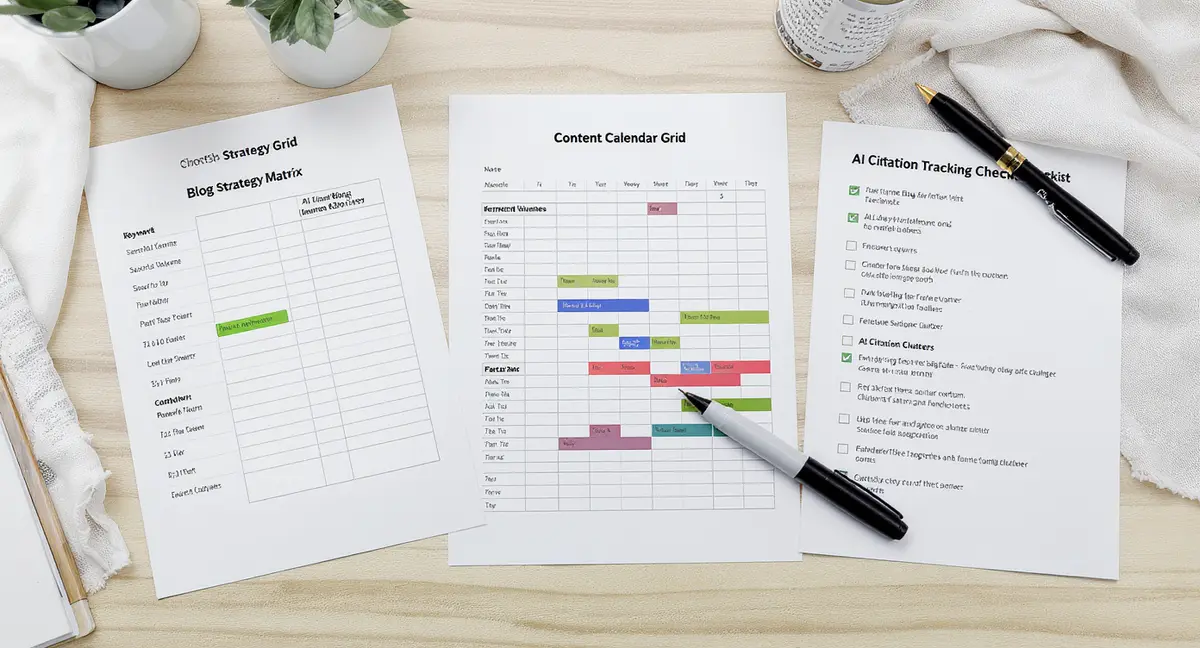
The short answer: A blog strategy for SEO builds topical authority through structured content that answers specific search queries, earns AI citations, and drives compounding traffic. The blog strategy for SEO combines keyword research, intent mapping, content architecture, and performance tracking to turn publishing into a revenue system. Success in blog strategy for SEO comes down to search intent alignment, content structure, and measurement discipline. According to Search Engine Journal, SEO leads close at 14.6% compared to 1.7% for outbound marketing. Before you publish another post, run through a current SEO checklist to ensure your technical foundation supports the content strategy.
Most businesses treat blogging like a checkbox. Publish something. Hit a word count. Hope Google notices. That approach stopped working around 2023. Google's algorithm updates now prioritize first-hand expertise and structured content. AI search platforms like ChatGPT and Perplexity cite only 3-5 sources per query. If your blog is not built for how search actually works today, you are invisible. A blog strategy for SEO is not about volume. It is about building a content system that generates traffic, citations, and conversions 12 months after you hit publish. The businesses winning organic search right now are not publishing more. They are publishing smarter. This article breaks down what works: how to map content to search intent, structure articles for AI citation, measure what matters, and build a blog that compounds instead of expires. No fluff. No outdated tactics from 2022. Just the framework that drives results when AI search accounts for half of all Google queries.Why Most Blog Strategies Fail Before They Start
The average business blog publishes inconsistently, targets vague topics, and measures nothing beyond traffic. That is not a strategy. That is hope disguised as marketing.The Intent Mismatch Problem
Search intent is the reason someone types a query. Google categorizes intent into four buckets: informational (learning), navigational (finding a specific site), commercial (researching options), and transactional (ready to buy). Most business blogs target informational queries exclusively, then wonder why traffic does not convert. A blog strategy for SEO maps content to the buyer journey. Top-of-funnel posts answer broad questions and build awareness. Middle-of-funnel content compares solutions and addresses objections. Bottom-of-funnel articles target high-intent keywords where prospects are evaluating specific providers. Data from Demand Gen Report shows B2B buyers consume 3-7 content pieces before engaging sales. If your blog only covers one stage, you are losing deals to competitors who own the full journey. The fix: audit your existing content by intent. If 80% of your posts are informational how-to guides, you have a gap. Add comparison posts, case study breakdowns, and decision-stage content that targets keywords like "best for " or "the service vs ."The Structure Gap
Google and AI search platforms prioritize content that is easy to parse. That means clear H2/H3 hierarchies, concise paragraphs, and direct answers near the top. Research from Princeton and Georgia Tech found that structured content with factual density and schema markup improves AI visibility by 30-40%. Most blog posts bury the answer. They open with three paragraphs of context, then meander through background before getting to the point. By the time the reader finds the answer, they have bounced. Google notices. AI models skip to the next source. A blog strategy for SEO front-loads value. The first 100 words should answer the core question. Use H2 headings that mirror search queries. Break dense sections into bullet lists. Add FAQ schema so Google can pull your content into featured snippets. Structure is not cosmetic. It is the difference between ranking and being ignored.Building a Keyword Foundation That Drives Revenue
Keyword research is where most blog strategies go wrong. Businesses pick topics based on gut feel, competitor mimicry, or whatever the CEO thinks is interesting. None of that predicts search demand.Start With Search Volume and Intent
A blog strategy for SEO begins with data. Use Google Keyword Planner or Search Console to identify queries your audience actually types. Filter by monthly search volume (target 100+ searches for niche topics, 500+ for broader terms) and intent category. Prioritize bottom-of-funnel keywords first. These are queries where the searcher is evaluating solutions: "best the service for ", "the product pricing", " vs ". According to Backlinko, organic CTR for position one is 27.6%. If you rank for a high-intent keyword, you own that traffic. Next, map middle-of-funnel content. These are comparison posts, objection-handling articles, and "how to choose" guides. They support the decision process and link internally to your bottom-of-funnel content. Finally, add top-of-funnel informational posts that build topical authority and attract backlinks. The ratio matters. A balanced blog strategy for SEO allocates roughly 30% of content to bottom-of-funnel keywords, 40% to middle-of-funnel, and 30% to top-of-funnel. This ensures you are not just driving traffic but converting it.Cluster Content Around Core Topics
Topical authority is Google's way of measuring expertise. Instead of publishing random one-off posts, build content clusters: a pillar page covering a broad topic, supported by 5-10 cluster posts that dive into subtopics. Example: A pillar page on "content marketing strategy" links to cluster posts on "how to measure content ROI", "content distribution channels", "repurposing content for social media", and "content calendar templates". Each cluster post links back to the pillar. This internal linking structure signals to Google that you own the topic. Marketing studies indicate that businesses using topic clusters see 3x more organic traffic growth than those publishing isolated posts. The reason: Google rewards depth over breadth. Ten well-linked posts on one topic outperform 50 scattered posts on unrelated subjects.Structuring Blog Posts for AI Search and Featured Snippets
AI search platforms like ChatGPT, Perplexity, and Google AI Overviews are reshaping how content gets discovered. These systems do not rank pages. They cite sources. If your content is not structured for citation, you are invisible.Write for Extraction, Not Just Ranking
AI models extract information from content that follows specific patterns: direct answers in the first 100 words, clear section headers that mirror questions, factual density with named sources, and FAQ sections with schema markup. A blog strategy for SEO optimizes for extraction. Start every post with a concise answer to the primary query. Use H2 headings formatted as questions ("How does X work?", "What is the best approach to Y?"). Include at least one statistic per major section, attributed to a named source. Add an FAQ section at the end with 3-5 common questions and 40-60 word answers. Industry research shows that content optimized for AI citation sees 30-40% higher visibility in AI-generated answers. The businesses that adapt early own the citations. The ones that wait lose traffic to competitors who show up in ChatGPT responses and Google AI Overviews.Use Schema Markup to Signal Content Type
Schema markup is code that tells search engines what your content is about. For blog posts, three schema types matter: Article schema (identifies the post as an article with author, publish date, and headline), FAQ schema (marks up question-and-answer sections so Google can pull them into featured snippets), and HowTo schema (structures step-by-step instructions). Adding schema takes 10 minutes per post. The payoff: featured snippets, AI citations, and higher CTR. Data from Search Engine Journal shows that pages with FAQ schema are 4x more likely to appear in featured snippets than pages without it. Most content management systems support schema plugins. Install one. Use it on every post. This is not optional anymore.Your competitors are optimizing for AI search right now. Book a 30-minute Content & Visibility Scan to see where you stand in Google, ChatGPT, and Perplexity before they own your category. Local businesses like real estate agencies face unique challenges in topical authority, which is why an SEO strategy for real estate must balance hyperlocal content with broader market insights.
See How Your Business Shows Up in AI Search
Get a free AI visibility scan. See exactly where you rank on ChatGPT, Perplexity, and Google AI, and what to do about it. Get Your Free Scan. The principles above apply across all content formats, not just blog posts, which is why a comprehensive content marketing strategy for SEO integrates video, social, and email alongside written content.
Measuring What Actually Matters in Blog Performance
Traffic is a vanity metric. A post that drives 10,000 visitors but zero conversions is not successful. It is noise.Track Conversions, Not Just Sessions
A blog strategy for SEO measures outcomes: leads generated, pipeline created, revenue influenced. Set up goal tracking in Google Analytics for every conversion action (form fills, demo requests, email signups, purchases). Tag blog traffic as a source. Track which posts drive conversions, not just which ones get clicks. According to industry data, organic search leads close at 14.6% compared to 1.7% for outbound leads. But that only matters if you know which content is generating those leads. Most businesses cannot answer "which blog post drove our best customer this quarter?" If you cannot answer that, you are flying blind. The fix: use UTM parameters on internal links from blog posts to conversion pages. Track assisted conversions (blog post viewed before conversion) in addition to last-click conversions. Attribute revenue to content. This is how you prove ROI.Monitor AI Search Visibility
Traditional rank tracking measures where you appear in Google's organic results. That is still important, but it is not the full picture. AI search visibility measures whether your content gets cited in ChatGPT responses, Perplexity answers, and Google AI Overviews. Test this manually: search for your target keywords in ChatGPT, Perplexity, and Google (with AI Overviews enabled). Does your brand appear in the answer? Are you cited as a source? If not, your competitors are.| Metric | What it measures | Target benchmark |
|---|---|---|
| Organic CTR | Percentage of searchers who click your result | 27.6% for position 1 (Backlinko) |
| Conversion rate | Percentage of blog visitors who complete goal action | 2-5% for B2B content |
| AI citation rate | Percentage of target queries where you are cited | 20%+ for owned topics |
| Time to first conversion | Days from publish to first lead generated | 30-90 days for new content |
| Content lifespan | Months a post continues driving traffic | 12+ months for evergreen topics |
Avoiding the Pitfalls That Kill Blog ROI
Most blog strategies fail because of execution gaps, not bad ideas. Here are the mistakes that kill ROI before it compounds.Publishing Inconsistently
A blog strategy for SEO requires consistency. Publishing 10 posts in January and then nothing until June does not build authority. It signals to Google that your site is inactive. The fix: publish on a schedule you can sustain. Two posts per month is better than 20 posts in one month followed by silence. Consistency beats volume. Marketing research shows that businesses publishing 2-4 posts per month see 3.5x more traffic growth than those publishing sporadically. Set a realistic cadence. Stick to it for 12 months. That is how topical authority compounds.Ignoring Internal Linking
Internal links are the connective tissue of a blog strategy for SEO. They distribute authority across your site, guide readers to related content, and signal topical relationships to Google. Most businesses publish posts and never link to them again. That is wasted effort. Every new post should link to 3-5 related articles. Every old post should be updated with links to new content. This creates a web of interconnected content that keeps readers on your site longer and helps Google understand your expertise. Use descriptive anchor text (the clickable words in a link). Instead of "click here", use "how to measure content ROI" or "AI search optimization guide". This tells Google what the linked page is about.The Bottom Line
A blog strategy for SEO is not a content calendar. It is a system that maps keywords to intent, structures content for AI citation, and measures conversions instead of vanity metrics. The businesses winning organic search right now are building content infrastructure they own. They are not renting visibility from ad platforms or agencies. They are installing publishing systems that compound over time. Start with bottom-of-funnel keywords. Build content clusters around core topics. Optimize for AI extraction. Track conversions, not just traffic. Publish consistently. That is the framework.Frequently Asked Questions
How long does it take to see results from a blog strategy for SEO?
Most businesses see measurable traffic increases within 3-6 months of consistent publishing. Bottom-of-funnel content often ranks faster (30-90 days) because it targets lower-competition keywords. Top-of-funnel posts take longer but generate compounding traffic over 12+ months. The key variable is consistency and content quality, not volume. If you need a structured starting point, a proven blog content strategy template eliminates guesswork and gives you a repeatable system from day one. Multi-location businesses face an additional layer of complexity, which is why local SEO for franchises requires balancing brand consistency with location-specific content at scale.
Can I build an effective blog strategy for SEO in-house?
Yes, if you have the resources. You need someone who understands keyword research, search intent mapping, content structure, and performance tracking. Most businesses underestimate the time required: 10-15 hours per post for research, writing, optimization, and promotion. The alternative is installing a system that handles the repeatable work while you control strategy and publishing.
What is the difference between a blog post and a service page for SEO?
Service pages target transactional keywords where the searcher is ready to buy (e.g., "hire SEO consultant in Chicago"). Blog posts target informational and commercial keywords where the searcher is learning or comparing options. Blog posts build topical authority and funnel traffic to service pages through internal links. Both are necessary for a complete blog strategy for SEO.
How do I measure ROI from organic content?
Track conversions, not just traffic. Set up goal tracking in Google Analytics for every conversion action (form fills, demo requests, purchases). Tag blog traffic as a source. Measure which posts drive leads and revenue. Use assisted conversion tracking to see which content influences deals even if it is not the last click. ROI = (revenue from organic leads - content production cost) / content production cost.
Should I update old blog posts or just publish new ones?
Both. Updating high-performing posts with fresh data, new sections, and improved structure often delivers faster ROI than publishing new content. Target posts ranking on page 2 (positions 11-20) for update priority. Add current statistics, expand thin sections, improve internal linking, and republish with a new date. This signals freshness to Google and can jump rankings considerably.