Blog Content Strategy Template: Build a System That Compounds Traffic for Years
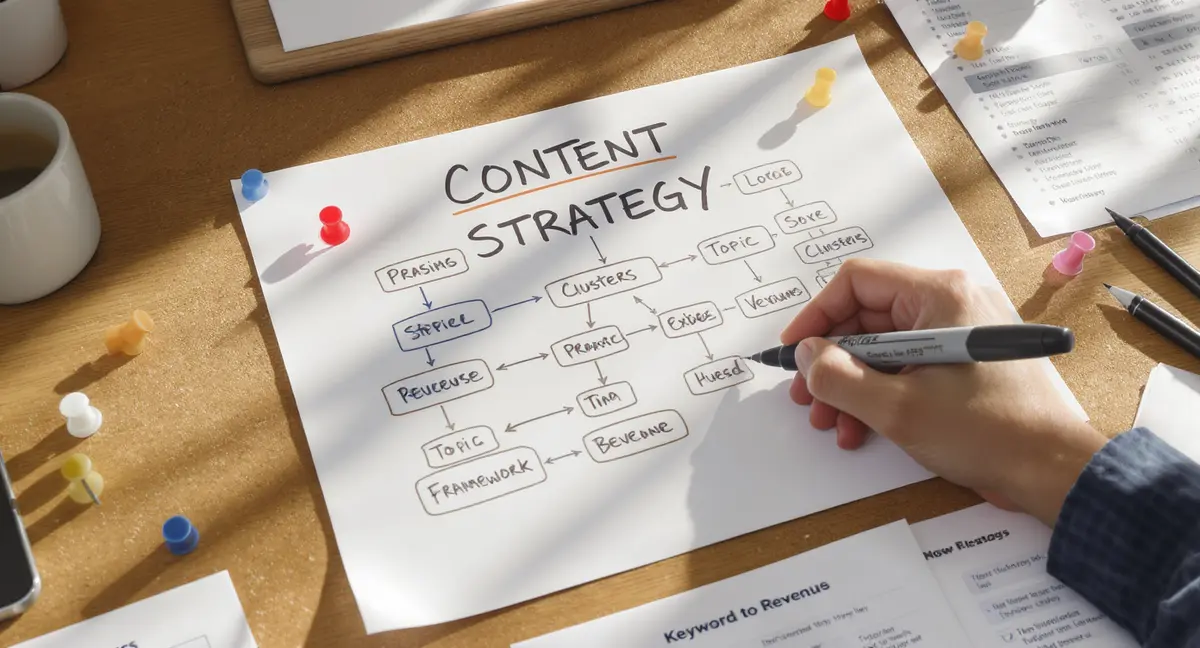
Most businesses treat blog content like a campaign. They publish a few posts, track a spike in traffic, then watch everything flatten when the publishing stops. That's not a content problem. That's a system problem. A blog content strategy template fixes this by turning random publishing into a repeatable process that generates compounding results. Instead of guessing what to write next, you're working from a documented system that connects every article to business goals, search demand, and long-term visibility. If your content isn't structured for AI citation, you're not in the running, and most businesses need external help to get this right through AI search optimization expertise that understands how models select sources.
The difference between businesses that see sustained organic growth and those that don't comes down to structure. Companies that blog consistently get 55% more website visitors than those that don't, according to HubSpot's State of Marketing 2024. But consistency without strategy is just noise. You need a framework that maps content to outcomes, tracks performance, and evolves as your business and search field change. That's what a blog content strategy template delivers: a blueprint for building content infrastructure that keeps working long after you hit publish.
What a Blog Content Strategy Template Actually Is (And Why Generic Content Calendars Fail)
A blog content strategy template is a structured framework that documents how your blog supports business goals, who you're writing for, what topics drive results, and how you measure success. It's not a content calendar. A calendar tells you when to publish. A strategy template tells you why you're publishing, what success looks like, and how each piece fits into a larger system. The template includes goal mapping, audience definitions, keyword clusters, competitive gaps, editorial workflows, and performance tracking, all in one place.
Why Most Businesses Skip Strategy and Pay for It Later
Most businesses start blogging without a template because it feels faster. Write something, publish it, move on. But three months in, they're facing the same problems: no clear topic pipeline, duplicate content targeting the same keywords, posts that get traffic but no conversions, and no way to know what's working. Only 8% of marketers feel confident they can measure content ROI, according to Firework 2025. That's not a measurement problem. It's a planning problem. Without a blog content strategy template, you're optimizing in the dark.
The Core Components Every Template Needs
A functional blog content strategy template includes these sections: business goals tied to specific content KPIs, audience personas mapped to search intent, keyword clusters organized by topic pillar, a competitive content gap analysis, an editorial workflow with roles and deadlines, a distribution and promotion plan, and a performance dashboard that tracks what's working. Each section answers a specific question: Why are we publishing? Who are we writing for? What are they searching for? What are competitors doing that we're not? Who's responsible for what? How do we amplify reach? What's the return? If your template doesn't answer all seven, you're missing infrastructure.
Goal Setting and KPI Mapping: Connecting Blog Content to Revenue
A blog content strategy template starts with goals, not topics. If you can't connect a piece of content to a business outcome, you're publishing for the sake of publishing. The template forces you to define what success looks like before you write a word. Common blog goals include increasing organic traffic, generating qualified leads, supporting sales conversations, building brand authority, and reducing customer acquisition cost. Each goal requires different content types, distribution tactics, and KPIs. A traffic goal measures sessions and rankings. A lead gen goal measures form fills and demo requests. A sales enablement goal tracks content shares by the sales team and deal velocity.
How to Tie Blog Metrics to Business Outcomes
Start by identifying which stage of the funnel each blog post targets. Top-of-funnel posts answer broad questions and drive awareness, measure them by impressions, traffic, and time on page. Middle-of-funnel posts compare solutions and build consideration, measure them by email signups, resource downloads, and return visitor rate. Bottom-of-funnel posts address objections and drive conversions, measure them by demo requests, sales conversations, and influenced revenue. SEO leads have a 14.6% close rate compared to 1.7% for outbound leads, according to Search Engine Journal. That gap exists because organic content pre-qualifies buyers. Your blog content strategy template should map each article to a funnel stage and assign the right KPIs. The same principles that make blog strategy templates work apply across all content types, which is why broader content strategy templates follow this same structure of goals, audience mapping, and performance tracking.
Setting Realistic Traffic and Conversion Benchmarks
New blogs don't rank overnight. Expect 6-12 months before you see meaningful organic traction, and 18-24 months before content starts compounding at scale. A realistic first-year target for a B2B blog publishing twice a week: 5,000-10,000 monthly organic sessions by month twelve, 2-3% conversion rate on gated content, and 15-20 qualified leads per month. These numbers scale as your content library grows. A business with 100+ indexed blog posts can generate 50,000+ monthly sessions and 100+ leads if the content is well-structured and targets the right keywords. The blog content strategy template tracks these benchmarks over time so you know when you're on track and when to adjust.
Audience Research and Search Intent: Turning Personas into Keywords
A blog content strategy template translates audience pain points into search queries. Most businesses stop at personas, job titles, demographics, challenges. That's useful for positioning, but it doesn't tell you what to write. The template forces you to go one step further: what does this persona search for when they have this problem? A CFO worried about cash flow might search "how to improve cash flow in a small business" or "cash flow forecasting tools." A marketing director trying to prove ROI might search "how to measure content marketing ROI" or "content attribution models." The template maps persona pain points to keyword clusters.
How to Build Persona-Driven Keyword Clusters
Start with your core personas and list their top three problems. For each problem, brainstorm the questions they'd ask at different stages of awareness. Someone just realizing they have a problem searches differently than someone comparing solutions. Use a keyword research tool like Google Keyword Planner to validate search volume and competition. Group related keywords into clusters, each cluster becomes a topic pillar. For example, a "content marketing ROI" cluster might include keywords like "how to measure content ROI," "content marketing KPIs," "content attribution," and "proving content value to executives." Your blog content strategy template organizes these clusters and assigns priority based on search volume, competition, and business relevance.
Mapping Search Intent to Content Format
Search intent determines content format. Informational queries ("what is X") need educational explainers. Navigational queries ("X tool review") need product comparisons. Transactional queries ("best X for Y") need solution-focused content with clear CTAs. Your blog content strategy template should tag each keyword with intent type and recommended format. A study by Ahrefs found that 96.55% of pages get zero search traffic from Google. Most fail because they mismatch intent, they write an explainer when searchers want a comparison, or a product pitch when searchers want education. The template prevents this by documenting intent before you write.
Topic Clustering and Content Architecture: Building Authority That AI Models Cite
A blog content strategy template organizes content into topic clusters, not random posts. A topic cluster is a group of related articles that all link back to a central pillar page. The pillar covers the broad topic. Supporting posts dive deep into subtopics. This structure signals topical authority to Google and AI search engines. When ChatGPT or Perplexity looks for a source to cite, it prioritizes sites with deep, interconnected content on a subject. 50% of Google queries now trigger AI Overviews, causing a 61% drop in organic CTR for traditional results, according to DemandSage 2025. If your content isn't structured for AI citation, you're invisible in the fastest-growing search channel.
How to Structure Pillar and Supporting Content
Choose 3-5 core topics that align with your business and have strong search demand. Each becomes a pillar. Write a full pillar page that covers the topic at a high level, aim for 3,000-5,000 words. Then create 8-12 supporting posts that go deep on specific subtopics. Each supporting post links back to the pillar, and the pillar links out to all supporting posts. For example, a pillar on "content marketing strategy" might have supporting posts on "content marketing KPIs," "content calendar templates," "content distribution tactics," and "content ROI measurement." Your blog content strategy template tracks which pillar each post supports and ensures internal linking is consistent. This template approach extends beyond blogging into every channel where content drives results, forming the foundation of content strategy digital marketing that builds systems instead of running isolated campaigns.
Optimizing Content Structure for AI Search Citation
AI models cite content that's factually dense, clearly structured, and easy to extract. Research from Princeton and Georgia Tech published at KDD 2024 found that content optimized for Generative Engine Optimization improves AI visibility by 30-40%. The tactics: use clear H2 and H3 headers that mirror search queries, include statistics with named sources, write concise direct answers followed by supporting evidence, add FAQ sections with schema markup, and attribute takeaways to named experts. Your blog content strategy template should include a checklist for AI-optimized structure. Every post should pass this filter before publishing. AI search is forming its knowledge base right now. If your content isn't citation-ready, you're not in the running.
Ready to take the next step with Strategyc?
Our team is ready to help you achieve your goals. Get Your Free Scan.
Competitive Content Gap Analysis: Finding What Your Competitors Miss
A blog content strategy template includes a competitive gap analysis, a documented review of what your competitors rank for that you don't. This isn't about copying their content. It's about identifying opportunities they've validated. If three competitors rank for "how to calculate customer lifetime value" and you don't have a post on that topic, you've found a gap. If they all publish shallow 800-word posts and you write a 2,500-word guide with examples and a calculator, you've found an angle. The template tracks competitor URLs, ranking keywords, content formats, and gaps you can exploit.
How to Conduct a Blog-Specific Competitor Audit
Identify 3-5 direct competitors who rank for keywords you care about. Use a rank tracking tool to pull their top-performing blog posts. Look for patterns: what topics do they cover repeatedly, what formats get the most engagement, what questions do they answer that you don't, and where is their content thin or outdated. Document this in your blog content strategy template. For each competitor post, note the target keyword, word count, structure, and what they do well or poorly. Then prioritize gaps based on search volume and relevance to your business. A competitive audit done once a quarter keeps your content strategy ahead of the market.
Turning Competitor Insights into Differentiated Content
Competitive analysis isn't about replication. It's about differentiation. If every competitor writes a 1,000-word post on a topic, write 2,500 words with data, examples, and a downloadable template. If they write generic how-tos, write case-study-driven walkthroughs. If they ignore AI search optimization, structure your content for AI citation. The blog content strategy template documents your differentiation angle for each piece. This keeps your content from blending into the noise. Organic search drives 53% of all trackable website traffic, according to BrightEdge. But only the top 3-5 results get meaningful clicks. Differentiation is what moves you from page two to position one.
Editorial Workflow and Content Governance: Turning Strategy into Execution
A blog content strategy template isn't just a planning document. It's an execution system. The editorial workflow section defines who does what, when, and how. Without this, content gets stuck in draft limbo, quality varies wildly, and deadlines slip. The template includes role assignments (who writes, who edits, who approves, who publishes), deadlines for each stage, quality checklists (fact-checking, EEAT, AI optimization), and a status tracker (ideation, draft, review, approved, published, promoted). This turns content production from a chaotic scramble into a repeatable process. The relationship between strategic planning and search visibility becomes clearer when you understand how content strategy and SEO work together to build authority that compounds over time.
Building a Quality Checklist for Every Post
Every post that goes live should pass a quality gate. Your blog content strategy template should include a checklist: Does the post target a specific keyword with documented search volume? Does it match search intent? Does it include at least two cited sources? Is it structured for AI citation (clear headers, FAQ section, factual density)? Does it link to at least two related internal posts? Does it include a clear CTA? Is it free of AI clichés and generic phrasing? Has it been fact-checked for accuracy? Platforms like Strategyc's Content & Visibility Engine build these quality gates directly into the production workflow. The system won't let a post move to "ready to publish" until it passes every check. That's the difference between content that compounds and content that disappears.
Setting Realistic Publishing Cadence and Scaling Over Time
Most businesses start too aggressive and burn out. A blog content strategy template sets a sustainable cadence. If you're starting from zero, aim for one high-quality post per week. That's 52 posts in year one, enough to build topical authority without sacrificing quality. As your team and process mature, scale to two posts per week, then three. Companies that blog consistently see 55% more traffic, but consistency means sustainable, not frantic. The template tracks your publishing rhythm and flags when you're falling behind or overcommitting. It also documents how long each stage takes (research: 2 hours, writing: 4 hours, editing: 1 hour, publishing: 30 minutes) so you can plan capacity realistically.
Measurement, Optimization, and the Content Audit Cycle
A blog content strategy template includes a performance dashboard that tracks what's working and what's not. This isn't a vanity metrics dump. It's a decision-making tool. For each post, track target keyword, current ranking, monthly organic sessions, conversion rate, and last updated date. Review this data quarterly. Posts that rank on page two can often jump to page one with a refresh, updated stats, new examples, better structure. Posts that get traffic but no conversions need a CTA or internal linking fix. Posts that get neither need to be consolidated, redirected, or deleted. This audit cycle is what separates content that compounds from content that decays.
How to Run a Blog Content Audit Using Your Template
Pull performance data for every published post. Sort by organic sessions descending. The top 20% of posts likely drive 80% of your traffic, these are your winners. Refresh them every 6-12 months to maintain rankings. The middle 60% are performing but underoptimized, these need better internal linking, updated CTAs, or improved structure. The bottom 20% are dead weight, thin content, outdated information, or topics with no search demand. Decide whether to improve, consolidate, or delete. Your blog content strategy template tracks this audit cycle and sets next review dates for every post. Content audits done consistently keep your blog lean and high-performing. Bloated blogs with 500 thin posts rank worse than focused blogs with 100 strong posts.
Tracking Content ROI and Proving Value to Stakeholders
The blog content strategy template connects content metrics to business outcomes. Don't just report traffic. Report leads, pipeline, and revenue influenced by content. Use UTM parameters and CRM attribution to track which posts drive conversions. If a post on "how to choose an X" generates 50 demo requests in six months, that's measurable ROI. If a post ranks #1 for a high-intent keyword and drives 20% of your organic leads, that's proof of value. Only 8% of marketers feel confident measuring content ROI (Firework 2025). The other 92% are guessing. The template eliminates guessing by documenting what you're tracking, how you're tracking it, and what success looks like. When budget conversations happen, you show up with data, not anecdotes. This template approach extends beyond blogging into every channel where content drives results, forming the foundation of content strategy digital marketing that builds systems instead of running isolated campaigns.
The Bottom Line: Strategy First, Content Second
Most businesses publish content without a system and wonder why it doesn't compound. A blog content strategy template fixes this by turning random publishing into a repeatable process. It connects every post to a business goal, maps topics to search demand, structures content for AI citation, tracks performance, and documents what works. The difference between businesses that see sustained organic growth and those that plateau comes down to infrastructure. Content without strategy is noise. Strategy without documentation is chaos. The template is the infrastructure that turns publishing into compounding results. If you're serious about organic visibility, start with the system, not the next blog post.
Frequently Asked Questions
What should a blog content strategy template include?
A blog content strategy template should include business goals tied to KPIs, audience personas mapped to search intent, keyword clusters organized by topic pillar, competitive gap analysis, editorial workflow with roles and deadlines, distribution plan, and performance tracking dashboard. Each section connects content to outcomes.
How often should I update my blog content strategy template?
Review and update your blog content strategy template quarterly. Refresh keyword priorities, audit content performance, update competitive gaps, and adjust KPIs based on what's working. The template is a living document, not a one-time exercise. Markets and search behavior change, your strategy should too.
Can I build a blog content strategy in-house without hiring an agency?
Yes, if you have the time and expertise. You need someone who understands SEO, search intent, content structure, and performance tracking. The template provides the framework, but execution requires skill and consistency. Many businesses start in-house and later install a system like Strategyc's Content & Visibility Engine to scale without adding headcount.
How do I measure ROI from blog content using a strategy template?
Track content-influenced conversions, not just traffic. Use UTM parameters and CRM attribution to connect blog posts to leads, demos, and revenue. Your blog content strategy template should document which posts drive conversions, what the average lead value is, and how content contributes to pipeline. SEO leads close at 14.6% compared to 1.7% for outbound (Search Engine Journal).
What's the difference between a blog content strategy template and a content calendar?
A content calendar tells you when to publish. A blog content strategy template tells you why you're publishing, who you're writing for, what topics drive results, how to structure content for AI search, and how to measure success. The calendar is a tactical tool. The template is the strategic infrastructure that makes the calendar effective.