AI Marketing for Storm Restoration Roofers: How to Capture High-value Claims Before Your Competitors Do
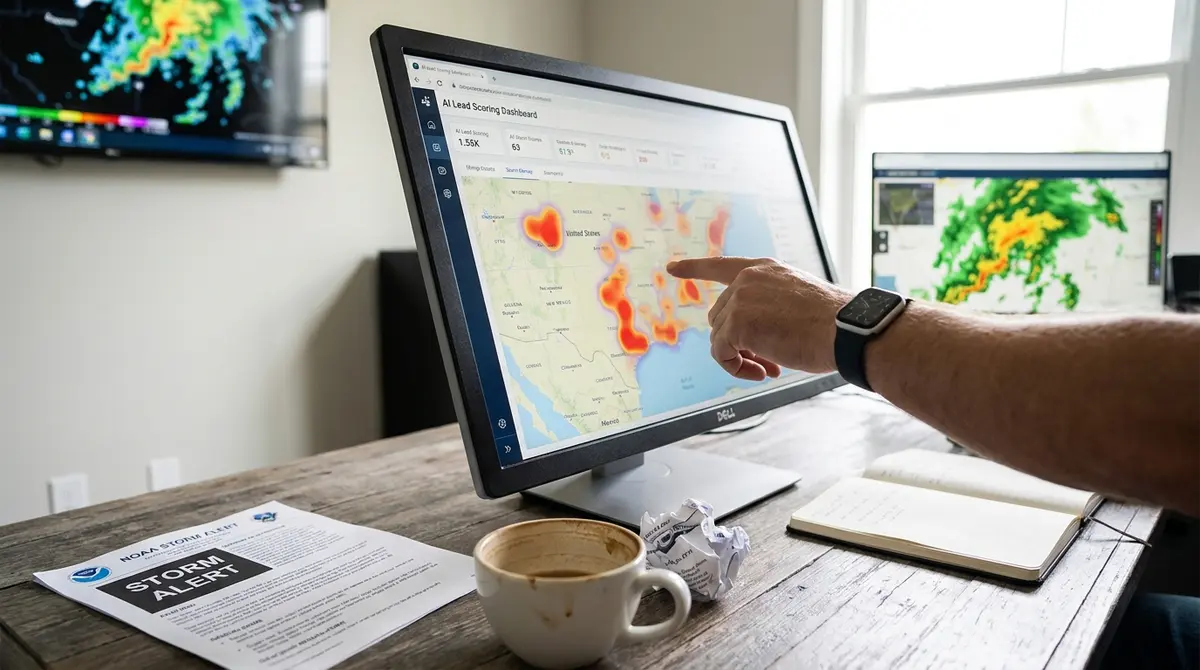
When a hailstorm hits, you have a few days to own the neighborhood. After that, your competitors have already knocked every door, run every ad, and claimed every insurance job worth taking. AI marketing for storm restoration roofers changes that timeline. Instead of scrambling after the storm, AI systems identify damage zones in real time, launch geo-targeted campaigns while homeowners are still assessing damage, and automate follow-up so you close jobs while others are still printing door hangers. These AI-driven storm response tactics sit within a broader shift in roofing marketing that prioritizes speed and automation over manual outreach.
The roofing industry runs on speed. Storm restoration work compounds that pressure. If you're not the first roofer homeowners talk to, you're fighting for scraps. Traditional marketing can't move fast enough. AI marketing for storm restoration roofers solves the timing problem by automating storm detection, lead qualification, and multi-channel outreach at machine speed.
This article breaks down how storm restoration contractors use AI to trigger campaigns the moment NOAA reports hail, score leads based on roof age and claim likelihood, automate insurance-claim education content, and convert more estimates into signed contracts. You'll see what works, what doesn't, and how to build a system that runs whether you're on a roof or in a truck.
Why Storm Restoration Roofers Need AI Marketing Systems That React in Hours, Not Days
Storm restoration is a different business than maintenance roofing. You're not waiting for homeowners to notice a leak. You're racing other contractors to be the first conversation after a weather event. The contractor who shows up first, explains the claim process clearly and follows up consistently has the best shot at the job. AI marketing for storm restoration roofers automates that first-mover advantage.
The First Few Days After a Storm Matter Most
Homeowners start looking for a roofer in the days right after a storm. That window closes fast. Wait too long and your target neighborhood has already heard from other roofers.
Manual storm response can't scale. You need someone monitoring weather reports, pulling property data, building audience lists, writing ad copy, launching campaigns, and managing inbound calls. That's a full-time job before you've even scheduled the first inspection. AI marketing for storm restoration roofers handles storm detection, audience building, and campaign activation automatically. When NOAA reports a hail swath over your service area, your system launches targeted ads and sends educational emails to affected zip codes before you finish your morning coffee.
AI Eliminates the Bottleneck Between Storm Detection and First Contact
Traditional storm marketing relies on someone checking weather apps, manually pulling address lists, and setting up campaigns in Google Ads or Facebook. That's hours of work even if you're fast. AI systems monitor weather APIs continuously and trigger pre-built campaigns the moment a storm meets your criteria (hail size, wind speed, affected area).
Speed matters because homeowners don't know what to do after a storm. They're Googling "does insurance cover hail damage" and "how to file a roof claim." If your content, ads, and follow-up system answer those questions first, you become the trusted advisor. AI marketing for storm restoration roofers positions you as the expert before competitors even know the storm happened.
How AI Identifies High-Probability Storm Damage Leads Before You Knock a Single Door
Not every house in a storm zone needs a roof. Canvassing an entire neighborhood wastes time and money. AI lead scoring uses property data, storm intensity, and roof age to predict which homes are most likely to have damage and file a claim. You focus your team on the addresses most likely to turn into jobs. The ability to publish storm-specific pages in minutes rather than days reflects a larger transformation in content creation for marketing that treats publishing as infrastructure, not a one-off project.
Predictive Lead Scoring Combines Weather Data, Property Records, and Roof Lifespan
AI marketing for storm restoration roofers starts with data layering. Weather APIs provide hail size, wind speed, and storm path. County assessor records show year built and property value. Building department records add permit history where it's available. AI models score each address based on damage probability. A 15-year-old asphalt shingle roof in a 2-inch hail zone scores higher than a 3-year-old metal roof in the same area.
You're not guessing which streets to work. You're targeting homes where the math says damage is likely and the homeowner has equity or insurance to pay for replacement.
AI Automates the Qualification Process So Your Sales Team Only Talks to Ready Buyers
Lead scoring doesn't stop at property data. AI chatbots and SMS sequences qualify inbound leads before they reach your phone. When a homeowner clicks your ad or fills out a form, the AI asks: Have you noticed damage? Have you filed a claim? Do you know your deductible? Answers feed into a qualification score. High-score leads get routed to sales immediately. Low-score leads enter a nurture sequence with educational content about the claims process.
AI-assisted qualification means your sales reps spend time with homeowners who are ready to move forward, not tire-kickers who haven't even called their insurance company yet. AI marketing for storm restoration roofers turns your website and ad campaigns into a qualification engine that runs 24/7.
AI-Powered Content Marketing That Educates Homeowners About Insurance Claims and Positions You as the Expert
Homeowners don't understand the insurance claim process. They don't know if wind damage is covered, how deductibles work, or what "recoverable depreciation" means. The roofer who explains it clearly wins the job. AI content systems generate educational articles, FAQs, and landing pages that answer every question a homeowner has after a storm.
AI Writes Storm-Specific Landing Pages and Blog Content Faster Than Any Human Copywriter
After a hailstorm, you need landing pages for "hail damage roof repair your area," "does insurance cover wind damage," and "how to file a roof claim in your state." Writing those pages manually takes days. AI content tools generate optimized drafts in minutes. You review, edit for local accuracy, and publish.
AI marketing for storm restoration roofers means you can flood search results with helpful content while competitors are still figuring out their blog strategy. When homeowners search "what does a roof inspection cost after hail," your article appears. When they ask "how long do I have to file a claim," your FAQ ranks. You own the educational search queries that precede every buying decision. Behavior-triggered sequences that adjust based on engagement mirror the same principles behind effective email marketing in other industries where timing and relevance determine conversion.
Structured Content Feeds AI Search Engines and Voice Assistants
Google isn't the only search engine anymore. ChatGPT, Perplexity, and voice assistants like Siri answer questions by pulling from structured content. If your website has clear FAQ sections, schema markup, and well-organized service pages, AI tools cite you. Researchers from Princeton and IIT Delhi presented a 2024 study at the KDD conference that found adding citations, quotations and statistics to content raised its visibility in AI-generated answers by up to 40% on their own benchmark.
When a homeowner asks Siri "who do I call for hail damage roof repair near me," you want your business in that answer. AI marketing for storm restoration roofers includes formatting content so machines can extract and cite it. That means FAQ schema, location pages with consistent NAP data, and service descriptions written in clear, declarative sentences.
Automated Multi-Channel Campaigns That Keep Your Brand in Front of Storm-Affected Homeowners Until They're Ready to Buy
One ad impression doesn't close a roofing job. Homeowners tend to need several touchpoints before they schedule an estimate. AI marketing for storm restoration roofers automates email sequences, retargeting ads, SMS follow-ups, and social media outreach so you stay top-of-mind without manual effort.
AI Builds and Manages Nurture Sequences Based on Homeowner Behavior
When a homeowner downloads your "Storm Damage Checklist" PDF, AI adds them to an email sequence. Day 1: "What to look for after a hailstorm." Day 3: "How to document damage for your insurance claim." Day 7: "Why you should get three estimates." If they click a link, the AI adjusts the sequence. If they visit your pricing page, they get a calendar link to book an inspection. If they go silent, they enter a long-term nurture track.
A 2015 report from the UK's Data & Marketing Association found that segmented and targeted emails produced 58% of email revenue. AI takes segmentation further by analyzing engagement patterns and predicting when a lead is ready to convert. Your CRM becomes a machine that moves prospects from awareness to signed contract without you touching a keyboard.
Retargeting Ads Follow Storm Leads Across Every Platform They Use
A homeowner visits your site, reads an article about insurance claims, and leaves. Without retargeting, they forget you exist. AI ad platforms track that visitor and show your ads on Facebook, Instagram, YouTube, and Google Display Network for the next 30 days. The ads change based on what they viewed. If they read about hail damage, they see ads about hail repair. If they visited your service area page, they see testimonials from neighbors.
AI marketing for storm restoration roofers ensures that every website visitor sees your brand repeatedly until they're ready to schedule an estimate. You're not hoping they remember your truck. You're algorithmically reminding them you exist.
Some roofing companies build these systems in-house. Others work with platforms that install the infrastructure and hand over the keys. For example, Strategyc's Content & Visibility Engine is an installed system that produces structured, AI-optimized content for Google, AI search tools, and voice assistants. The business owns the workflows, the content, and the data. It's not a retainer. It's infrastructure you control.
Storm Leads Coming In Faster Than You Can Answer?
A system you own can reply to each new inquiry, ask your qualifying questions and send the good ones to the right person. See How Lead Routing Works. Storm restoration contractors who educate homeowners about claims are applying the same trust-building approach that defines successful insurance marketing across the industry.
AI Call Tracking and Conversation Analysis That Turns Every Phone Call Into Sales Training Data
Storm restoration roofers live on the phone. Inbound calls spike after weather events. AI call tracking records every conversation, transcribes it, and analyzes what works. You see which sales reps close the most estimates, which objections kill deals, and which scripts convert best. That data feeds back into training and campaign optimization.
AI Transcription and Sentiment Analysis Reveal What Homeowners Actually Care About
AI call tracking tools transcribe every inbound call and tag it by topic: insurance questions, pricing objections, urgency level, competitor mentions. Sentiment analysis scores the homeowner's tone. Are they frustrated? Confused? Ready to buy? You get a dashboard showing which questions come up most often and which answers lead to booked inspections.
Sales teams use conversation intelligence tools to identify winning talk tracks and eliminate losing ones. AI marketing for storm restoration roofers extends that intelligence to marketing. If call transcripts show that homeowners ask "do you work with my insurance company" in 60% of calls, you add that answer to your landing pages and ad copy.
Automated Call Routing Ensures High-Value Leads Reach Your Best Closers
Not every inbound call is equal. A homeowner who says "I just got off the phone with my adjuster and need a quote by Friday" is worth more than someone asking "do you do free estimates." AI call routing uses lead score, caller intent, and rep performance data to route high-priority calls to your top closers. Lower-priority calls go to junior reps or automated scheduling systems.
Intelligent call routing gets the right leads to the right people. AI marketing for storm restoration roofers treats your phone system as a revenue optimization tool, not just a way to answer calls.
Measuring ROI: How to Track Which AI Marketing Tactics Actually Generate Signed Contracts
AI marketing for storm restoration roofers only matters if it produces measurable revenue. You need attribution systems that connect ad clicks, website visits, and phone calls to signed contracts and collected payments. AI analytics platforms unify data from Google Ads, your CRM, call tracking, and accounting software so you see exactly which campaigns pay for themselves.
Multi-Touch Attribution Shows the Full Path from Storm Alert to Signed Contract
A homeowner sees your Facebook ad after a storm, clicks through, reads a blog post, leaves, sees a retargeting ad three days later, calls your number, schedules an estimate, and signs a contract two weeks later. Which marketing touchpoint gets credit? Multi-touch attribution models assign value to every interaction. AI platforms automate this tracking and show you which channels drive the most revenue per dollar spent.
Multi-touch attribution helps you stop wasting budget on channels that don't convert. For storm restoration roofers, that means knowing whether Google Ads, door hangers, or email nurture sequences actually close jobs. You double down on what works and cut what doesn't. The same weather-triggered campaign logic that works for storm roofers powers AI marketing for HVAC contractors responding to heat waves and cold snaps.
AI Dashboards Predict Future Revenue Based on Current Pipeline Activity
AI analytics don't just report what happened last month. They predict what will happen next quarter. By analyzing lead volume, conversion rates, and seasonal patterns, AI forecasting models estimate how many signed contracts you'll close in the next 30, 60, or 90 days. If the forecast shows a revenue gap, you adjust marketing spend or sales activity before it's too late.
AI marketing for storm restoration roofers turns your CRM into a forward-looking revenue engine, not just a contact database.
The Bottom Line: AI Marketing Gives Storm Restoration Roofers the Speed and Scale to Dominate Every Weather Event
Storm restoration is a speed game. The contractor who reaches homeowners first, explains the claim process clearly and follows up consistently gives themselves the best chance at the work. AI marketing for storm restoration roofers automates storm detection, lead scoring, content creation, multi-channel outreach, and call analysis so you operate faster than competitors who still rely on manual processes. You're not working harder. You're using systems that scale.
Every storm is an opportunity. Reaching homeowners quickly gives you a better chance of being one of the first roofers they talk to.
Frequently Asked Questions About AI Marketing for Storm Restoration Roofers
How quickly can AI marketing systems activate after a storm hits my service area?
AI systems monitoring weather APIs can detect qualifying storm events and launch pre-built geo-targeted campaigns without waiting for someone to set them up by hand. Manual storm response is slower because someone has to check weather reports, pull addresses and build each campaign. The speed advantage means you reach homeowners before competitors even know the storm happened.
What does it cost to build an AI marketing system for storm restoration work?
Costs vary widely. DIY setups using off-the-shelf tools run on monthly software subscriptions. Installed systems with custom workflows and integrations cost more upfront, with lower ongoing costs. Calculate ROI based on one additional signed contract per storm.
Can I measure which AI marketing tactics actually close roofing jobs?
Yes. Multi-touch attribution platforms connect ad clicks, website visits, phone calls, and CRM data to show which marketing channels generate signed contracts. You see cost-per-acquisition by campaign and adjust spending based on actual revenue, not vanity metrics like impressions.
Do I need a full-time marketing person to run AI systems, or can my sales team handle it?
Depends on the system. Installed platforms with pre-built workflows require minimal daily management, mostly reviewing leads and approving content. DIY setups using multiple disconnected tools need someone who understands marketing automation, CRM integration, and campaign optimization. The usual options are a part-time marketer or a system that handles execution.
How does AI content help with insurance claim education and homeowner trust?
AI generates educational articles, FAQs, and landing pages that answer common homeowner questions about the claim process, coverage, and timelines. When your content ranks for searches like "how to file a hail damage claim," you become the trusted advisor before competitors even get a phone call. Structured content also feeds AI search tools and voice assistants.